

A Plausible Mechanism for Drosophila Larva Intermittent Behavior
293
this case the duration of quiescence bouts (the interval between two consecutive
avalanches) follows an exponential distribution (Fig. 1B, right).
This simple conceptual model alternates autonomously between avalanches
of power-law distributed durations and quiescence intervals of exponentially
distributed durations. This alternation between power-law and non-power-law
regimes can serve as a basic qualitative model of the transition between rest and
activity bouts in the larva (cf. Discussion).
3.2 Parameterization of Larval Intermittent Behavior
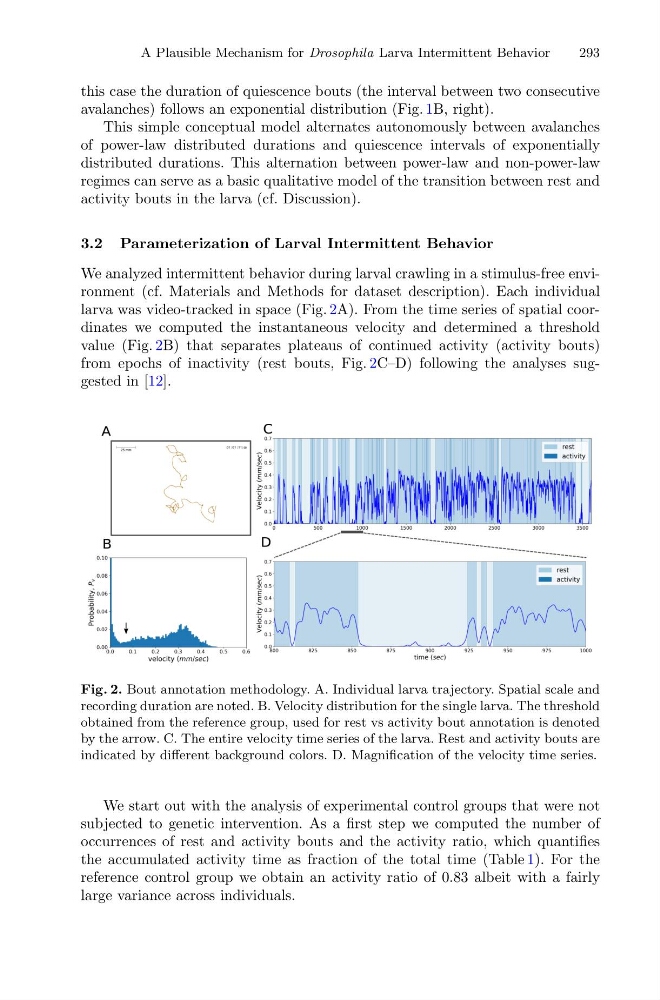
We analyzed intermittent behavior during larval crawling in a stimulus-free environment (cf. Materials and Methods for dataset description). Each individual
larva was video-tracked in space (Fig. 2A). From the time series of spatial coordinates we computed the instantaneous velocity and determined a threshold
value (Fig. 2B) that separates plateaus of continued activity (activity bouts)
from epochs of inactivity (rest bouts, Fig. 2C–D) following the analyses suggested in [12].
Fig. 2. Bout annotation methodology. A. Individual larva trajectory. Spatial scale and
recording duration are noted. B. Velocity distribution for the single larva. The threshold
obtained from the reference group, used for rest vs activity bout annotation is denoted
by the arrow. C. The entire velocity time series of the larva. Rest and activity bouts are
indicated by different background colors. D. Magnification of the velocity time series.
We start out with the analysis of experimental control groups that were not
subjected to genetic intervention. As a first step we computed the number of
occurrences of rest and activity bouts and the activity ratio, which quantifies
the accumulated activity time as fraction of the total time (Table 1). For the
reference control group we obtain an activity ratio of 0.83 albeit with a fairly
large variance across individuals.
293
this case the duration of quiescence bouts (the interval between two consecutive
avalanches) follows an exponential distribution (Fig. 1B, right).
This simple conceptual model alternates autonomously between avalanches
of power-law distributed durations and quiescence intervals of exponentially
distributed durations. This alternation between power-law and non-power-law
regimes can serve as a basic qualitative model of the transition between rest and
activity bouts in the larva (cf. Discussion).
3.2 Parameterization of Larval Intermittent Behavior
We analyzed intermittent behavior during larval crawling in a stimulus-free environment (cf. Materials and Methods for dataset description). Each individual
larva was video-tracked in space (Fig. 2A). From the time series of spatial coordinates we computed the instantaneous velocity and determined a threshold
value (Fig. 2B) that separates plateaus of continued activity (activity bouts)
from epochs of inactivity (rest bouts, Fig. 2C–D) following the analyses suggested in [12].
Fig. 2. Bout annotation methodology. A. Individual larva trajectory. Spatial scale and
recording duration are noted. B. Velocity distribution for the single larva. The threshold
obtained from the reference group, used for rest vs activity bout annotation is denoted
by the arrow. C. The entire velocity time series of the larva. Rest and activity bouts are
indicated by different background colors. D. Magnification of the velocity time series.
We start out with the analysis of experimental control groups that were not
subjected to genetic intervention. As a first step we computed the number of
occurrences of rest and activity bouts and the activity ratio, which quantifies
the accumulated activity time as fraction of the total time (Table 1). For the
reference control group we obtain an activity ratio of 0.83 albeit with a fairly
large variance across individuals.