

292
P. Sakagiannis et al.
A
s i
Rest, if Σs i
Active, otherwise
B
10 0
10 1
10 2
10
−5
10
−4
10
−3
10
−2
10
−1
10 0
rest
rest bouts
powerlaw MLE
10 0
10 1
10 2
activity
non-rest bouts
exponential MLE
10 10
10
10 1 1
duration, d(sec)
10 10
10 10 2 2
10 10
− − − −1 1
0 0
probability, P
d
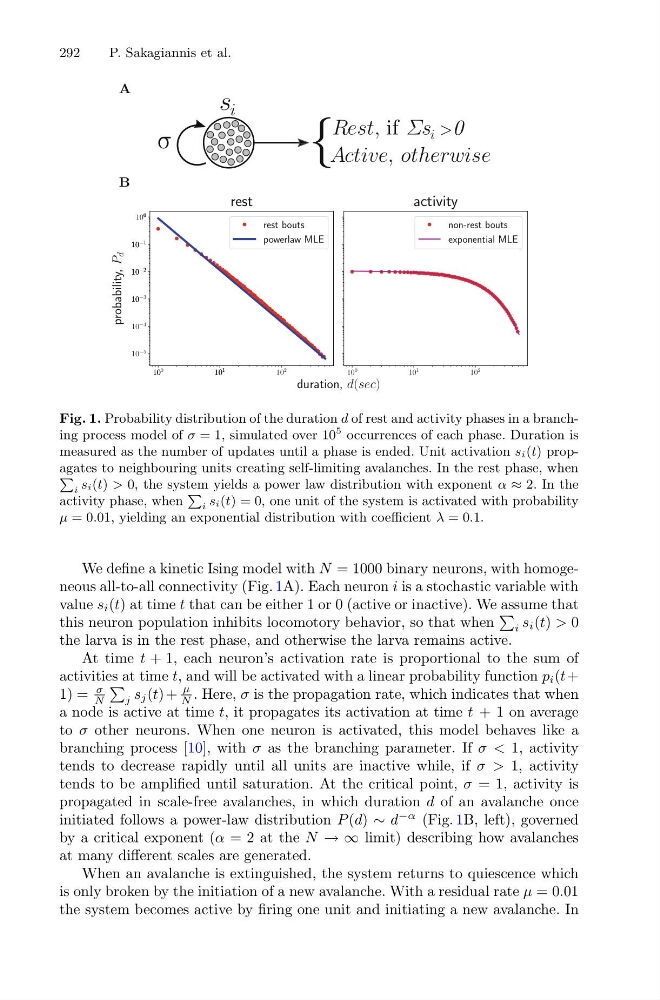
Fig. 1. Probability distribution of the duration d of rest and activity phases in a branching process model of σ = 1, simulated over 10
5 occurrences of each phase. Duration is
measured as the number of updates until a phase is ended. Unit activation si(t) propagates to neighbouring units creating self-limiting avalanches. In the rest phase, when
i si(t) > 0, the system yields a power law distribution with exponent α ≈ 2. In the
activity phase, when
i si(t) = 0, one unit of the system is activated with probability
μ = 0.01, yielding an exponential distribution with coefficient λ = 0.1.
We define a kinetic Ising model with N = 1000 binary neurons, with homogeneous all-to-all connectivity (Fig. 1A). Each neuron i is a stochastic variable with
value s i (t) at time t that can be either 1 or 0 (active or inactive). We assume that
this neuron population inhibits locomotory behavior, so that when
i s i (t) > 0
the larva is in the rest phase, and otherwise the larva remains active.
At time t + 1, each neuron’s activation rate is proportional to the sum of
activities at time t, and will be activated with a linear probability function p i (t+
1) =
σ
N
j s j (t) +
μ
N . Here, σ is the propagation rate, which indicates that when
a node is active at time t, it propagates its activation at time t + 1 on average
to σ other neurons. When one neuron is activated, this model behaves like a
branching process [10], with σ as the branching parameter. If σ < 1, activity
tends to decrease rapidly until all units are inactive while, if σ > 1, activity
tends to be amplified until saturation. At the critical point, σ = 1, activity is
propagated in scale-free avalanches, in which duration d of an avalanche once
initiated follows a power-law distribution P (d) ∼ d
−α (Fig. 1B, left), governed
by a critical exponent (α = 2 at the N → ∞ limit) describing how avalanches
at many different scales are generated.
When an avalanche is extinguished, the system returns to quiescence which
is only broken by the initiation of a new avalanche. With a residual rate μ = 0.01
the system becomes active by firing one unit and initiating a new avalanche. In
P. Sakagiannis et al.
A
s i
Rest, if Σs i
Active, otherwise
B
10 0
10 1
10 2
10
−5
10
−4
10
−3
10
−2
10
−1
10 0
rest
rest bouts
powerlaw MLE
10 0
10 1
10 2
activity
non-rest bouts
exponential MLE
10 10
10
10 1 1
duration, d(sec)
10 10
10 10 2 2
10 10
− − − −1 1
0 0
probability, P
d
Fig. 1. Probability distribution of the duration d of rest and activity phases in a branching process model of σ = 1, simulated over 10
5 occurrences of each phase. Duration is
measured as the number of updates until a phase is ended. Unit activation si(t) propagates to neighbouring units creating self-limiting avalanches. In the rest phase, when
i si(t) > 0, the system yields a power law distribution with exponent α ≈ 2. In the
activity phase, when
i si(t) = 0, one unit of the system is activated with probability
μ = 0.01, yielding an exponential distribution with coefficient λ = 0.1.
We define a kinetic Ising model with N = 1000 binary neurons, with homogeneous all-to-all connectivity (Fig. 1A). Each neuron i is a stochastic variable with
value s i (t) at time t that can be either 1 or 0 (active or inactive). We assume that
this neuron population inhibits locomotory behavior, so that when
i s i (t) > 0
the larva is in the rest phase, and otherwise the larva remains active.
At time t + 1, each neuron’s activation rate is proportional to the sum of
activities at time t, and will be activated with a linear probability function p i (t+
1) =
σ
N
j s j (t) +
μ
N . Here, σ is the propagation rate, which indicates that when
a node is active at time t, it propagates its activation at time t + 1 on average
to σ other neurons. When one neuron is activated, this model behaves like a
branching process [10], with σ as the branching parameter. If σ < 1, activity
tends to decrease rapidly until all units are inactive while, if σ > 1, activity
tends to be amplified until saturation. At the critical point, σ = 1, activity is
propagated in scale-free avalanches, in which duration d of an avalanche once
initiated follows a power-law distribution P (d) ∼ d
−α (Fig. 1B, left), governed
by a critical exponent (α = 2 at the N → ∞ limit) describing how avalanches
at many different scales are generated.
When an avalanche is extinguished, the system returns to quiescence which
is only broken by the initiation of a new avalanche. With a residual rate μ = 0.01
the system becomes active by firing one unit and initiating a new avalanche. In