

14
F. Angelini et al.
done by repeating several times the same task and performing it better each
time (learning by repetition). To implement this feature, we propose a control
law based on Iterative Learning Control (ILC) [3]: u i+1 = u i + Γ FFp e i (t) +
Γ FFd ˙
e i (t) + Γ FBp e i+1 (t) + Γ FBd ˙
e i+1 (t). We call u i and e i ˆ
x − x i the control
action and the error at the i−th repetition of the task. Γ FFp ∈ R
m×2n and
Γ FFd ∈ R
m×2n are the PD control gains of the iterative update while Γ FBp ∈
R
m×2n and Γ FBd ∈ R
m×2n are the PD feedback gains. We analyzed the theoretic
control implications of using similar algorithms in [1,6].
0
0.5
1
1.5
2
2.5
3
3.5
4
4.5
5
−0.2
0
0.2
0.4
0.6
0.8
1
1.2
time [sec]
angle [rad]
Reference evolution
(a) Reference Trajectory
0
0.5
1
1.5
2
2.5
3
3.5
4
4.5
−0.5
−0.4
−0.3
−0.2
−0.1
0
0.1
0.2
time [sec]
control [rad]
iteration 0
iteration 10
iteration 20
iteration 30
iteration 40
(b) Control joint 1
5
10
15
20
25
30
35
40
0
0.2
0.4
0.6
0.8
1
1.2
1.4
1.6
1.8
iterations
error [rad]
joint 1
joint 2
(c) Error evolution
0
5
10
15
20
25
30
35
40
0
0.5
1
1.5
2
2.5
3
3.5
iterations
control ratio
joint 1
joint 2
(d) Feedforward and feedback ratio
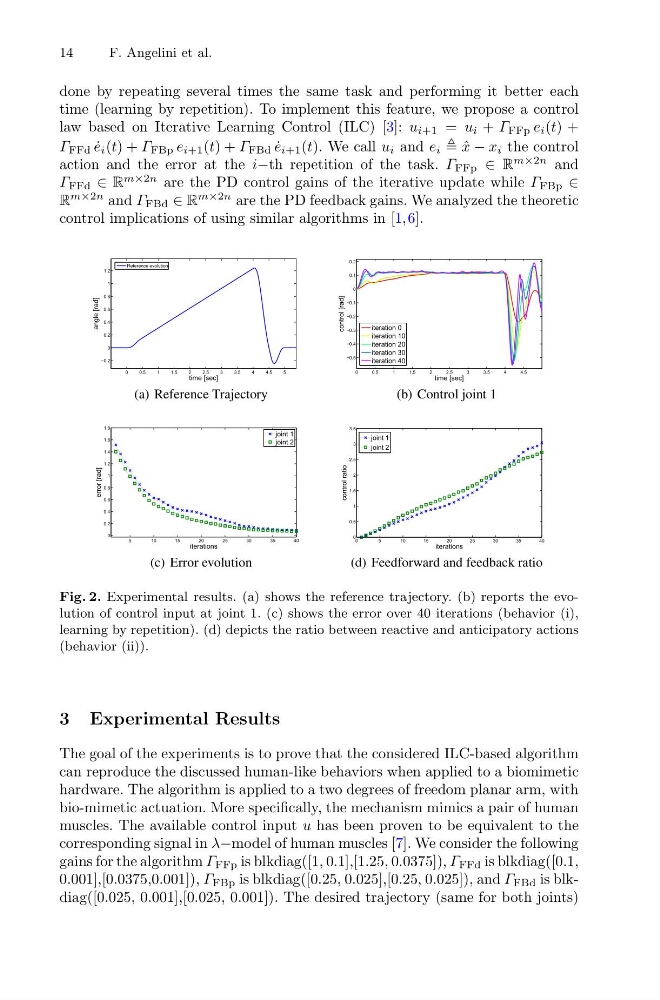
Fig. 2. Experimental results. (a) shows the reference trajectory. (b) reports the evolution of control input at joint 1. (c) shows the error over 40 iterations (behavior (i),
learning by repetition). (d) depicts the ratio between reactive and anticipatory actions
(behavior (ii)).
3 Experimental Results
The goal of the experiments is to prove that the considered ILC-based algorithm
can reproduce the discussed human-like behaviors when applied to a biomimetic
hardware. The algorithm is applied to a two degrees of freedom planar arm, with
bio-mimetic actuation. More specifically, the mechanism mimics a pair of human
muscles. The available control input u has been proven to be equivalent to the
corresponding signal in λ−model of human muscles [7]. We consider the following
gains for the algorithm Γ FFp is blkdiag([1, 0.1],[1.25, 0.0375]), Γ FFd is blkdiag([0.1,
0.001],[0.0375,0.001]), Γ FBp is blkdiag([0.25, 0.025],[0.25, 0.025]), and Γ FBd is blkdiag([0.025, 0.001],[0.025, 0.001]). The desired trajectory (same for both joints)
F. Angelini et al.
done by repeating several times the same task and performing it better each
time (learning by repetition). To implement this feature, we propose a control
law based on Iterative Learning Control (ILC) [3]: u i+1 = u i + Γ FFp e i (t) +
Γ FFd ˙
e i (t) + Γ FBp e i+1 (t) + Γ FBd ˙
e i+1 (t). We call u i and e i ˆ
x − x i the control
action and the error at the i−th repetition of the task. Γ FFp ∈ R
m×2n and
Γ FFd ∈ R
m×2n are the PD control gains of the iterative update while Γ FBp ∈
R
m×2n and Γ FBd ∈ R
m×2n are the PD feedback gains. We analyzed the theoretic
control implications of using similar algorithms in [1,6].
0
0.5
1
1.5
2
2.5
3
3.5
4
4.5
5
−0.2
0
0.2
0.4
0.6
0.8
1
1.2
time [sec]
angle [rad]
Reference evolution
(a) Reference Trajectory
0
0.5
1
1.5
2
2.5
3
3.5
4
4.5
−0.5
−0.4
−0.3
−0.2
−0.1
0
0.1
0.2
time [sec]
control [rad]
iteration 0
iteration 10
iteration 20
iteration 30
iteration 40
(b) Control joint 1
5
10
15
20
25
30
35
40
0
0.2
0.4
0.6
0.8
1
1.2
1.4
1.6
1.8
iterations
error [rad]
joint 1
joint 2
(c) Error evolution
0
5
10
15
20
25
30
35
40
0
0.5
1
1.5
2
2.5
3
3.5
iterations
control ratio
joint 1
joint 2
(d) Feedforward and feedback ratio
Fig. 2. Experimental results. (a) shows the reference trajectory. (b) reports the evolution of control input at joint 1. (c) shows the error over 40 iterations (behavior (i),
learning by repetition). (d) depicts the ratio between reactive and anticipatory actions
(behavior (ii)).
3 Experimental Results
The goal of the experiments is to prove that the considered ILC-based algorithm
can reproduce the discussed human-like behaviors when applied to a biomimetic
hardware. The algorithm is applied to a two degrees of freedom planar arm, with
bio-mimetic actuation. More specifically, the mechanism mimics a pair of human
muscles. The available control input u has been proven to be equivalent to the
corresponding signal in λ−model of human muscles [7]. We consider the following
gains for the algorithm Γ FFp is blkdiag([1, 0.1],[1.25, 0.0375]), Γ FFd is blkdiag([0.1,
0.001],[0.0375,0.001]), Γ FBp is blkdiag([0.25, 0.025],[0.25, 0.025]), and Γ FBd is blkdiag([0.025, 0.001],[0.025, 0.001]). The desired trajectory (same for both joints)