

Iterative Learning Control as a Framework for Human-Inspired Control
13
q
q
u
u
λ
λ
(a) Biomimetic mech.
ILC
Memory
Feedback
−
+
+
x
u
ˆ
x
e
Feedforward
(b) Control architecture
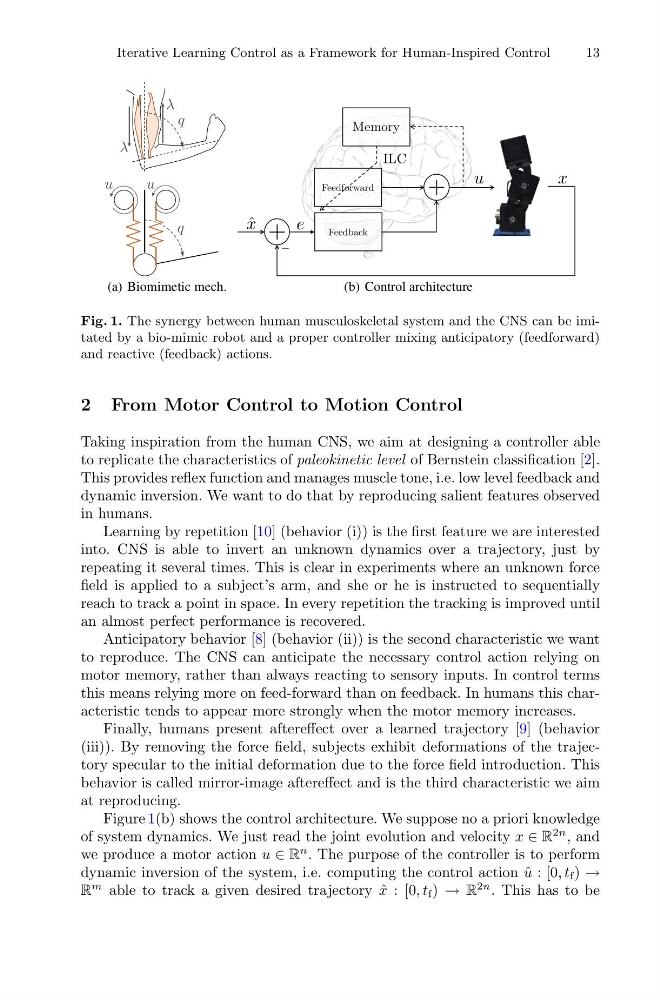
Fig. 1. The synergy between human musculoskeletal system and the CNS can be imitated by a bio-mimic robot and a proper controller mixing anticipatory (feedforward)
and reactive (feedback) actions.
2 From Motor Control to Motion Control
Taking inspiration from the human CNS, we aim at designing a controller able
to replicate the characteristics of paleokinetic level of Bernstein classification [2].
This provides reflex function and manages muscle tone, i.e. low level feedback and
dynamic inversion. We want to do that by reproducing salient features observed
in humans.
Learning by repetition [10] (behavior (i)) is the first feature we are interested
into. CNS is able to invert an unknown dynamics over a trajectory, just by
repeating it several times. This is clear in experiments where an unknown force
field is applied to a subject’s arm, and she or he is instructed to sequentially
reach to track a point in space. In every repetition the tracking is improved until
an almost perfect performance is recovered.
Anticipatory behavior [8] (behavior (ii)) is the second characteristic we want
to reproduce. The CNS can anticipate the necessary control action relying on
motor memory, rather than always reacting to sensory inputs. In control terms
this means relying more on feed-forward than on feedback. In humans this characteristic tends to appear more strongly when the motor memory increases.
Finally, humans present aftereffect over a learned trajectory [9] (behavior
(iii)). By removing the force field, subjects exhibit deformations of the trajectory specular to the initial deformation due to the force field introduction. This
behavior is called mirror-image aftereffect and is the third characteristic we aim
at reproducing.
Figure 1(b) shows the control architecture. We suppose no a priori knowledge
of system dynamics. We just read the joint evolution and velocity x ∈ R
2n , and
we produce a motor action u ∈ R
n . The purpose of the controller is to perform
dynamic inversion of the system, i.e. computing the control action ˆ
u : [0, t f ) →
R
m able to track a given desired trajectory ˆ
x : [0, t f ) → R
2n . This has to be
13
q
q
u
u
λ
λ
(a) Biomimetic mech.
ILC
Memory
Feedback
−
+
+
x
u
ˆ
x
e
Feedforward
(b) Control architecture
Fig. 1. The synergy between human musculoskeletal system and the CNS can be imitated by a bio-mimic robot and a proper controller mixing anticipatory (feedforward)
and reactive (feedback) actions.
2 From Motor Control to Motion Control
Taking inspiration from the human CNS, we aim at designing a controller able
to replicate the characteristics of paleokinetic level of Bernstein classification [2].
This provides reflex function and manages muscle tone, i.e. low level feedback and
dynamic inversion. We want to do that by reproducing salient features observed
in humans.
Learning by repetition [10] (behavior (i)) is the first feature we are interested
into. CNS is able to invert an unknown dynamics over a trajectory, just by
repeating it several times. This is clear in experiments where an unknown force
field is applied to a subject’s arm, and she or he is instructed to sequentially
reach to track a point in space. In every repetition the tracking is improved until
an almost perfect performance is recovered.
Anticipatory behavior [8] (behavior (ii)) is the second characteristic we want
to reproduce. The CNS can anticipate the necessary control action relying on
motor memory, rather than always reacting to sensory inputs. In control terms
this means relying more on feed-forward than on feedback. In humans this characteristic tends to appear more strongly when the motor memory increases.
Finally, humans present aftereffect over a learned trajectory [9] (behavior
(iii)). By removing the force field, subjects exhibit deformations of the trajectory specular to the initial deformation due to the force field introduction. This
behavior is called mirror-image aftereffect and is the third characteristic we aim
at reproducing.
Figure 1(b) shows the control architecture. We suppose no a priori knowledge
of system dynamics. We just read the joint evolution and velocity x ∈ R
2n , and
we produce a motor action u ∈ R
n . The purpose of the controller is to perform
dynamic inversion of the system, i.e. computing the control action ˆ
u : [0, t f ) →
R
m able to track a given desired trajectory ˆ
x : [0, t f ) → R
2n . This has to be