

Iterative Learning Control as a Framework for Human-Inspired Control
15
is shown in Fig. 2(a). Note that this is a very challenging reference, having large
amplitudes and abrupt changes in velocities. For performance evaluation we use
norm 1 of the tracking error. The proposed algorithm learns the task by repeating
it 40 times achieving good performance. Figure 2(b) shows the joint 1 control evolution for some meaningful iterations (similar results apply to joint 2). Figure 2(c)
proves that the system implements learning by repetition (behavior (i)), reducing
the error exponentially to 0 by repeating the same movement. Figure 2(d) depicts
the ratio between total feedforward and feedback action, over learning iterations.
This shows the predominance of anticipatory action at the growth of sensory-motor memory (behavior (ii)). It is worth to be noticed that feedback it is not
completely replaced by feedforward, which is coherent with many physiological
evidences (e.g. [10]).
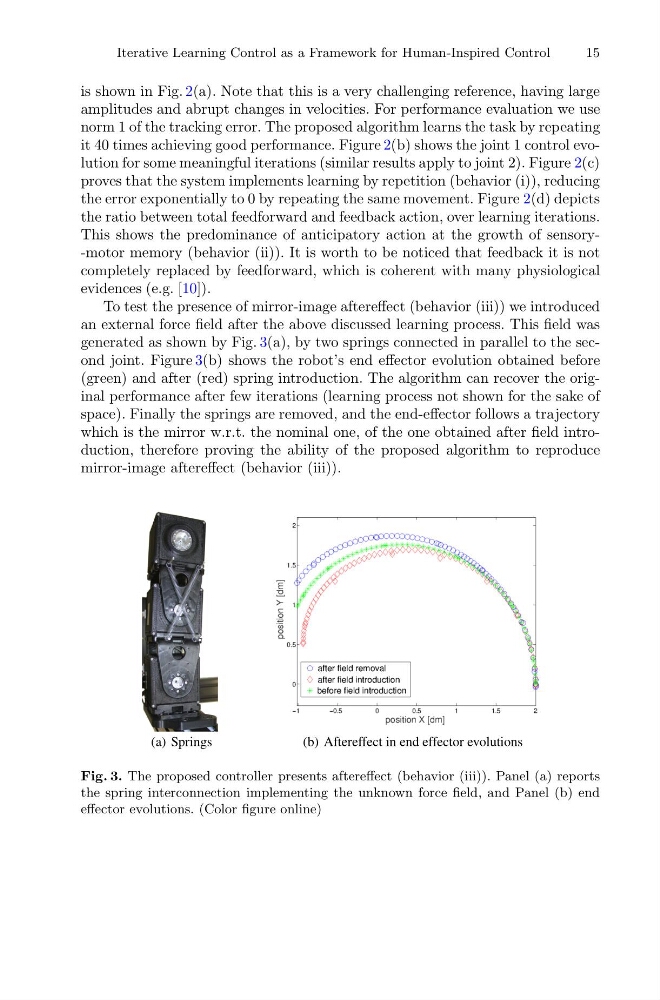
To test the presence of mirror-image aftereffect (behavior (iii)) we introduced
an external force field after the above discussed learning process. This field was
generated as shown by Fig. 3(a), by two springs connected in parallel to the second joint. Figure 3(b) shows the robot’s end effector evolution obtained before
(green) and after (red) spring introduction. The algorithm can recover the original performance after few iterations (learning process not shown for the sake of
space). Finally the springs are removed, and the end-effector follows a trajectory
which is the mirror w.r.t. the nominal one, of the one obtained after field introduction, therefore proving the ability of the proposed algorithm to reproduce
mirror-image aftereffect (behavior (iii)).
(a) Springs
(b) Aftereffect in end effector evolutions
Fig. 3. The proposed controller presents aftereffect (behavior (iii)). Panel (a) reports
the spring interconnection implementing the unknown force field, and Panel (b) end
effector evolutions. (Color figure online)
15
is shown in Fig. 2(a). Note that this is a very challenging reference, having large
amplitudes and abrupt changes in velocities. For performance evaluation we use
norm 1 of the tracking error. The proposed algorithm learns the task by repeating
it 40 times achieving good performance. Figure 2(b) shows the joint 1 control evolution for some meaningful iterations (similar results apply to joint 2). Figure 2(c)
proves that the system implements learning by repetition (behavior (i)), reducing
the error exponentially to 0 by repeating the same movement. Figure 2(d) depicts
the ratio between total feedforward and feedback action, over learning iterations.
This shows the predominance of anticipatory action at the growth of sensory-motor memory (behavior (ii)). It is worth to be noticed that feedback it is not
completely replaced by feedforward, which is coherent with many physiological
evidences (e.g. [10]).
To test the presence of mirror-image aftereffect (behavior (iii)) we introduced
an external force field after the above discussed learning process. This field was
generated as shown by Fig. 3(a), by two springs connected in parallel to the second joint. Figure 3(b) shows the robot’s end effector evolution obtained before
(green) and after (red) spring introduction. The algorithm can recover the original performance after few iterations (learning process not shown for the sake of
space). Finally the springs are removed, and the end-effector follows a trajectory
which is the mirror w.r.t. the nominal one, of the one obtained after field introduction, therefore proving the ability of the proposed algorithm to reproduce
mirror-image aftereffect (behavior (iii)).
(a) Springs
(b) Aftereffect in end effector evolutions
Fig. 3. The proposed controller presents aftereffect (behavior (iii)). Panel (a) reports
the spring interconnection implementing the unknown force field, and Panel (b) end
effector evolutions. (Color figure online)