

260
C. Morrow et al.
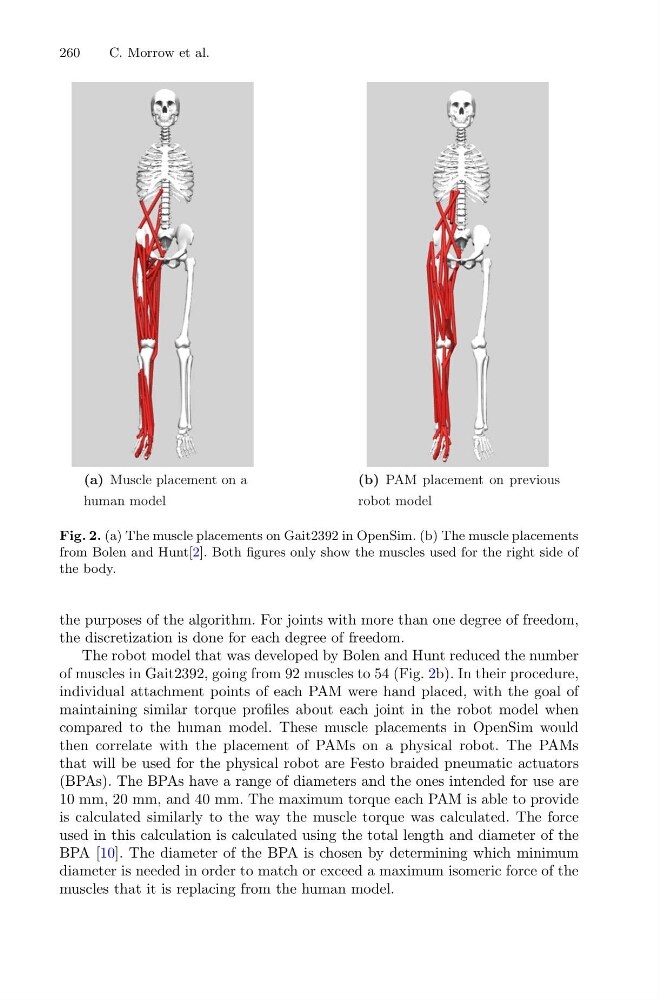
(a) Muscle placement on a
(b) PAM placement on previous
robot model
human model
Fig. 2. (a) The muscle placements on Gait2392 in OpenSim. (b) The muscle placements
from Bolen and Hunt[2]. Both figures only show the muscles used for the right side of
the body.
the purposes of the algorithm. For joints with more than one degree of freedom,
the discretization is done for each degree of freedom.
The robot model that was developed by Bolen and Hunt reduced the number
of muscles in Gait2392, going from 92 muscles to 54 (Fig. 2b). In their procedure,
individual attachment points of each PAM were hand placed, with the goal of
maintaining similar torque profiles about each joint in the robot model when
compared to the human model. These muscle placements in OpenSim would
then correlate with the placement of PAMs on a physical robot. The PAMs
that will be used for the physical robot are Festo braided pneumatic actuators
(BPAs). The BPAs have a range of diameters and the ones intended for use are
10 mm, 20 mm, and 40 mm. The maximum torque each PAM is able to provide
is calculated similarly to the way the muscle torque was calculated. The force
used in this calculation is calculated using the total length and diameter of the
BPA [10]. The diameter of the BPA is chosen by determining which minimum
diameter is needed in order to match or exceed a maximum isomeric force of the
muscles that it is replacing from the human model.
C. Morrow et al.
(a) Muscle placement on a
(b) PAM placement on previous
robot model
human model
Fig. 2. (a) The muscle placements on Gait2392 in OpenSim. (b) The muscle placements
from Bolen and Hunt[2]. Both figures only show the muscles used for the right side of
the body.
the purposes of the algorithm. For joints with more than one degree of freedom,
the discretization is done for each degree of freedom.
The robot model that was developed by Bolen and Hunt reduced the number
of muscles in Gait2392, going from 92 muscles to 54 (Fig. 2b). In their procedure,
individual attachment points of each PAM were hand placed, with the goal of
maintaining similar torque profiles about each joint in the robot model when
compared to the human model. These muscle placements in OpenSim would
then correlate with the placement of PAMs on a physical robot. The PAMs
that will be used for the physical robot are Festo braided pneumatic actuators
(BPAs). The BPAs have a range of diameters and the ones intended for use are
10 mm, 20 mm, and 40 mm. The maximum torque each PAM is able to provide
is calculated similarly to the way the muscle torque was calculated. The force
used in this calculation is calculated using the total length and diameter of the
BPA [10]. The diameter of the BPA is chosen by determining which minimum
diameter is needed in order to match or exceed a maximum isomeric force of the
muscles that it is replacing from the human model.