

Optimization of Artificial Muscle Placements
259
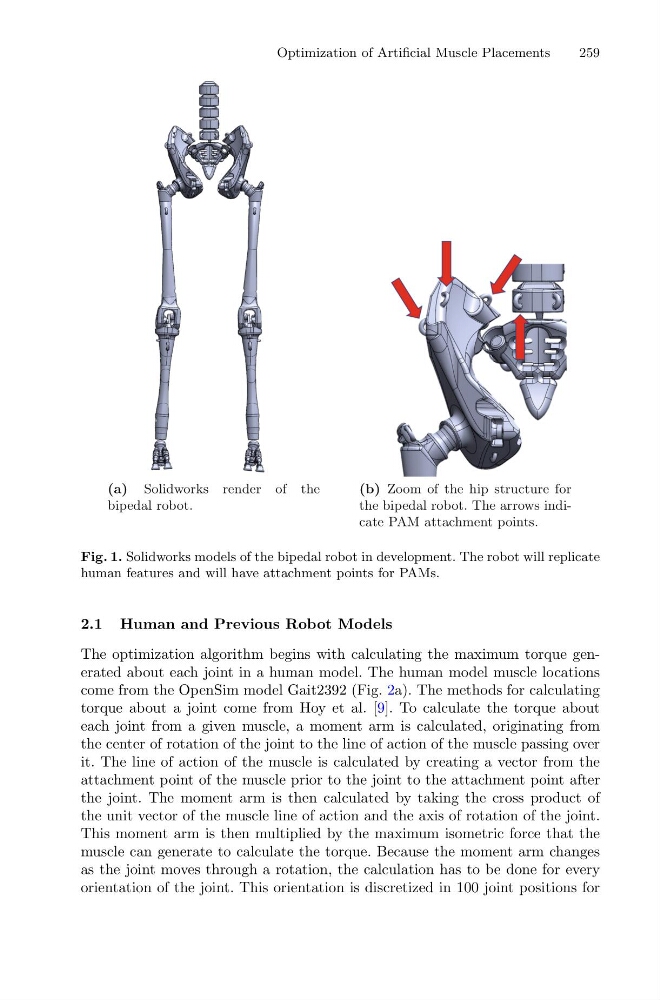
(a) Solidworks render of the
bipedal robot.
(b) Zoom of the hip structure for
the bipedal robot. The arrows indicate PAM attachment points.
Fig. 1. Solidworks models of the bipedal robot in development. The robot will replicate
human features and will have attachment points for PAMs.
2.1 Human and Previous Robot Models
The optimization algorithm begins with calculating the maximum torque generated about each joint in a human model. The human model muscle locations
come from the OpenSim model Gait2392 (Fig. 2a). The methods for calculating
torque about a joint come from Hoy et al. [9]. To calculate the torque about
each joint from a given muscle, a moment arm is calculated, originating from
the center of rotation of the joint to the line of action of the muscle passing over
it. The line of action of the muscle is calculated by creating a vector from the
attachment point of the muscle prior to the joint to the attachment point after
the joint. The moment arm is then calculated by taking the cross product of
the unit vector of the muscle line of action and the axis of rotation of the joint.
This moment arm is then multiplied by the maximum isometric force that the
muscle can generate to calculate the torque. Because the moment arm changes
as the joint moves through a rotation, the calculation has to be done for every
orientation of the joint. This orientation is discretized in 100 joint positions for
259
(a) Solidworks render of the
bipedal robot.
(b) Zoom of the hip structure for
the bipedal robot. The arrows indicate PAM attachment points.
Fig. 1. Solidworks models of the bipedal robot in development. The robot will replicate
human features and will have attachment points for PAMs.
2.1 Human and Previous Robot Models
The optimization algorithm begins with calculating the maximum torque generated about each joint in a human model. The human model muscle locations
come from the OpenSim model Gait2392 (Fig. 2a). The methods for calculating
torque about a joint come from Hoy et al. [9]. To calculate the torque about
each joint from a given muscle, a moment arm is calculated, originating from
the center of rotation of the joint to the line of action of the muscle passing over
it. The line of action of the muscle is calculated by creating a vector from the
attachment point of the muscle prior to the joint to the attachment point after
the joint. The moment arm is then calculated by taking the cross product of
the unit vector of the muscle line of action and the axis of rotation of the joint.
This moment arm is then multiplied by the maximum isometric force that the
muscle can generate to calculate the torque. Because the moment arm changes
as the joint moves through a rotation, the calculation has to be done for every
orientation of the joint. This orientation is discretized in 100 joint positions for