

Optimization of Artificial Muscle Placements
261
2.2 Cost Function
Muscle attachment locations are optimized using an exhaustive search method
according to the cost function in Eq. 1. The C values in the function are the
constraints calculated during every iteration. The G values are the weights that
assign relative importance of each cost component.
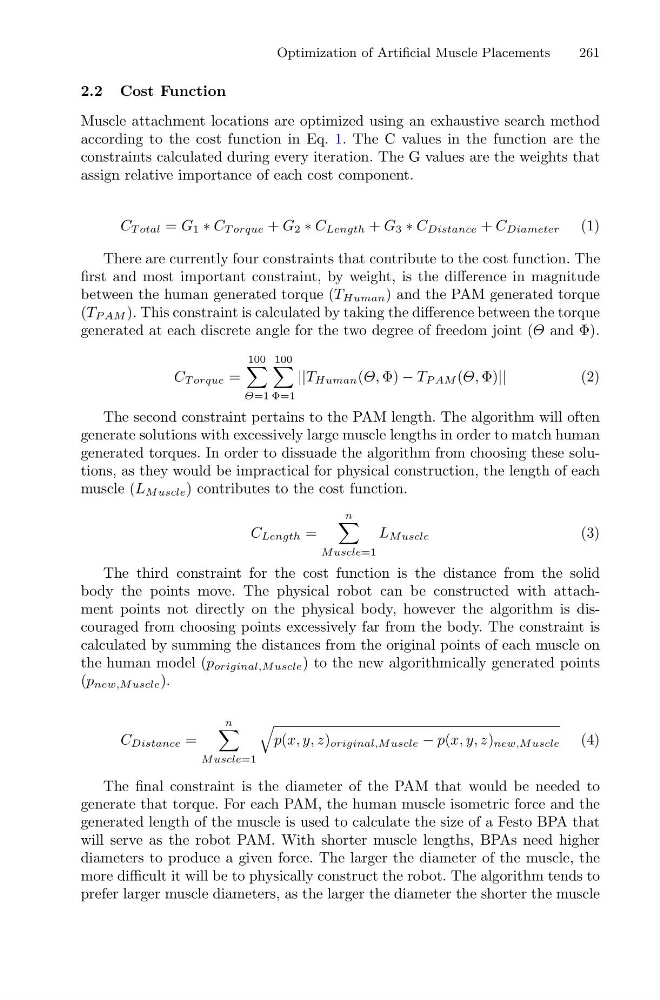
C T otal = G 1 ∗ C T orque + G 2 ∗ C Length + G 3 ∗ C Distance + C Diameter (1)
There are currently four constraints that contribute to the cost function. The
first and most important constraint, by weight, is the difference in magnitude
between the human generated torque (T Human ) and the PAM generated torque
(T P AM ). This constraint is calculated by taking the difference between the torque
generated at each discrete angle for the two degree of freedom joint (Θ and Φ).
C T orque =
100
Θ=1
100
Φ=1
||T Human (Θ, Φ) − T P AM (Θ, Φ)||
(2)
The second constraint pertains to the PAM length. The algorithm will often
generate solutions with excessively large muscle lengths in order to match human
generated torques. In order to dissuade the algorithm from choosing these solutions, as they would be impractical for physical construction, the length of each
muscle (L Muscle ) contributes to the cost function.
C Length =
n
Muscle=1
L Muscle
(3)
The third constraint for the cost function is the distance from the solid
body the points move. The physical robot can be constructed with attachment points not directly on the physical body, however the algorithm is discouraged from choosing points excessively far from the body. The constraint is
calculated by summing the distances from the original points of each muscle on
the human model (p original,M uscle ) to the new algorithmically generated points
(p new,M uscle ).
C Distance =
n
Muscle=1
p(x, y, z) original,M uscle − p(x, y, z) new,M uscle (4)
The final constraint is the diameter of the PAM that would be needed to
generate that torque. For each PAM, the human muscle isometric force and the
generated length of the muscle is used to calculate the size of a Festo BPA that
will serve as the robot PAM. With shorter muscle lengths, BPAs need higher
diameters to produce a given force. The larger the diameter of the muscle, the
more difficult it will be to physically construct the robot. The algorithm tends to
prefer larger muscle diameters, as the larger the diameter the shorter the muscle
261
2.2 Cost Function
Muscle attachment locations are optimized using an exhaustive search method
according to the cost function in Eq. 1. The C values in the function are the
constraints calculated during every iteration. The G values are the weights that
assign relative importance of each cost component.
C T otal = G 1 ∗ C T orque + G 2 ∗ C Length + G 3 ∗ C Distance + C Diameter (1)
There are currently four constraints that contribute to the cost function. The
first and most important constraint, by weight, is the difference in magnitude
between the human generated torque (T Human ) and the PAM generated torque
(T P AM ). This constraint is calculated by taking the difference between the torque
generated at each discrete angle for the two degree of freedom joint (Θ and Φ).
C T orque =
100
Θ=1
100
Φ=1
||T Human (Θ, Φ) − T P AM (Θ, Φ)||
(2)
The second constraint pertains to the PAM length. The algorithm will often
generate solutions with excessively large muscle lengths in order to match human
generated torques. In order to dissuade the algorithm from choosing these solutions, as they would be impractical for physical construction, the length of each
muscle (L Muscle ) contributes to the cost function.
C Length =
n
Muscle=1
L Muscle
(3)
The third constraint for the cost function is the distance from the solid
body the points move. The physical robot can be constructed with attachment points not directly on the physical body, however the algorithm is discouraged from choosing points excessively far from the body. The constraint is
calculated by summing the distances from the original points of each muscle on
the human model (p original,M uscle ) to the new algorithmically generated points
(p new,M uscle ).
C Distance =
n
Muscle=1
p(x, y, z) original,M uscle − p(x, y, z) new,M uscle (4)
The final constraint is the diameter of the PAM that would be needed to
generate that torque. For each PAM, the human muscle isometric force and the
generated length of the muscle is used to calculate the size of a Festo BPA that
will serve as the robot PAM. With shorter muscle lengths, BPAs need higher
diameters to produce a given force. The larger the diameter of the muscle, the
more difficult it will be to physically construct the robot. The algorithm tends to
prefer larger muscle diameters, as the larger the diameter the shorter the muscle