

Snapshot Navigation in the Wavelet Domain
251
of any agent. Aligning vertical edges is hence similar to aligning objects, which
is the underlying principle of visual navigation via landmarks. However, when
using wavelet based RIDF it is not necessary to actually detect landmarks in
two different views, match them and find the best alignment. Thus we assume
that the existence of pronounced objects (like certain patches of tussocks) is the
most relevant aspect of the environment determining the shape of the RIDF.
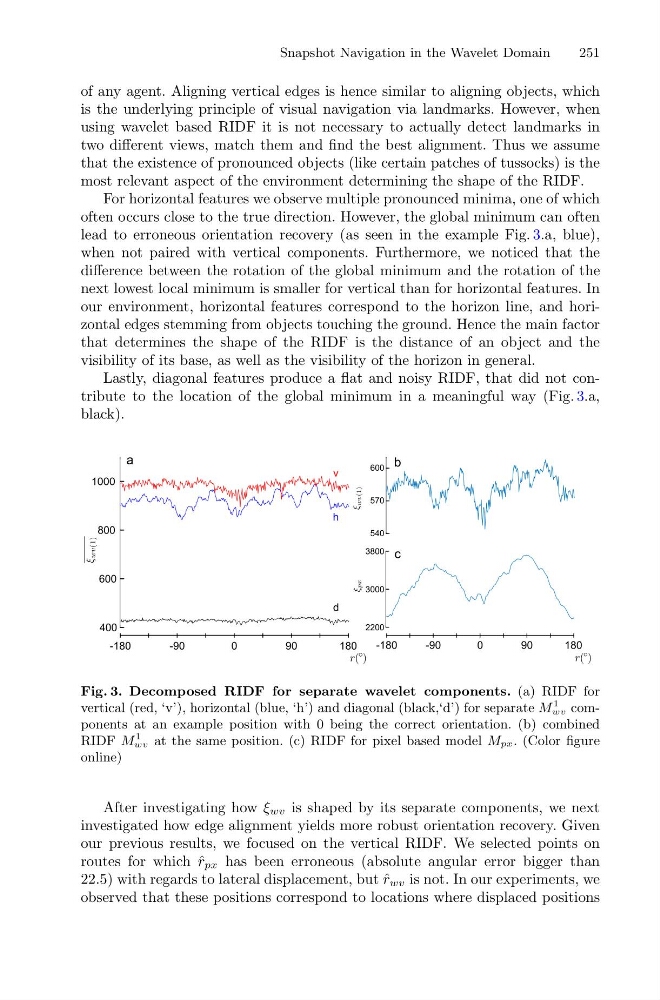
For horizontal features we observe multiple pronounced minima, one of which
often occurs close to the true direction. However, the global minimum can often
lead to erroneous orientation recovery (as seen in the example Fig. 3.a, blue),
when not paired with vertical components. Furthermore, we noticed that the
difference between the rotation of the global minimum and the rotation of the
next lowest local minimum is smaller for vertical than for horizontal features. In
our environment, horizontal features correspond to the horizon line, and horizontal edges stemming from objects touching the ground. Hence the main factor
that determines the shape of the RIDF is the distance of an object and the
visibility of its base, as well as the visibility of the horizon in general.
Lastly, diagonal features produce a flat and noisy RIDF, that did not contribute to the location of the global minimum in a meaningful way (Fig. 3.a,
black).
Fig. 3. Decomposed RIDF for separate wavelet components. (a) RIDF for
vertical (red, ‘v’), horizontal (blue, ‘h’) and diagonal (black,‘d’) for separate M
1
wv components at an example position with 0 being the correct orientation. (b) combined
RIDF M
1
wv at the same position. (c) RIDF for pixel based model Mpx. (Color figure
online)
After investigating how ξ wv is shaped by its separate components, we next
investigated how edge alignment yields more robust orientation recovery. Given
our previous results, we focused on the vertical RIDF. We selected points on
routes for which ˆ
r px has been erroneous (absolute angular error bigger than
22.5) with regards to lateral displacement, but ˆ
r wv is not. In our experiments, we
observed that these positions correspond to locations where displaced positions
251
of any agent. Aligning vertical edges is hence similar to aligning objects, which
is the underlying principle of visual navigation via landmarks. However, when
using wavelet based RIDF it is not necessary to actually detect landmarks in
two different views, match them and find the best alignment. Thus we assume
that the existence of pronounced objects (like certain patches of tussocks) is the
most relevant aspect of the environment determining the shape of the RIDF.
For horizontal features we observe multiple pronounced minima, one of which
often occurs close to the true direction. However, the global minimum can often
lead to erroneous orientation recovery (as seen in the example Fig. 3.a, blue),
when not paired with vertical components. Furthermore, we noticed that the
difference between the rotation of the global minimum and the rotation of the
next lowest local minimum is smaller for vertical than for horizontal features. In
our environment, horizontal features correspond to the horizon line, and horizontal edges stemming from objects touching the ground. Hence the main factor
that determines the shape of the RIDF is the distance of an object and the
visibility of its base, as well as the visibility of the horizon in general.
Lastly, diagonal features produce a flat and noisy RIDF, that did not contribute to the location of the global minimum in a meaningful way (Fig. 3.a,
black).
Fig. 3. Decomposed RIDF for separate wavelet components. (a) RIDF for
vertical (red, ‘v’), horizontal (blue, ‘h’) and diagonal (black,‘d’) for separate M
1
wv components at an example position with 0 being the correct orientation. (b) combined
RIDF M
1
wv at the same position. (c) RIDF for pixel based model Mpx. (Color figure
online)
After investigating how ξ wv is shaped by its separate components, we next
investigated how edge alignment yields more robust orientation recovery. Given
our previous results, we focused on the vertical RIDF. We selected points on
routes for which ˆ
r px has been erroneous (absolute angular error bigger than
22.5) with regards to lateral displacement, but ˆ
r wv is not. In our experiments, we
observed that these positions correspond to locations where displaced positions