

226
K. Kodono and H. Kimura
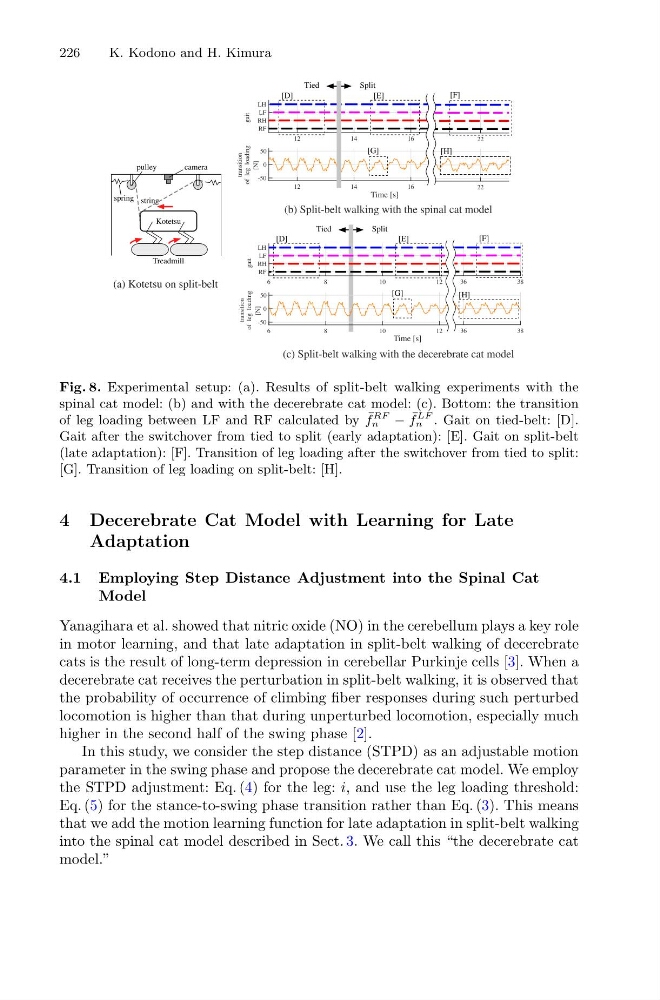
Fig. 8. Experimental setup: (a). Results of split-belt walking experiments with the
spinal cat model: (b) and with the decerebrate cat model: (c). Bottom: the transition
of leg loading between LF and RF calculated by ¯
f
RF
n
− ¯
f
LF
n . Gait on tied-belt: [D].
Gait after the switchover from tied to split (early adaptation): [E]. Gait on split-belt
(late adaptation): [F]. Transition of leg loading after the switchover from tied to split:
[G]. Transition of leg loading on split-belt: [H].
4 Decerebrate Cat Model with Learning for Late
Adaptation
4.1 Employing Step Distance Adjustment into the Spinal Cat
Model
Yanagihara et al. showed that nitric oxide (NO) in the cerebellum plays a key role
in motor learning, and that late adaptation in split-belt walking of decerebrate
cats is the result of long-term depression in cerebellar Purkinje cells [3]. When a
decerebrate cat receives the perturbation in split-belt walking, it is observed that
the probability of occurrence of climbing fiber responses during such perturbed
locomotion is higher than that during unperturbed locomotion, especially much
higher in the second half of the swing phase [2].
In this study, we consider the step distance (STPD) as an adjustable motion
parameter in the swing phase and propose the decerebrate cat model. We employ
the STPD adjustment: Eq. (4) for the leg: i, and use the leg loading threshold:
Eq. (5) for the stance-to-swing phase transition rather than Eq. (3). This means
that we add the motion learning function for late adaptation in split-belt walking
into the spinal cat model described in Sect. 3. We call this “the decerebrate cat
model.”
K. Kodono and H. Kimura
Fig. 8. Experimental setup: (a). Results of split-belt walking experiments with the
spinal cat model: (b) and with the decerebrate cat model: (c). Bottom: the transition
of leg loading between LF and RF calculated by ¯
f
RF
n
− ¯
f
LF
n . Gait on tied-belt: [D].
Gait after the switchover from tied to split (early adaptation): [E]. Gait on split-belt
(late adaptation): [F]. Transition of leg loading after the switchover from tied to split:
[G]. Transition of leg loading on split-belt: [H].
4 Decerebrate Cat Model with Learning for Late
Adaptation
4.1 Employing Step Distance Adjustment into the Spinal Cat
Model
Yanagihara et al. showed that nitric oxide (NO) in the cerebellum plays a key role
in motor learning, and that late adaptation in split-belt walking of decerebrate
cats is the result of long-term depression in cerebellar Purkinje cells [3]. When a
decerebrate cat receives the perturbation in split-belt walking, it is observed that
the probability of occurrence of climbing fiber responses during such perturbed
locomotion is higher than that during unperturbed locomotion, especially much
higher in the second half of the swing phase [2].
In this study, we consider the step distance (STPD) as an adjustable motion
parameter in the swing phase and propose the decerebrate cat model. We employ
the STPD adjustment: Eq. (4) for the leg: i, and use the leg loading threshold:
Eq. (5) for the stance-to-swing phase transition rather than Eq. (3). This means
that we add the motion learning function for late adaptation in split-belt walking
into the spinal cat model described in Sect. 3. We call this “the decerebrate cat
model.”