

Split-Belt Adaptation Model of a Decerebrate Cat
227
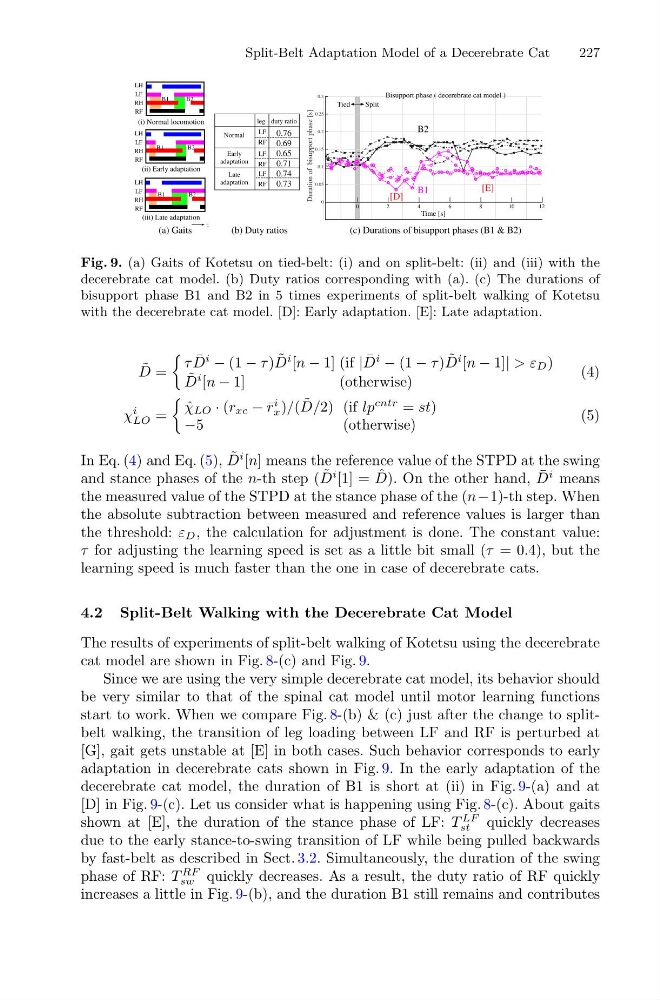
Fig. 9. (a) Gaits of Kotetsu on tied-belt: (i) and on split-belt: (ii) and (iii) with the
decerebrate cat model. (b) Duty ratios corresponding with (a). (c) The durations of
bisupport phase B1 and B2 in 5 times experiments of split-belt walking of Kotetsu
with the decerebrate cat model. [D]: Early adaptation. [E]: Late adaptation.
˜
D =
τ ¯
D
i
− (1 − τ ) ˜
D
i [n − 1] (if | ¯
D
i
− (1 − τ ) ˜
D
i [n − 1]| > ε D )
˜
D
i [n − 1]
(otherwise)
(4)
χ
i
LO =
ˆ
χ LO · (r xc − ¯
r
i
x )/( ˜
D/2) (if lp
cntr = st)
−5
(otherwise)
(5)
In Eq. (4) and Eq. (5), ˜
D
i [n] means the reference value of the STPD at the swing
and stance phases of the n-th step ( ˜
D
i [1] = ˆ
D). On the other hand, ¯
D
i means
the measured value of the STPD at the stance phase of the (n−1)-th step. When
the absolute subtraction between measured and reference values is larger than
the threshold: ε D , the calculation for adjustment is done. The constant value:
τ for adjusting the learning speed is set as a little bit small (τ = 0.4), but the
learning speed is much faster than the one in case of decerebrate cats.
4.2 Split-Belt Walking with the Decerebrate Cat Model
The results of experiments of split-belt walking of Kotetsu using the decerebrate
cat model are shown in Fig. 8-(c) and Fig. 9.
Since we are using the very simple decerebrate cat model, its behavior should
be very similar to that of the spinal cat model until motor learning functions
start to work. When we compare Fig. 8-(b) & (c) just after the change to splitbelt walking, the transition of leg loading between LF and RF is perturbed at
[G], gait gets unstable at [E] in both cases. Such behavior corresponds to early
adaptation in decerebrate cats shown in Fig. 9. In the early adaptation of the
decerebrate cat model, the duration of B1 is short at (ii) in Fig. 9-(a) and at
[D] in Fig. 9-(c). Let us consider what is happening using Fig. 8-(c). About gaits
shown at [E], the duration of the stance phase of LF: T
LF
st
quickly decreases
due to the early stance-to-swing transition of LF while being pulled backwards
by fast-belt as described in Sect. 3.2. Simultaneously, the duration of the swing
phase of RF: T
RF
sw quickly decreases. As a result, the duty ratio of RF quickly
increases a little in Fig. 9-(b), and the duration B1 still remains and contributes
227
Fig. 9. (a) Gaits of Kotetsu on tied-belt: (i) and on split-belt: (ii) and (iii) with the
decerebrate cat model. (b) Duty ratios corresponding with (a). (c) The durations of
bisupport phase B1 and B2 in 5 times experiments of split-belt walking of Kotetsu
with the decerebrate cat model. [D]: Early adaptation. [E]: Late adaptation.
˜
D =
τ ¯
D
i
− (1 − τ ) ˜
D
i [n − 1] (if | ¯
D
i
− (1 − τ ) ˜
D
i [n − 1]| > ε D )
˜
D
i [n − 1]
(otherwise)
(4)
χ
i
LO =
ˆ
χ LO · (r xc − ¯
r
i
x )/( ˜
D/2) (if lp
cntr = st)
−5
(otherwise)
(5)
In Eq. (4) and Eq. (5), ˜
D
i [n] means the reference value of the STPD at the swing
and stance phases of the n-th step ( ˜
D
i [1] = ˆ
D). On the other hand, ¯
D
i means
the measured value of the STPD at the stance phase of the (n−1)-th step. When
the absolute subtraction between measured and reference values is larger than
the threshold: ε D , the calculation for adjustment is done. The constant value:
τ for adjusting the learning speed is set as a little bit small (τ = 0.4), but the
learning speed is much faster than the one in case of decerebrate cats.
4.2 Split-Belt Walking with the Decerebrate Cat Model
The results of experiments of split-belt walking of Kotetsu using the decerebrate
cat model are shown in Fig. 8-(c) and Fig. 9.
Since we are using the very simple decerebrate cat model, its behavior should
be very similar to that of the spinal cat model until motor learning functions
start to work. When we compare Fig. 8-(b) & (c) just after the change to splitbelt walking, the transition of leg loading between LF and RF is perturbed at
[G], gait gets unstable at [E] in both cases. Such behavior corresponds to early
adaptation in decerebrate cats shown in Fig. 9. In the early adaptation of the
decerebrate cat model, the duration of B1 is short at (ii) in Fig. 9-(a) and at
[D] in Fig. 9-(c). Let us consider what is happening using Fig. 8-(c). About gaits
shown at [E], the duration of the stance phase of LF: T
LF
st
quickly decreases
due to the early stance-to-swing transition of LF while being pulled backwards
by fast-belt as described in Sect. 3.2. Simultaneously, the duration of the swing
phase of RF: T
RF
sw quickly decreases. As a result, the duty ratio of RF quickly
increases a little in Fig. 9-(b), and the duration B1 still remains and contributes