

Split-Belt Adaptation Model of a Decerebrate Cat
223
3 Spinal Cat Model for the Leg Phase Transition
3.1 Frigon’s Model
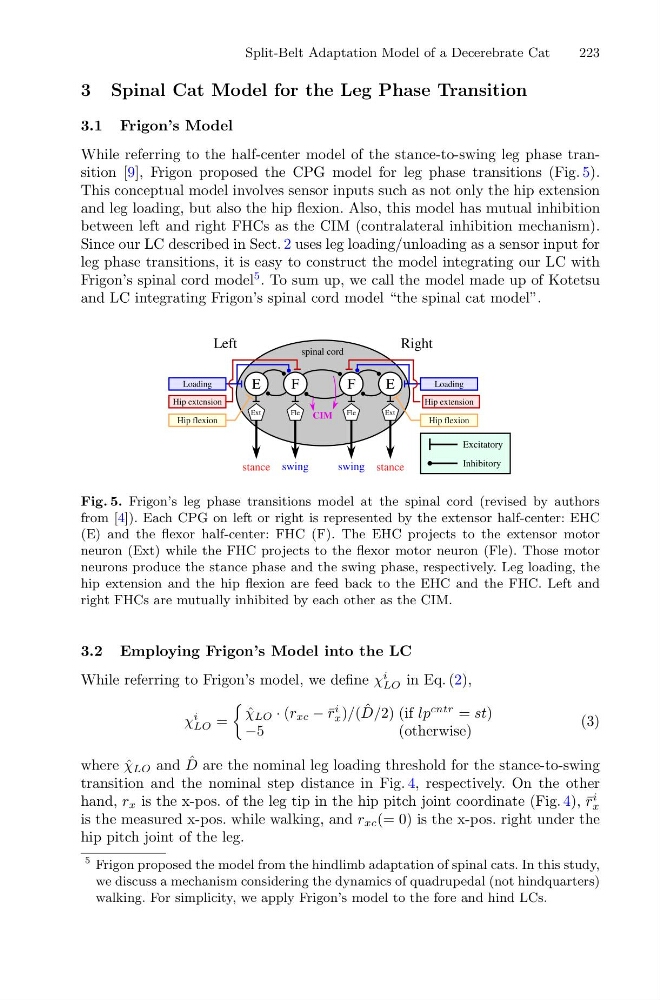
While referring to the half-center model of the stance-to-swing leg phase transition [9], Frigon proposed the CPG model for leg phase transitions (Fig. 5).
This conceptual model involves sensor inputs such as not only the hip extension
and leg loading, but also the hip flexion. Also, this model has mutual inhibition
between left and right FHCs as the CIM (contralateral inhibition mechanism).
Since our LC described in Sect. 2 uses leg loading/unloading as a sensor input for
leg phase transitions, it is easy to construct the model integrating our LC with
Frigon’s spinal cord model
5 . To sum up, we call the model made up of Kotetsu
and LC integrating Frigon’s spinal cord model “the spinal cat model”.
Fig. 5. Frigon’s leg phase transitions model at the spinal cord (revised by authors
from [4]). Each CPG on left or right is represented by the extensor half-center: EHC
(E) and the flexor half-center: FHC (F). The EHC projects to the extensor motor
neuron (Ext) while the FHC projects to the flexor motor neuron (Fle). Those motor
neurons produce the stance phase and the swing phase, respectively. Leg loading, the
hip extension and the hip flexion are feed back to the EHC and the FHC. Left and
right FHCs are mutually inhibited by each other as the CIM.
3.2 Employing Frigon’s Model into the LC
While referring to Frigon’s model, we define χ
i
LO in Eq. (2),
χ
i
LO =
ˆ
χ LO · (r xc − ¯
r
i
x )/( ˆ
D/2) (if lp
cntr = st)
−5
(otherwise)
(3)
where ˆ
χ LO and ˆ
D are the nominal leg loading threshold for the stance-to-swing
transition and the nominal step distance in Fig. 4, respectively. On the other
hand, r x is the x-pos. of the leg tip in the hip pitch joint coordinate (Fig. 4), ¯
r
i
x
is the measured x-pos. while walking, and r xc (= 0) is the x-pos. right under the
hip pitch joint of the leg.
5 Frigon proposed the model from the hindlimb adaptation of spinal cats. In this study,
we discuss a mechanism considering the dynamics of quadrupedal (not hindquarters)
walking. For simplicity, we apply Frigon’s model to the fore and hind LCs.
223
3 Spinal Cat Model for the Leg Phase Transition
3.1 Frigon’s Model
While referring to the half-center model of the stance-to-swing leg phase transition [9], Frigon proposed the CPG model for leg phase transitions (Fig. 5).
This conceptual model involves sensor inputs such as not only the hip extension
and leg loading, but also the hip flexion. Also, this model has mutual inhibition
between left and right FHCs as the CIM (contralateral inhibition mechanism).
Since our LC described in Sect. 2 uses leg loading/unloading as a sensor input for
leg phase transitions, it is easy to construct the model integrating our LC with
Frigon’s spinal cord model
5 . To sum up, we call the model made up of Kotetsu
and LC integrating Frigon’s spinal cord model “the spinal cat model”.
Fig. 5. Frigon’s leg phase transitions model at the spinal cord (revised by authors
from [4]). Each CPG on left or right is represented by the extensor half-center: EHC
(E) and the flexor half-center: FHC (F). The EHC projects to the extensor motor
neuron (Ext) while the FHC projects to the flexor motor neuron (Fle). Those motor
neurons produce the stance phase and the swing phase, respectively. Leg loading, the
hip extension and the hip flexion are feed back to the EHC and the FHC. Left and
right FHCs are mutually inhibited by each other as the CIM.
3.2 Employing Frigon’s Model into the LC
While referring to Frigon’s model, we define χ
i
LO in Eq. (2),
χ
i
LO =
ˆ
χ LO · (r xc − ¯
r
i
x )/( ˆ
D/2) (if lp
cntr = st)
−5
(otherwise)
(3)
where ˆ
χ LO and ˆ
D are the nominal leg loading threshold for the stance-to-swing
transition and the nominal step distance in Fig. 4, respectively. On the other
hand, r x is the x-pos. of the leg tip in the hip pitch joint coordinate (Fig. 4), ¯
r
i
x
is the measured x-pos. while walking, and r xc (= 0) is the x-pos. right under the
hip pitch joint of the leg.
5 Frigon proposed the model from the hindlimb adaptation of spinal cats. In this study,
we discuss a mechanism considering the dynamics of quadrupedal (not hindquarters)
walking. For simplicity, we apply Frigon’s model to the fore and hind LCs.