

222
K. Kodono and H. Kimura
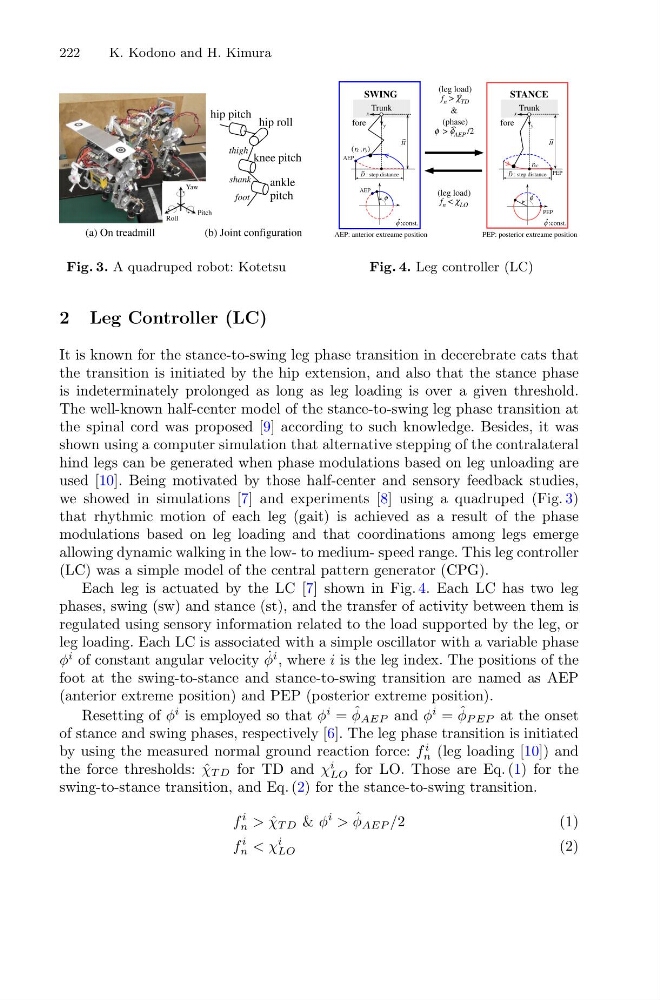
Fig. 3. A quadruped robot: Kotetsu
Fig. 4. Leg controller (LC)
2 Leg Controller (LC)
It is known for the stance-to-swing leg phase transition in decerebrate cats that
the transition is initiated by the hip extension, and also that the stance phase
is indeterminately prolonged as long as leg loading is over a given threshold.
The well-known half-center model of the stance-to-swing leg phase transition at
the spinal cord was proposed [9] according to such knowledge. Besides, it was
shown using a computer simulation that alternative stepping of the contralateral
hind legs can be generated when phase modulations based on leg unloading are
used [10]. Being motivated by those half-center and sensory feedback studies,
we showed in simulations [7] and experiments [8] using a quadruped (Fig. 3)
that rhythmic motion of each leg (gait) is achieved as a result of the phase
modulations based on leg loading and that coordinations among legs emerge
allowing dynamic walking in the low- to medium- speed range. This leg controller
(LC) was a simple model of the central pattern generator (CPG).
Each leg is actuated by the LC [7] shown in Fig. 4. Each LC has two leg
phases, swing (sw) and stance (st), and the transfer of activity between them is
regulated using sensory information related to the load supported by the leg, or
leg loading. Each LC is associated with a simple oscillator with a variable phase
φ
i of constant angular velocity ˙
φ
i , where i is the leg index. The positions of the
foot at the swing-to-stance and stance-to-swing transition are named as AEP
(anterior extreme position) and PEP (posterior extreme position).
Resetting of φ
i is employed so that φ
i = ˆ
φ AEP and φ
i = ˆ
φ P EP at the onset
of stance and swing phases, respectively [6]. The leg phase transition is initiated
by using the measured normal ground reaction force: f
i
n (leg loading [10]) and
the force thresholds: ˆ
χ T D for TD and χ
i
LO for LO. Those are Eq. (1) for the
swing-to-stance transition, and Eq. (2) for the stance-to-swing transition.
f
i
n > ˆ
χ T D & φ
i
> ˆ
φ AEP /2
(1)
f
i
n < χ
i
LO
(2)
K. Kodono and H. Kimura
Fig. 3. A quadruped robot: Kotetsu
Fig. 4. Leg controller (LC)
2 Leg Controller (LC)
It is known for the stance-to-swing leg phase transition in decerebrate cats that
the transition is initiated by the hip extension, and also that the stance phase
is indeterminately prolonged as long as leg loading is over a given threshold.
The well-known half-center model of the stance-to-swing leg phase transition at
the spinal cord was proposed [9] according to such knowledge. Besides, it was
shown using a computer simulation that alternative stepping of the contralateral
hind legs can be generated when phase modulations based on leg unloading are
used [10]. Being motivated by those half-center and sensory feedback studies,
we showed in simulations [7] and experiments [8] using a quadruped (Fig. 3)
that rhythmic motion of each leg (gait) is achieved as a result of the phase
modulations based on leg loading and that coordinations among legs emerge
allowing dynamic walking in the low- to medium- speed range. This leg controller
(LC) was a simple model of the central pattern generator (CPG).
Each leg is actuated by the LC [7] shown in Fig. 4. Each LC has two leg
phases, swing (sw) and stance (st), and the transfer of activity between them is
regulated using sensory information related to the load supported by the leg, or
leg loading. Each LC is associated with a simple oscillator with a variable phase
φ
i of constant angular velocity ˙
φ
i , where i is the leg index. The positions of the
foot at the swing-to-stance and stance-to-swing transition are named as AEP
(anterior extreme position) and PEP (posterior extreme position).
Resetting of φ
i is employed so that φ
i = ˆ
φ AEP and φ
i = ˆ
φ P EP at the onset
of stance and swing phases, respectively [6]. The leg phase transition is initiated
by using the measured normal ground reaction force: f
i
n (leg loading [10]) and
the force thresholds: ˆ
χ T D for TD and χ
i
LO for LO. Those are Eq. (1) for the
swing-to-stance transition, and Eq. (2) for the stance-to-swing transition.
f
i
n > ˆ
χ T D & φ
i
> ˆ
φ AEP /2
(1)
f
i
n < χ
i
LO
(2)