

Split-Belt Adaptation Model of a Decerebrate Cat
221
phase transitions, respectively. On the other hand, Frigon et al. [4] carried splitbelt walking experiments with hind legs of a spinal cat and proposed the leg
phase transitions model at the spinal cord. In this paper, we employ Frigon’s
model into our method and construct the spinal cat model for early adaptation.
In addition, to show that motor learning is necessary to adapt to split-belt in
quadruped walking, we employ the learning function at the cerebellum into the
spinal cat model and construct the decerebrate cat model for late adaptation.
As one of the related studies, Fujiki and Aoi et al. [6] proposed such learning
model at the cerebellum as adjusting the amount of the phase resetting on
TD of each leg, and realized gait adaptation in split-belt walking of a biped
robot in simulations and experiments. The target of this study is the pattern
adaptation in the non-linear dynamic system, and it is the constructive model
with the embodiment in the sense that is mathematically dealing with dynamics
of the relative phase between legs. Therefore, it is “the robot controlling model
described as the non-linear dynamic system.”
On the other hand, we explicitly describe the leg phase transition based on
sensor information. Therefore, it is “the model much close to robotics described
as the sensory-motor system” in the sense that dynamics of the relative phases
among legs emerges through the interaction between the body and environment [7,8]. While using such a model, we aim at constructively clarifying the
relation among the embodiment, sensor feedback and motor learning in split-belt
walking of a decerebrate cat.
1.3 Indexes and Values of Parameters
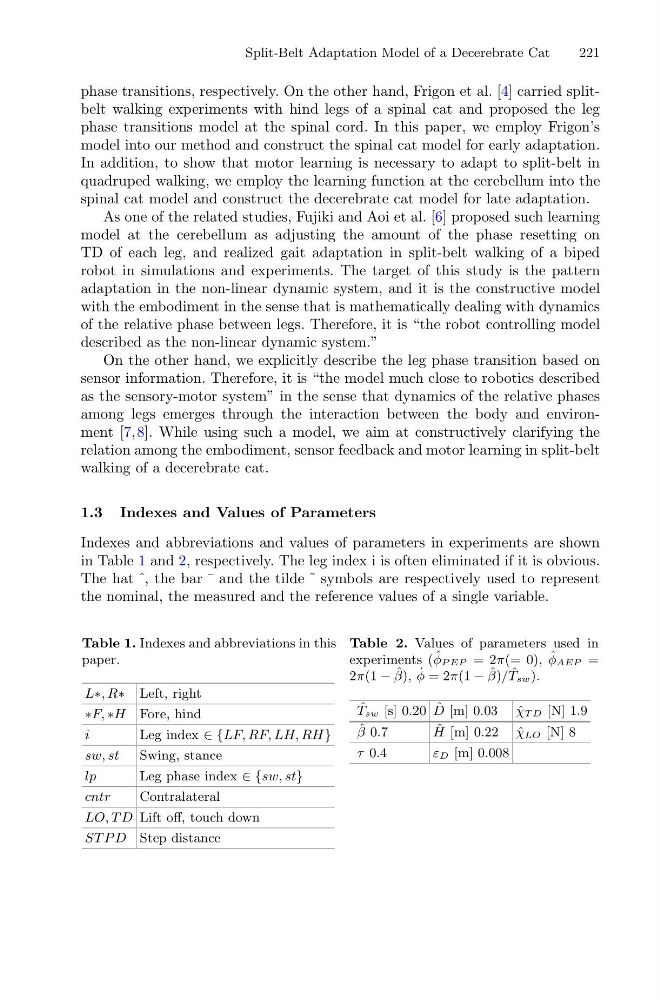
Indexes and abbreviations and values of parameters in experiments are shown
in Table 1 and 2, respectively. The leg index i is often eliminated if it is obvious.
The hat ˆ, the bar ¯ and the tilde ˜ symbols are respectively used to represent
the nominal, the measured and the reference values of a single variable.
Table 1. Indexes and abbreviations in this
paper.
L∗, R∗ Left, right
∗F, ∗H Fore, hind
i
Leg index ∈ {LF, RF, LH, RH}
sw, st
Swing, stance
lp
Leg phase index ∈ {sw, st}
cntr
Contralateral
LO, T D Lift off, touch down
ST P D Step distance
Table 2. Values of parameters used in
experiments ( ˆ
φPEP = 2π(= 0), ˆ
φAEP =
2π(1 − ˆ
β), ˙
φ = 2π(1 − ˆ
β)/ ˆ
Tsw).
ˆ
Tsw [s] 0.20 ˆ
D [m] 0.03 ˆ
χTD [N] 1.9
ˆ
β 0.7
ˆ
H [m] 0.22 ˆ
χLO [N] 8
τ 0.4
εD [m] 0.008
221
phase transitions, respectively. On the other hand, Frigon et al. [4] carried splitbelt walking experiments with hind legs of a spinal cat and proposed the leg
phase transitions model at the spinal cord. In this paper, we employ Frigon’s
model into our method and construct the spinal cat model for early adaptation.
In addition, to show that motor learning is necessary to adapt to split-belt in
quadruped walking, we employ the learning function at the cerebellum into the
spinal cat model and construct the decerebrate cat model for late adaptation.
As one of the related studies, Fujiki and Aoi et al. [6] proposed such learning
model at the cerebellum as adjusting the amount of the phase resetting on
TD of each leg, and realized gait adaptation in split-belt walking of a biped
robot in simulations and experiments. The target of this study is the pattern
adaptation in the non-linear dynamic system, and it is the constructive model
with the embodiment in the sense that is mathematically dealing with dynamics
of the relative phase between legs. Therefore, it is “the robot controlling model
described as the non-linear dynamic system.”
On the other hand, we explicitly describe the leg phase transition based on
sensor information. Therefore, it is “the model much close to robotics described
as the sensory-motor system” in the sense that dynamics of the relative phases
among legs emerges through the interaction between the body and environment [7,8]. While using such a model, we aim at constructively clarifying the
relation among the embodiment, sensor feedback and motor learning in split-belt
walking of a decerebrate cat.
1.3 Indexes and Values of Parameters
Indexes and abbreviations and values of parameters in experiments are shown
in Table 1 and 2, respectively. The leg index i is often eliminated if it is obvious.
The hat ˆ, the bar ¯ and the tilde ˜ symbols are respectively used to represent
the nominal, the measured and the reference values of a single variable.
Table 1. Indexes and abbreviations in this
paper.
L∗, R∗ Left, right
∗F, ∗H Fore, hind
i
Leg index ∈ {LF, RF, LH, RH}
sw, st
Swing, stance
lp
Leg phase index ∈ {sw, st}
cntr
Contralateral
LO, T D Lift off, touch down
ST P D Step distance
Table 2. Values of parameters used in
experiments ( ˆ
φPEP = 2π(= 0), ˆ
φAEP =
2π(1 − ˆ
β), ˙
φ = 2π(1 − ˆ
β)/ ˆ
Tsw).
ˆ
Tsw [s] 0.20 ˆ
D [m] 0.03 ˆ
χTD [N] 1.9
ˆ
β 0.7
ˆ
H [m] 0.22 ˆ
χLO [N] 8
τ 0.4
εD [m] 0.008