

Improving Recall in an Associative Neural Network Model of the Hippocampus
7
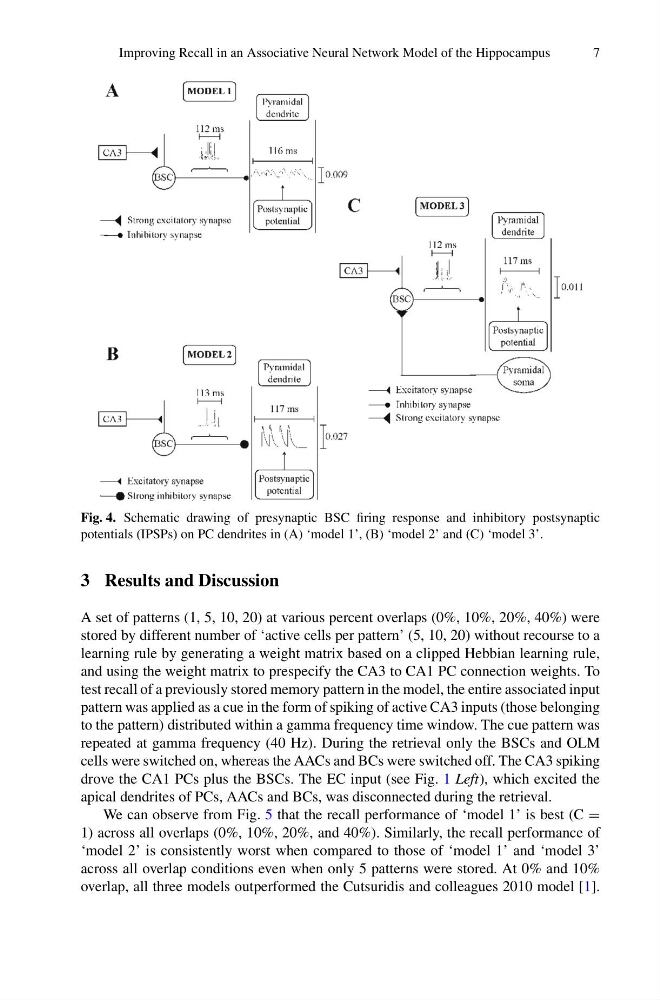
Fig. 4. Schematic drawing of presynaptic BSC firing response and inhibitory postsynaptic
potentials (IPSPs) on PC dendrites in (A) ‘model 1’, (B) ‘model 2’ and (C) ‘model 3’.
3 Results and Discussion
A set of patterns (1, 5, 10, 20) at various percent overlaps (0%, 10%, 20%, 40%) were
stored by different number of ‘active cells per pattern’ (5, 10, 20) without recourse to a
learning rule by generating a weight matrix based on a clipped Hebbian learning rule,
and using the weight matrix to prespecify the CA3 to CA1 PC connection weights. To
test recall of a previously stored memory pattern in the model, the entire associated input
pattern was applied as a cue in the form of spiking of active CA3 inputs (those belonging
to the pattern) distributed within a gamma frequency time window. The cue pattern was
repeated at gamma frequency (40 Hz). During the retrieval only the BSCs and OLM
cells were switched on, whereas the AACs and BCs were switched off. The CA3 spiking
drove the CA1 PCs plus the BSCs. The EC input (see Fig. 1 Left), which excited the
apical dendrites of PCs, AACs and BCs, was disconnected during the retrieval.
We can observe from Fig. 5 that the recall performance of ‘model 1’ is best (C =
1) across all overlaps (0%, 10%, 20%, and 40%). Similarly, the recall performance of
‘model 2’ is consistently worst when compared to those of ‘model 1’ and ‘model 3’
across all overlap conditions even when only 5 patterns were stored. At 0% and 10%
overlap, all three models outperformed the Cutsuridis and colleagues 2010 model [1].
7
Fig. 4. Schematic drawing of presynaptic BSC firing response and inhibitory postsynaptic
potentials (IPSPs) on PC dendrites in (A) ‘model 1’, (B) ‘model 2’ and (C) ‘model 3’.
3 Results and Discussion
A set of patterns (1, 5, 10, 20) at various percent overlaps (0%, 10%, 20%, 40%) were
stored by different number of ‘active cells per pattern’ (5, 10, 20) without recourse to a
learning rule by generating a weight matrix based on a clipped Hebbian learning rule,
and using the weight matrix to prespecify the CA3 to CA1 PC connection weights. To
test recall of a previously stored memory pattern in the model, the entire associated input
pattern was applied as a cue in the form of spiking of active CA3 inputs (those belonging
to the pattern) distributed within a gamma frequency time window. The cue pattern was
repeated at gamma frequency (40 Hz). During the retrieval only the BSCs and OLM
cells were switched on, whereas the AACs and BCs were switched off. The CA3 spiking
drove the CA1 PCs plus the BSCs. The EC input (see Fig. 1 Left), which excited the
apical dendrites of PCs, AACs and BCs, was disconnected during the retrieval.
We can observe from Fig. 5 that the recall performance of ‘model 1’ is best (C =
1) across all overlaps (0%, 10%, 20%, and 40%). Similarly, the recall performance of
‘model 2’ is consistently worst when compared to those of ‘model 1’ and ‘model 3’
across all overlap conditions even when only 5 patterns were stored. At 0% and 10%
overlap, all three models outperformed the Cutsuridis and colleagues 2010 model [1].