

196
A. Jimenez-Rodriguez et al.
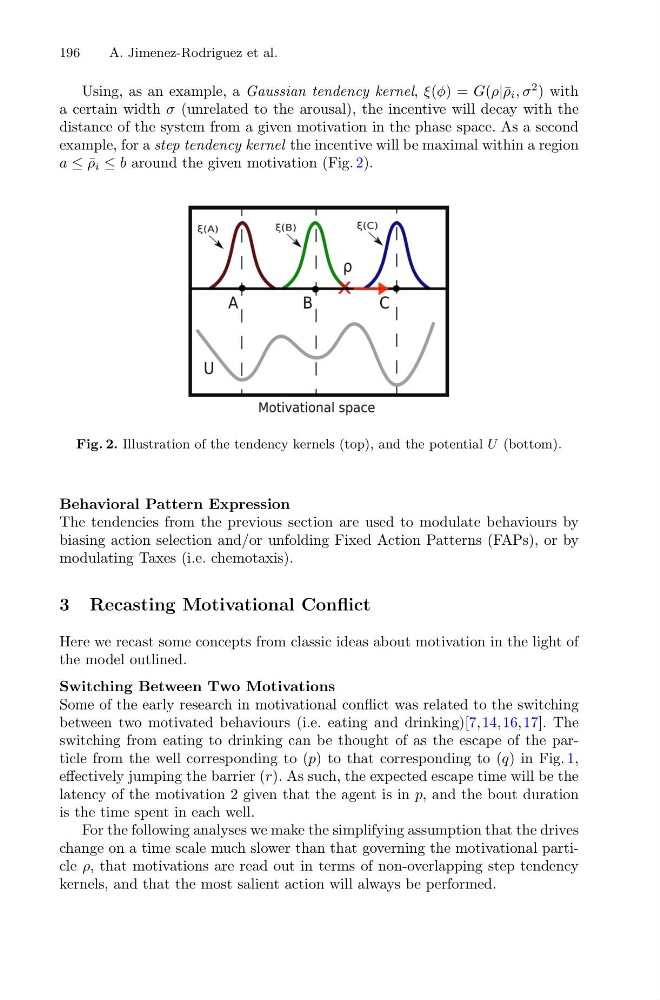
Using, as an example, a Gaussian tendency kernel, ξ(φ) = G(ρ|¯ ρ i , σ
2 ) with
a certain width σ (unrelated to the arousal), the incentive will decay with the
distance of the system from a given motivation in the phase space. As a second
example, for a step tendency kernel the incentive will be maximal within a region
a ≤ ¯
ρ i ≤ b around the given motivation (Fig. 2).
Fig. 2. Illustration of the tendency kernels (top), and the potential U (bottom).
Behavioral Pattern Expression
The tendencies from the previous section are used to modulate behaviours by
biasing action selection and/or unfolding Fixed Action Patterns (FAPs), or by
modulating Taxes (i.e. chemotaxis).
3 Recasting Motivational Conflict
Here we recast some concepts from classic ideas about motivation in the light of
the model outlined.
Switching Between Two Motivations
Some of the early research in motivational conflict was related to the switching
between two motivated behaviours (i.e. eating and drinking)[7,14,16,17]. The
switching from eating to drinking can be thought of as the escape of the particle from the well corresponding to (p) to that corresponding to (q) in Fig. 1,
effectively jumping the barrier (r). As such, the expected escape time will be the
latency of the motivation 2 given that the agent is in p, and the bout duration
is the time spent in each well.
For the following analyses we make the simplifying assumption that the drives
change on a time scale much slower than that governing the motivational particle ρ, that motivations are read out in terms of non-overlapping step tendency
kernels, and that the most salient action will always be performed.
A. Jimenez-Rodriguez et al.
Using, as an example, a Gaussian tendency kernel, ξ(φ) = G(ρ|¯ ρ i , σ
2 ) with
a certain width σ (unrelated to the arousal), the incentive will decay with the
distance of the system from a given motivation in the phase space. As a second
example, for a step tendency kernel the incentive will be maximal within a region
a ≤ ¯
ρ i ≤ b around the given motivation (Fig. 2).
Fig. 2. Illustration of the tendency kernels (top), and the potential U (bottom).
Behavioral Pattern Expression
The tendencies from the previous section are used to modulate behaviours by
biasing action selection and/or unfolding Fixed Action Patterns (FAPs), or by
modulating Taxes (i.e. chemotaxis).
3 Recasting Motivational Conflict
Here we recast some concepts from classic ideas about motivation in the light of
the model outlined.
Switching Between Two Motivations
Some of the early research in motivational conflict was related to the switching
between two motivated behaviours (i.e. eating and drinking)[7,14,16,17]. The
switching from eating to drinking can be thought of as the escape of the particle from the well corresponding to (p) to that corresponding to (q) in Fig. 1,
effectively jumping the barrier (r). As such, the expected escape time will be the
latency of the motivation 2 given that the agent is in p, and the bout duration
is the time spent in each well.
For the following analyses we make the simplifying assumption that the drives
change on a time scale much slower than that governing the motivational particle ρ, that motivations are read out in terms of non-overlapping step tendency
kernels, and that the most salient action will always be performed.