

From Models of Cognition to Robot Control and Back Using SNNs
185
3.2 Hardware
To allow for 3D movement, the arm needs at least two different rotational axes.
Furthermore, REACH outputs joint torque values, so ideally, the arm should be
controllable through torque commands. Lastly, to compute these torque commands, REACH necessitates the current joint angles and angular velocities. It
should at least be possible to read out the joint angles from the arm. Preferably,
angular velocities should be directly readable as well, although these can also be
estimated within the model implementation.
We make use of Universal Robot’s UR5e, which satisfies most requirements,
except for torque control. Instead, the joints can be moved to a specified position,
or with a specified angular velocity. Torque control can be approximated by
continuously estimating the goal joint angles that would result from the torque
command.
3.3 Experiment Design
So far, we have covered the process of transforming 2D simulated REACH into
a real 3-joint robot arm controller moving in 3D. From directly observing the
behaviour, the arm controller appears to work in a similar fashion to REACH,
and succeeds in reaching the given targets. In this subsection we describe what
experiments where used to compare the extension of REACH to the original
version. In the next section, we discuss the results to these experiments.
To compare our REACH implementation with the results of DeWolf et al.
[10], we use an adapted version of the experiment setup that was used in their
paper, namely, the 8-reach task. In this task, the robot arm reaches for eight
targets, evenly spaced on a circle. After each target, the arm moves back to
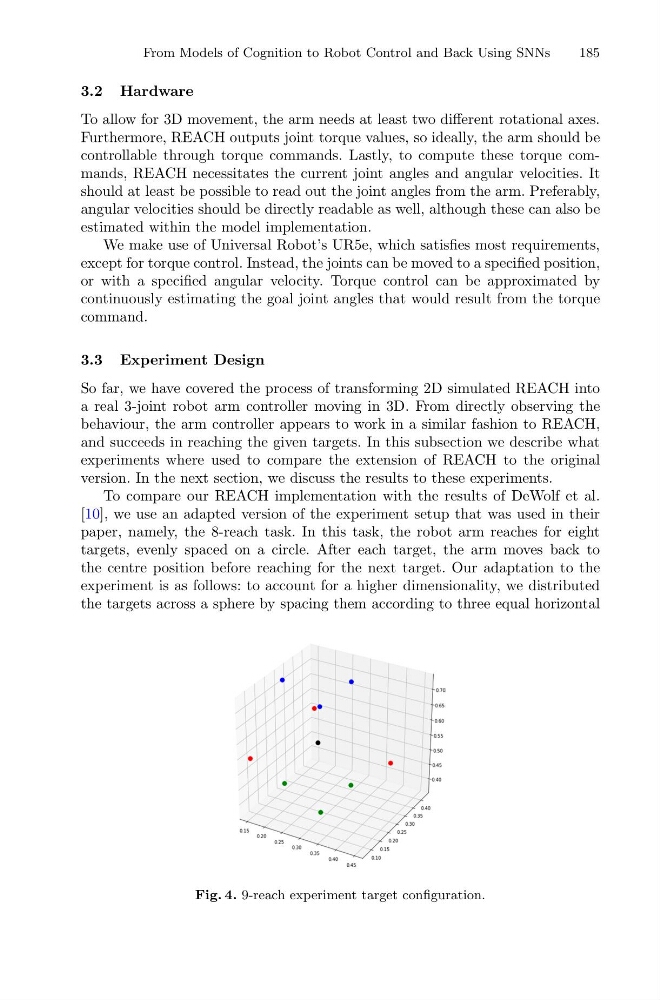
the centre position before reaching for the next target. Our adaptation to the
experiment is as follows: to account for a higher dimensionality, we distributed
the targets across a sphere by spacing them according to three equal horizontal
Fig. 4. 9-reach experiment target configuration.
185
3.2 Hardware
To allow for 3D movement, the arm needs at least two different rotational axes.
Furthermore, REACH outputs joint torque values, so ideally, the arm should be
controllable through torque commands. Lastly, to compute these torque commands, REACH necessitates the current joint angles and angular velocities. It
should at least be possible to read out the joint angles from the arm. Preferably,
angular velocities should be directly readable as well, although these can also be
estimated within the model implementation.
We make use of Universal Robot’s UR5e, which satisfies most requirements,
except for torque control. Instead, the joints can be moved to a specified position,
or with a specified angular velocity. Torque control can be approximated by
continuously estimating the goal joint angles that would result from the torque
command.
3.3 Experiment Design
So far, we have covered the process of transforming 2D simulated REACH into
a real 3-joint robot arm controller moving in 3D. From directly observing the
behaviour, the arm controller appears to work in a similar fashion to REACH,
and succeeds in reaching the given targets. In this subsection we describe what
experiments where used to compare the extension of REACH to the original
version. In the next section, we discuss the results to these experiments.
To compare our REACH implementation with the results of DeWolf et al.
[10], we use an adapted version of the experiment setup that was used in their
paper, namely, the 8-reach task. In this task, the robot arm reaches for eight
targets, evenly spaced on a circle. After each target, the arm moves back to
the centre position before reaching for the next target. Our adaptation to the
experiment is as follows: to account for a higher dimensionality, we distributed
the targets across a sphere by spacing them according to three equal horizontal
Fig. 4. 9-reach experiment target configuration.