

182
S. Iacob et al.
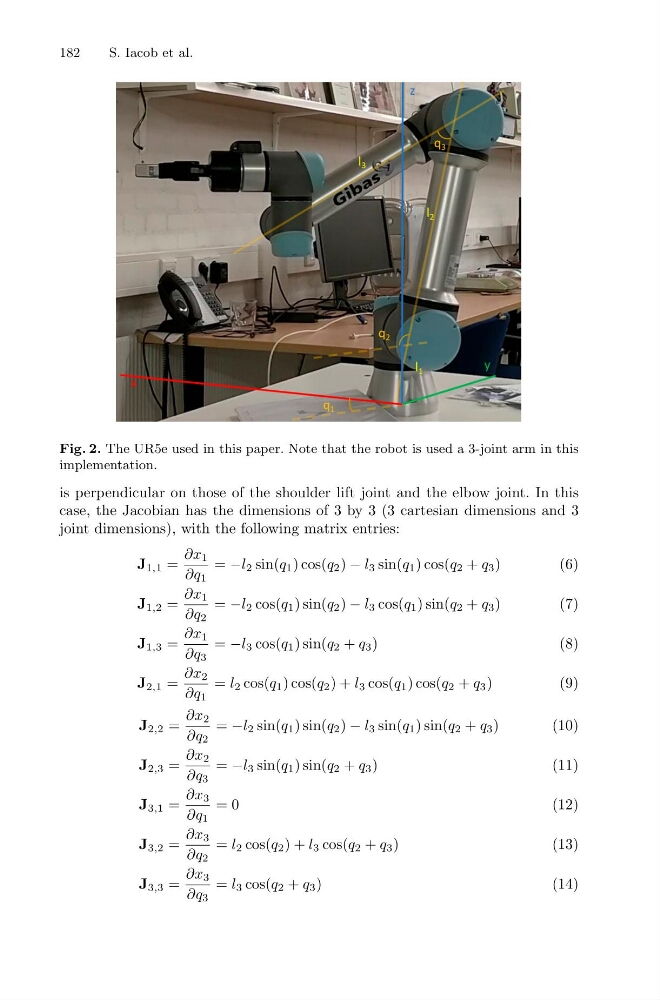
Fig. 2. The UR5e used in this paper. Note that the robot is used a 3-joint arm in this
implementation.
is perpendicular on those of the shoulder lift joint and the elbow joint. In this
case, the Jacobian has the dimensions of 3 by 3 (3 cartesian dimensions and 3
joint dimensions), with the following matrix entries:
J 1,1 =
∂x 1
∂q 1
= −l 2 sin(q 1 ) cos(q 2 ) − l 3 sin(q 1 ) cos(q 2 + q 3 )
(6)
J 1,2 =
∂x 1
∂q 2
= −l 2 cos(q 1 ) sin(q 2 ) − l 3 cos(q 1 ) sin(q 2 + q 3 )
(7)
J 1,3 =
∂x 1
∂q 3
= −l 3 cos(q 1 ) sin(q 2 + q 3 )
(8)
J 2,1 =
∂x 2
∂q 1
= l 2 cos(q 1 ) cos(q 2 ) + l 3 cos(q 1 ) cos(q 2 + q 3 )
(9)
J 2,2 =
∂x 2
∂q 2
= −l 2 sin(q 1 ) sin(q 2 ) − l 3 sin(q 1 ) sin(q 2 + q 3 )
(10)
J 2,3 =
∂x 2
∂q 3
= −l 3 sin(q 1 ) sin(q 2 + q 3 )
(11)
J 3,1 =
∂x 3
∂q 1
= 0
(12)
J 3,2 =
∂x 3
∂q 2
= l 2 cos(q 2 ) + l 3 cos(q 2 + q 3 )
(13)
J 3,3 =
∂x 3
∂q 3
= l 3 cos(q 2 + q 3 )
(14)
S. Iacob et al.
Fig. 2. The UR5e used in this paper. Note that the robot is used a 3-joint arm in this
implementation.
is perpendicular on those of the shoulder lift joint and the elbow joint. In this
case, the Jacobian has the dimensions of 3 by 3 (3 cartesian dimensions and 3
joint dimensions), with the following matrix entries:
J 1,1 =
∂x 1
∂q 1
= −l 2 sin(q 1 ) cos(q 2 ) − l 3 sin(q 1 ) cos(q 2 + q 3 )
(6)
J 1,2 =
∂x 1
∂q 2
= −l 2 cos(q 1 ) sin(q 2 ) − l 3 cos(q 1 ) sin(q 2 + q 3 )
(7)
J 1,3 =
∂x 1
∂q 3
= −l 3 cos(q 1 ) sin(q 2 + q 3 )
(8)
J 2,1 =
∂x 2
∂q 1
= l 2 cos(q 1 ) cos(q 2 ) + l 3 cos(q 1 ) cos(q 2 + q 3 )
(9)
J 2,2 =
∂x 2
∂q 2
= −l 2 sin(q 1 ) sin(q 2 ) − l 3 sin(q 1 ) sin(q 2 + q 3 )
(10)
J 2,3 =
∂x 2
∂q 3
= −l 3 sin(q 1 ) sin(q 2 + q 3 )
(11)
J 3,1 =
∂x 3
∂q 1
= 0
(12)
J 3,2 =
∂x 3
∂q 2
= l 2 cos(q 2 ) + l 3 cos(q 2 + q 3 )
(13)
J 3,3 =
∂x 3
∂q 3
= l 3 cos(q 2 + q 3 )
(14)