

174
J. Herault et al.
x
-0.3
-0.2
-0.1
0
0.1
0.2
0.3
-0.7
-0.6
-0.5
-0.4
-0.3
-0.2
-0.1
0
0.1
0.2
0.2
0.1
0
-0.1
-0.2
-0.3
y
-0.4
-0.5
-0.6
-0.7
0.5
0
x
-0.05
0
0.05
0.1
0.15
-0.5
z
0.4
0.2
0
x
-0.2
-0.4
-0.7
-0.6
-0.5
-0.4
y
-0.3
-0.2
-0.1
0
0.1
0.2
-0.05
0.05
0.1
0.15
0
z
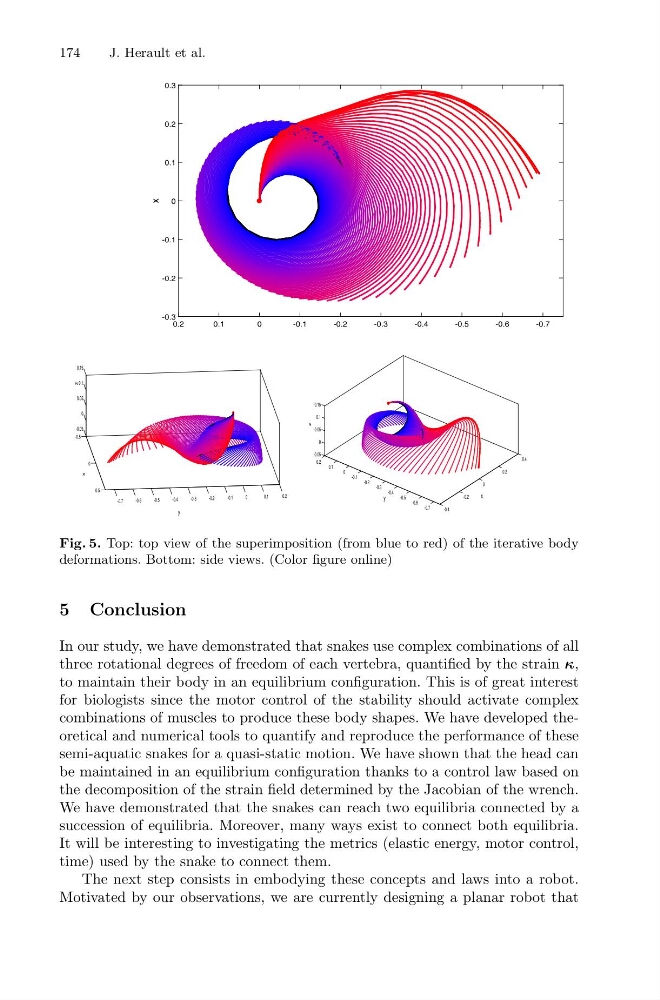
Fig. 5. Top: top view of the superimposition (from blue to red) of the iterative body
deformations. Bottom: side views. (Color figure online)
5 Conclusion
In our study, we have demonstrated that snakes use complex combinations of all
three rotational degrees of freedom of each vertebra, quantified by the strain κ,
to maintain their body in an equilibrium configuration. This is of great interest
for biologists since the motor control of the stability should activate complex
combinations of muscles to produce these body shapes. We have developed theoretical and numerical tools to quantify and reproduce the performance of these
semi-aquatic snakes for a quasi-static motion. We have shown that the head can
be maintained in an equilibrium configuration thanks to a control law based on
the decomposition of the strain field determined by the Jacobian of the wrench.
We have demonstrated that the snakes can reach two equilibria connected by a
succession of equilibria. Moreover, many ways exist to connect both equilibria.
It will be interesting to investigating the metrics (elastic energy, motor control,
time) used by the snake to connect them.
The next step consists in embodying these concepts and laws into a robot.
Motivated by our observations, we are currently designing a planar robot that
J. Herault et al.
x
-0.3
-0.2
-0.1
0
0.1
0.2
0.3
-0.7
-0.6
-0.5
-0.4
-0.3
-0.2
-0.1
0
0.1
0.2
0.2
0.1
0
-0.1
-0.2
-0.3
y
-0.4
-0.5
-0.6
-0.7
0.5
0
x
-0.05
0
0.05
0.1
0.15
-0.5
z
0.4
0.2
0
x
-0.2
-0.4
-0.7
-0.6
-0.5
-0.4
y
-0.3
-0.2
-0.1
0
0.1
0.2
-0.05
0.05
0.1
0.15
0
z
Fig. 5. Top: top view of the superimposition (from blue to red) of the iterative body
deformations. Bottom: side views. (Color figure online)
5 Conclusion
In our study, we have demonstrated that snakes use complex combinations of all
three rotational degrees of freedom of each vertebra, quantified by the strain κ,
to maintain their body in an equilibrium configuration. This is of great interest
for biologists since the motor control of the stability should activate complex
combinations of muscles to produce these body shapes. We have developed theoretical and numerical tools to quantify and reproduce the performance of these
semi-aquatic snakes for a quasi-static motion. We have shown that the head can
be maintained in an equilibrium configuration thanks to a control law based on
the decomposition of the strain field determined by the Jacobian of the wrench.
We have demonstrated that the snakes can reach two equilibria connected by a
succession of equilibria. Moreover, many ways exist to connect both equilibria.
It will be interesting to investigating the metrics (elastic energy, motor control,
time) used by the snake to connect them.
The next step consists in embodying these concepts and laws into a robot.
Motivated by our observations, we are currently designing a planar robot that