

Standing on the Water: Stability Mechanisms of Snakes on Free Surface
175
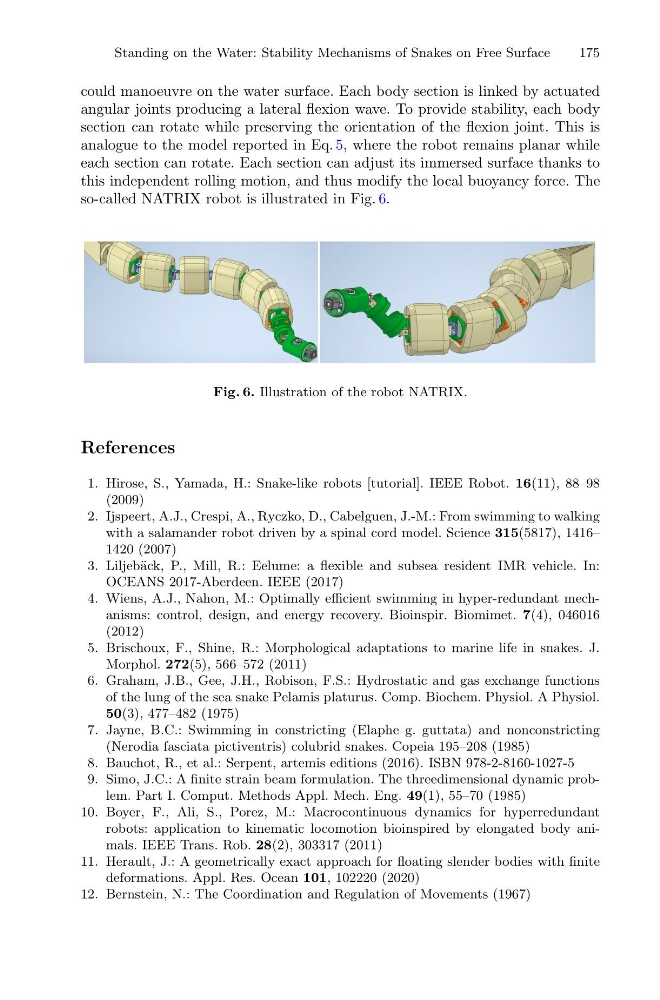
could manoeuvre on the water surface. Each body section is linked by actuated
angular joints producing a lateral flexion wave. To provide stability, each body
section can rotate while preserving the orientation of the flexion joint. This is
analogue to the model reported in Eq. 5, where the robot remains planar while
each section can rotate. Each section can adjust its immersed surface thanks to
this independent rolling motion, and thus modify the local buoyancy force. The
so-called NATRIX robot is illustrated in Fig. 6.
Fig. 6. Illustration of the robot NATRIX.
References
1. Hirose, S., Yamada, H.: Snake-like robots [tutorial]. IEEE Robot. 16(11), 88–98
(2009)
2. Ijspeert, A.J., Crespi, A., Ryczko, D., Cabelguen, J.-M.: From swimming to walking
with a salamander robot driven by a spinal cord model. Science 315(5817), 1416–
1420 (2007)
3. Liljeb¨ ack, P., Mill, R.: Eelume: a flexible and subsea resident IMR vehicle. In:
OCEANS 2017-Aberdeen. IEEE (2017)
4. Wiens, A.J., Nahon, M.: Optimally efficient swimming in hyper-redundant mechanisms: control, design, and energy recovery. Bioinspir. Biomimet. 7(4), 046016
(2012)
5. Brischoux, F., Shine, R.: Morphological adaptations to marine life in snakes. J.
Morphol. 272(5), 566–572 (2011)
6. Graham, J.B., Gee, J.H., Robison, F.S.: Hydrostatic and gas exchange functions
of the lung of the sea snake Pelamis platurus. Comp. Biochem. Physiol. A Physiol.
50(3), 477–482 (1975)
7. Jayne, B.C.: Swimming in constricting (Elaphe g. guttata) and nonconstricting
(Nerodia fasciata pictiventris) colubrid snakes. Copeia 195–208 (1985)
8. Bauchot, R., et al.: Serpent, artemis editions (2016). ISBN 978-2-8160-1027-5
9. Simo, J.C.: A finite strain beam formulation. The threedimensional dynamic problem. Part I. Comput. Methods Appl. Mech. Eng. 49(1), 55–70 (1985)
10. Boyer, F., Ali, S., Porez, M.: Macrocontinuous dynamics for hyperredundant
robots: application to kinematic locomotion bioinspired by elongated body animals. IEEE Trans. Rob. 28(2), 303317 (2011)
11. Herault, J.: A geometrically exact approach for floating slender bodies with finite
deformations. Appl. Res. Ocean 101, 102220 (2020)
12. Bernstein, N.: The Coordination and Regulation of Movements (1967)
175
could manoeuvre on the water surface. Each body section is linked by actuated
angular joints producing a lateral flexion wave. To provide stability, each body
section can rotate while preserving the orientation of the flexion joint. This is
analogue to the model reported in Eq. 5, where the robot remains planar while
each section can rotate. Each section can adjust its immersed surface thanks to
this independent rolling motion, and thus modify the local buoyancy force. The
so-called NATRIX robot is illustrated in Fig. 6.
Fig. 6. Illustration of the robot NATRIX.
References
1. Hirose, S., Yamada, H.: Snake-like robots [tutorial]. IEEE Robot. 16(11), 88–98
(2009)
2. Ijspeert, A.J., Crespi, A., Ryczko, D., Cabelguen, J.-M.: From swimming to walking
with a salamander robot driven by a spinal cord model. Science 315(5817), 1416–
1420 (2007)
3. Liljeb¨ ack, P., Mill, R.: Eelume: a flexible and subsea resident IMR vehicle. In:
OCEANS 2017-Aberdeen. IEEE (2017)
4. Wiens, A.J., Nahon, M.: Optimally efficient swimming in hyper-redundant mechanisms: control, design, and energy recovery. Bioinspir. Biomimet. 7(4), 046016
(2012)
5. Brischoux, F., Shine, R.: Morphological adaptations to marine life in snakes. J.
Morphol. 272(5), 566–572 (2011)
6. Graham, J.B., Gee, J.H., Robison, F.S.: Hydrostatic and gas exchange functions
of the lung of the sea snake Pelamis platurus. Comp. Biochem. Physiol. A Physiol.
50(3), 477–482 (1975)
7. Jayne, B.C.: Swimming in constricting (Elaphe g. guttata) and nonconstricting
(Nerodia fasciata pictiventris) colubrid snakes. Copeia 195–208 (1985)
8. Bauchot, R., et al.: Serpent, artemis editions (2016). ISBN 978-2-8160-1027-5
9. Simo, J.C.: A finite strain beam formulation. The threedimensional dynamic problem. Part I. Comput. Methods Appl. Mech. Eng. 49(1), 55–70 (1985)
10. Boyer, F., Ali, S., Porez, M.: Macrocontinuous dynamics for hyperredundant
robots: application to kinematic locomotion bioinspired by elongated body animals. IEEE Trans. Rob. 28(2), 303317 (2011)
11. Herault, J.: A geometrically exact approach for floating slender bodies with finite
deformations. Appl. Res. Ocean 101, 102220 (2020)
12. Bernstein, N.: The Coordination and Regulation of Movements (1967)