

Standing on the Water: Stability Mechanisms of Snakes on Free Surface
173
cancel for each strain increment δ ˜
κ. However, Eq. 6 is a linear approximation
of the wrench, and the equilibrium is only satisfied at order |δκ|. Any deformation δ ˜
κ produces a residual wrench (even small) that must be corrected to
avoid a departure from the equilibrium. Hence, we use the component (δ ˜
κ) ⊥
to compensate the residual wrench in order to cancel out the net wrench. The
ratio |δκ ⊥ |/|δκ | is typically of order 10
−4 so that the body shape variation is
essentially controlled by the component δκ . The second right-hand side term
in Eq. 7 is thus used as a corrector.
Illustration. To illustrate this process, we will uncoil a slender body mimicking
a snake. The process consists in decreasing progressively the torsion κ 1 and the
bending κ 3 while remaining stable at each time step, to satisfy the equilibrium
point hypothesis. At each step, the spectral strain variation ˜
κ i at the iteration “i”
is proportional to the current strain ˜
κ i so that δ ˜
κ i (s) = −˜ κ i with = 2× 10
−3 .
The density of the body is fixed to d = 0.25 (much lighter than a snake) for a
body of unitary length and radius a = 0.04L. This geometry corresponds to a
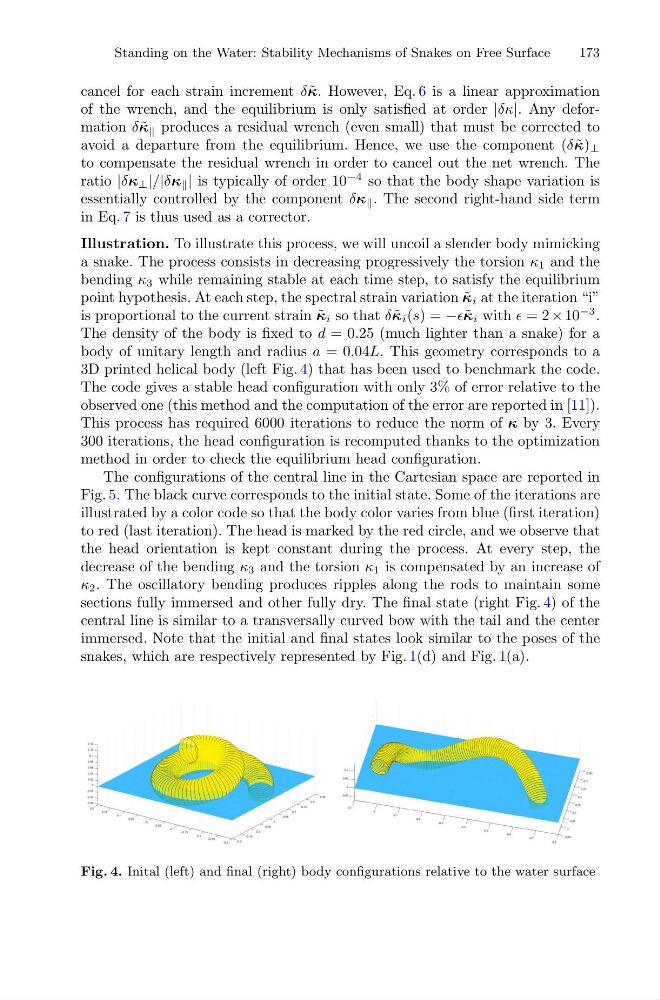
3D printed helical body (left Fig. 4) that has been used to benchmark the code.
The code gives a stable head configuration with only 3% of error relative to the
observed one (this method and the computation of the error are reported in [11]).
This process has required 6000 iterations to reduce the norm of κ by 3. Every
300 iterations, the head configuration is recomputed thanks to the optimization
method in order to check the equilibrium head configuration.
The configurations of the central line in the Cartesian space are reported in
Fig. 5. The black curve corresponds to the initial state. Some of the iterations are
illustrated by a color code so that the body color varies from blue (first iteration)
to red (last iteration). The head is marked by the red circle, and we observe that
the head orientation is kept constant during the process. At every step, the
decrease of the bending κ 3 and the torsion κ 1 is compensated by an increase of
κ 2 . The oscillatory bending produces ripples along the rods to maintain some
sections fully immersed and other fully dry. The final state (right Fig. 4) of the
central line is similar to a transversally curved bow with the tail and the center
immersed. Note that the initial and final states look similar to the poses of the
snakes, which are respectively represented by Fig. 1(d) and Fig. 1(a).
Fig. 4. Inital (left) and final (right) body configurations relative to the water surface
173
cancel for each strain increment δ ˜
κ. However, Eq. 6 is a linear approximation
of the wrench, and the equilibrium is only satisfied at order |δκ|. Any deformation δ ˜
κ produces a residual wrench (even small) that must be corrected to
avoid a departure from the equilibrium. Hence, we use the component (δ ˜
κ) ⊥
to compensate the residual wrench in order to cancel out the net wrench. The
ratio |δκ ⊥ |/|δκ | is typically of order 10
−4 so that the body shape variation is
essentially controlled by the component δκ . The second right-hand side term
in Eq. 7 is thus used as a corrector.
Illustration. To illustrate this process, we will uncoil a slender body mimicking
a snake. The process consists in decreasing progressively the torsion κ 1 and the
bending κ 3 while remaining stable at each time step, to satisfy the equilibrium
point hypothesis. At each step, the spectral strain variation ˜
κ i at the iteration “i”
is proportional to the current strain ˜
κ i so that δ ˜
κ i (s) = −˜ κ i with = 2× 10
−3 .
The density of the body is fixed to d = 0.25 (much lighter than a snake) for a
body of unitary length and radius a = 0.04L. This geometry corresponds to a
3D printed helical body (left Fig. 4) that has been used to benchmark the code.
The code gives a stable head configuration with only 3% of error relative to the
observed one (this method and the computation of the error are reported in [11]).
This process has required 6000 iterations to reduce the norm of κ by 3. Every
300 iterations, the head configuration is recomputed thanks to the optimization
method in order to check the equilibrium head configuration.
The configurations of the central line in the Cartesian space are reported in
Fig. 5. The black curve corresponds to the initial state. Some of the iterations are
illustrated by a color code so that the body color varies from blue (first iteration)
to red (last iteration). The head is marked by the red circle, and we observe that
the head orientation is kept constant during the process. At every step, the
decrease of the bending κ 3 and the torsion κ 1 is compensated by an increase of
κ 2 . The oscillatory bending produces ripples along the rods to maintain some
sections fully immersed and other fully dry. The final state (right Fig. 4) of the
central line is similar to a transversally curved bow with the tail and the center
immersed. Note that the initial and final states look similar to the poses of the
snakes, which are respectively represented by Fig. 1(d) and Fig. 1(a).
Fig. 4. Inital (left) and final (right) body configurations relative to the water surface