

170
J. Herault et al.
with
κ the matrix form of the cross product κ × (·). Therefore, we distinguish
the body shape characterized by the fields (
0 R s ,
0 p s ), which is fully determined
by the strain κ(s), from the head configuration (R 0 , p 0 ), which results from an
equilibrium between buoyancy forces and gravity force.
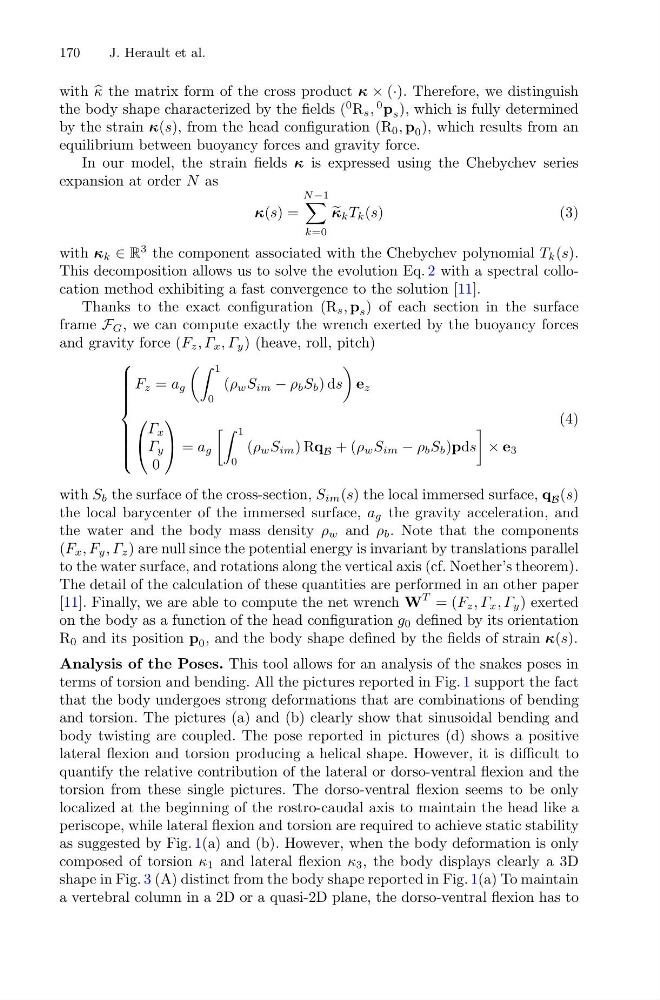
In our model, the strain fields κ is expressed using the Chebychev series
expansion at order N as
κ(s) =
N −1
k=0
κ k T k (s)
(3)
with κ k ∈ R
3 the component associated with the Chebychev polynomial T k (s).
This decomposition allows us to solve the evolution Eq. 2 with a spectral collocation method exhibiting a fast convergence to the solution [11].
Thanks to the exact configuration (R s , p s ) of each section in the surface
frame F G , we can compute exactly the wrench exerted by the buoyancy forces
and gravity force (F z , Γ x , Γ y ) (heave, roll, pitch)
⎧
⎪ ⎪ ⎪ ⎪ ⎪ ⎪ ⎨
⎪ ⎪ ⎪ ⎪ ⎪ ⎪ ⎩
F z = a g
1
0
(ρ w S im − ρ b S b ) ds
e z
⎛
⎝
Γ x
Γ y
0
⎞
⎠ = a g
1
0
(ρ w S im ) Rq B + (ρ w S im − ρ b S b )pds
× e 3
(4)
with S b the surface of the cross-section, S im (s) the local immersed surface, q B (s)
the local barycenter of the immersed surface, a g the gravity acceleration, and
the water and the body mass density ρ w and ρ b . Note that the components
(F x , F y , Γ z ) are null since the potential energy is invariant by translations parallel
to the water surface, and rotations along the vertical axis (cf. Noether’s theorem).
The detail of the calculation of these quantities are performed in an other paper
[11]. Finally, we are able to compute the net wrench W
T = (F z , Γ x , Γ y ) exerted
on the body as a function of the head configuration g 0 defined by its orientation
R 0 and its position p 0 , and the body shape defined by the fields of strain κ(s).
Analysis of the Poses. This tool allows for an analysis of the snakes poses in
terms of torsion and bending. All the pictures reported in Fig. 1 support the fact
that the body undergoes strong deformations that are combinations of bending
and torsion. The pictures (a) and (b) clearly show that sinusoidal bending and
body twisting are coupled. The pose reported in pictures (d) shows a positive
lateral flexion and torsion producing a helical shape. However, it is difficult to
quantify the relative contribution of the lateral or dorso-ventral flexion and the
torsion from these single pictures. The dorso-ventral flexion seems to be only
localized at the beginning of the rostro-caudal axis to maintain the head like a
periscope, while lateral flexion and torsion are required to achieve static stability
as suggested by Fig. 1(a) and (b). However, when the body deformation is only
composed of torsion κ 1 and lateral flexion κ 3 , the body displays clearly a 3D
shape in Fig. 3 (A) distinct from the body shape reported in Fig. 1(a) To maintain
a vertebral column in a 2D or a quasi-2D plane, the dorso-ventral flexion has to
J. Herault et al.
with
κ the matrix form of the cross product κ × (·). Therefore, we distinguish
the body shape characterized by the fields (
0 R s ,
0 p s ), which is fully determined
by the strain κ(s), from the head configuration (R 0 , p 0 ), which results from an
equilibrium between buoyancy forces and gravity force.
In our model, the strain fields κ is expressed using the Chebychev series
expansion at order N as
κ(s) =
N −1
k=0
κ k T k (s)
(3)
with κ k ∈ R
3 the component associated with the Chebychev polynomial T k (s).
This decomposition allows us to solve the evolution Eq. 2 with a spectral collocation method exhibiting a fast convergence to the solution [11].
Thanks to the exact configuration (R s , p s ) of each section in the surface
frame F G , we can compute exactly the wrench exerted by the buoyancy forces
and gravity force (F z , Γ x , Γ y ) (heave, roll, pitch)
⎧
⎪ ⎪ ⎪ ⎪ ⎪ ⎪ ⎨
⎪ ⎪ ⎪ ⎪ ⎪ ⎪ ⎩
F z = a g
1
0
(ρ w S im − ρ b S b ) ds
e z
⎛
⎝
Γ x
Γ y
0
⎞
⎠ = a g
1
0
(ρ w S im ) Rq B + (ρ w S im − ρ b S b )pds
× e 3
(4)
with S b the surface of the cross-section, S im (s) the local immersed surface, q B (s)
the local barycenter of the immersed surface, a g the gravity acceleration, and
the water and the body mass density ρ w and ρ b . Note that the components
(F x , F y , Γ z ) are null since the potential energy is invariant by translations parallel
to the water surface, and rotations along the vertical axis (cf. Noether’s theorem).
The detail of the calculation of these quantities are performed in an other paper
[11]. Finally, we are able to compute the net wrench W
T = (F z , Γ x , Γ y ) exerted
on the body as a function of the head configuration g 0 defined by its orientation
R 0 and its position p 0 , and the body shape defined by the fields of strain κ(s).
Analysis of the Poses. This tool allows for an analysis of the snakes poses in
terms of torsion and bending. All the pictures reported in Fig. 1 support the fact
that the body undergoes strong deformations that are combinations of bending
and torsion. The pictures (a) and (b) clearly show that sinusoidal bending and
body twisting are coupled. The pose reported in pictures (d) shows a positive
lateral flexion and torsion producing a helical shape. However, it is difficult to
quantify the relative contribution of the lateral or dorso-ventral flexion and the
torsion from these single pictures. The dorso-ventral flexion seems to be only
localized at the beginning of the rostro-caudal axis to maintain the head like a
periscope, while lateral flexion and torsion are required to achieve static stability
as suggested by Fig. 1(a) and (b). However, when the body deformation is only
composed of torsion κ 1 and lateral flexion κ 3 , the body displays clearly a 3D
shape in Fig. 3 (A) distinct from the body shape reported in Fig. 1(a) To maintain
a vertebral column in a 2D or a quasi-2D plane, the dorso-ventral flexion has to