

Standing on the Water: Stability Mechanisms of Snakes on Free Surface
171
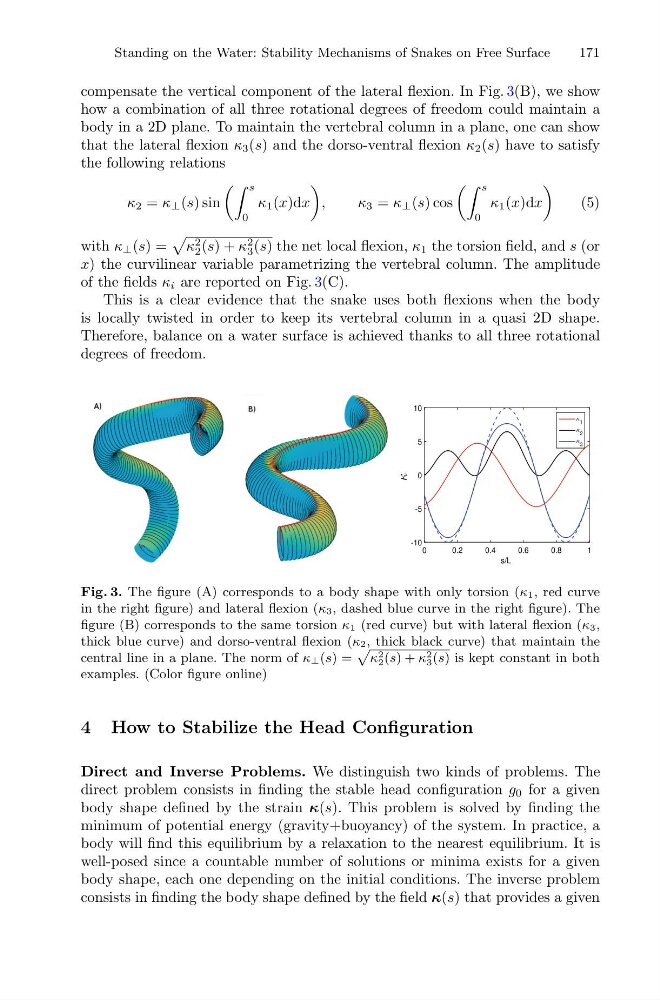
compensate the vertical component of the lateral flexion. In Fig. 3(B), we show
how a combination of all three rotational degrees of freedom could maintain a
body in a 2D plane. To maintain the vertebral column in a plane, one can show
that the lateral flexion κ 3 (s) and the dorso-ventral flexion κ 2 (s) have to satisfy
the following relations
κ 2 = κ ⊥ (s) sin
s
0
κ 1 (x)dx
,
κ 3 = κ ⊥ (s) cos
s
0
κ 1 (x)dx
(5)
with κ ⊥ (s) =
κ 2
2 (s) + κ 2
3 (s) the net local flexion, κ 1 the torsion field, and s (or
x) the curvilinear variable parametrizing the vertebral column. The amplitude
of the fields κ i are reported on Fig. 3(C).
This is a clear evidence that the snake uses both flexions when the body
is locally twisted in order to keep its vertebral column in a quasi 2D shape.
Therefore, balance on a water surface is achieved thanks to all three rotational
degrees of freedom.
Fig. 3. The figure (A) corresponds to a body shape with only torsion (κ1, red curve
in the right figure) and lateral flexion (κ3, dashed blue curve in the right figure). The
figure (B) corresponds to the same torsion κ1 (red curve) but with lateral flexion (κ3,
thick blue curve) and dorso-ventral flexion (κ2, thick black curve) that maintain the
central line in a plane. The norm of κ ⊥ (s) =
κ
2
2 (s) + κ
2
3 (s) is kept constant in both
examples. (Color figure online)
4 How to Stabilize the Head Configuration
Direct and Inverse Problems. We distinguish two kinds of problems. The
direct problem consists in finding the stable head configuration g 0 for a given
body shape defined by the strain κ(s). This problem is solved by finding the
minimum of potential energy (gravity+buoyancy) of the system. In practice, a
body will find this equilibrium by a relaxation to the nearest equilibrium. It is
well-posed since a countable number of solutions or minima exists for a given
body shape, each one depending on the initial conditions. The inverse problem
consists in finding the body shape defined by the field κ(s) that provides a given
171
compensate the vertical component of the lateral flexion. In Fig. 3(B), we show
how a combination of all three rotational degrees of freedom could maintain a
body in a 2D plane. To maintain the vertebral column in a plane, one can show
that the lateral flexion κ 3 (s) and the dorso-ventral flexion κ 2 (s) have to satisfy
the following relations
κ 2 = κ ⊥ (s) sin
s
0
κ 1 (x)dx
,
κ 3 = κ ⊥ (s) cos
s
0
κ 1 (x)dx
(5)
with κ ⊥ (s) =
κ 2
2 (s) + κ 2
3 (s) the net local flexion, κ 1 the torsion field, and s (or
x) the curvilinear variable parametrizing the vertebral column. The amplitude
of the fields κ i are reported on Fig. 3(C).
This is a clear evidence that the snake uses both flexions when the body
is locally twisted in order to keep its vertebral column in a quasi 2D shape.
Therefore, balance on a water surface is achieved thanks to all three rotational
degrees of freedom.
Fig. 3. The figure (A) corresponds to a body shape with only torsion (κ1, red curve
in the right figure) and lateral flexion (κ3, dashed blue curve in the right figure). The
figure (B) corresponds to the same torsion κ1 (red curve) but with lateral flexion (κ3,
thick blue curve) and dorso-ventral flexion (κ2, thick black curve) that maintain the
central line in a plane. The norm of κ ⊥ (s) =
κ
2
2 (s) + κ
2
3 (s) is kept constant in both
examples. (Color figure online)
4 How to Stabilize the Head Configuration
Direct and Inverse Problems. We distinguish two kinds of problems. The
direct problem consists in finding the stable head configuration g 0 for a given
body shape defined by the strain κ(s). This problem is solved by finding the
minimum of potential energy (gravity+buoyancy) of the system. In practice, a
body will find this equilibrium by a relaxation to the nearest equilibrium. It is
well-posed since a countable number of solutions or minima exists for a given
body shape, each one depending on the initial conditions. The inverse problem
consists in finding the body shape defined by the field κ(s) that provides a given