

Standing on the Water: Stability Mechanisms of Snakes on Free Surface
169
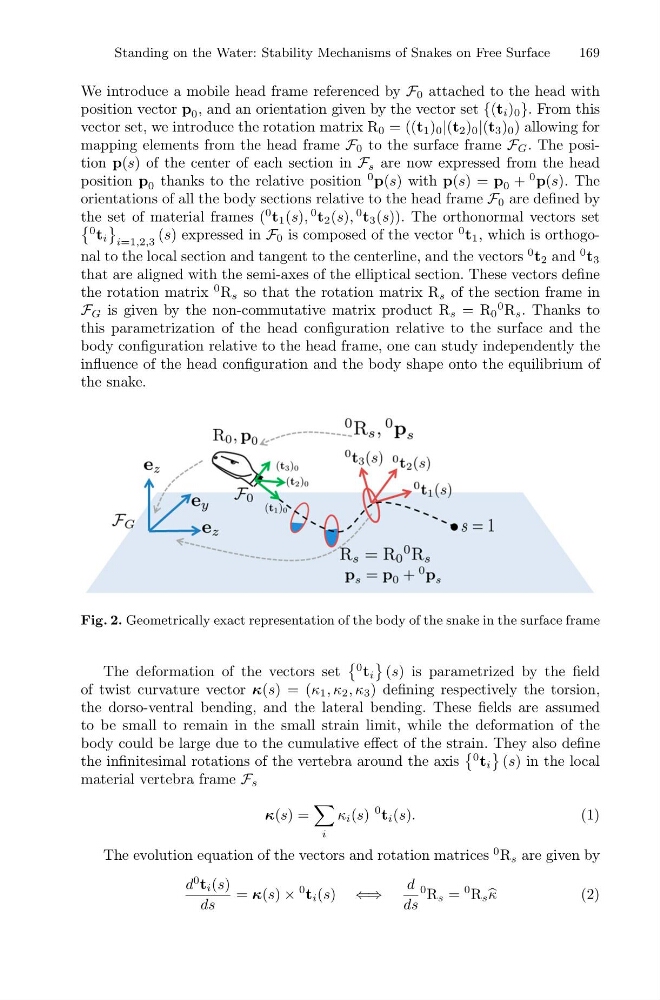
We introduce a mobile head frame referenced by F 0 attached to the head with
position vector p 0 , and an orientation given by the vector set {(t i ) 0 }. From this
vector set, we introduce the rotation matrix R 0 = ((t 1 ) 0 |(t 2 ) 0 |(t 3 ) 0 ) allowing for
mapping elements from the head frame F 0 to the surface frame F G . The position p(s) of the center of each section in F s are now expressed from the head
position p 0 thanks to the relative position
0 p(s) with p(s) = p 0 +
0 p(s). The
orientations of all the body sections relative to the head frame F 0 are defined by
the set of material frames (
0 t 1 (s),
0 t 2 (s),
0 t 3 (s)). The orthonormal vectors set
0 t i
i=1,2,3
(s) expressed in F 0 is composed of the vector
0 t 1 , which is orthogonal to the local section and tangent to the centerline, and the vectors
0 t 2 and
0 t 3
that are aligned with the semi-axes of the elliptical section. These vectors define
the rotation matrix
0 R s so that the rotation matrix R s of the section frame in
F G is given by the non-commutative matrix product R s = R 0
0 R s . Thanks to
this parametrization of the head configuration relative to the surface and the
body configuration relative to the head frame, one can study independently the
influence of the head configuration and the body shape onto the equilibrium of
the snake.
Fig. 2. Geometrically exact representation of the body of the snake in the surface frame
The deformation of the vectors set
0 t i
(s) is parametrized by the field
of twist curvature vector κ(s) = (κ 1 , κ 2 , κ 3 ) defining respectively the torsion,
the dorso-ventral bending, and the lateral bending. These fields are assumed
to be small to remain in the small strain limit, while the deformation of the
body could be large due to the cumulative effect of the strain. They also define
the infinitesimal rotations of the vertebra around the axis
0 t i
(s) in the local
material vertebra frame F s
κ(s) =
i
κ i (s)
0 t i (s).
(1)
The evolution equation of the vectors and rotation matrices
0 R s are given by
d
0 t i (s)
ds
= κ(s) ×
0 t i (s) ⇐⇒
d
ds
0 R s =
0 R s
κ
(2)
169
We introduce a mobile head frame referenced by F 0 attached to the head with
position vector p 0 , and an orientation given by the vector set {(t i ) 0 }. From this
vector set, we introduce the rotation matrix R 0 = ((t 1 ) 0 |(t 2 ) 0 |(t 3 ) 0 ) allowing for
mapping elements from the head frame F 0 to the surface frame F G . The position p(s) of the center of each section in F s are now expressed from the head
position p 0 thanks to the relative position
0 p(s) with p(s) = p 0 +
0 p(s). The
orientations of all the body sections relative to the head frame F 0 are defined by
the set of material frames (
0 t 1 (s),
0 t 2 (s),
0 t 3 (s)). The orthonormal vectors set
0 t i
i=1,2,3
(s) expressed in F 0 is composed of the vector
0 t 1 , which is orthogonal to the local section and tangent to the centerline, and the vectors
0 t 2 and
0 t 3
that are aligned with the semi-axes of the elliptical section. These vectors define
the rotation matrix
0 R s so that the rotation matrix R s of the section frame in
F G is given by the non-commutative matrix product R s = R 0
0 R s . Thanks to
this parametrization of the head configuration relative to the surface and the
body configuration relative to the head frame, one can study independently the
influence of the head configuration and the body shape onto the equilibrium of
the snake.
Fig. 2. Geometrically exact representation of the body of the snake in the surface frame
The deformation of the vectors set
0 t i
(s) is parametrized by the field
of twist curvature vector κ(s) = (κ 1 , κ 2 , κ 3 ) defining respectively the torsion,
the dorso-ventral bending, and the lateral bending. These fields are assumed
to be small to remain in the small strain limit, while the deformation of the
body could be large due to the cumulative effect of the strain. They also define
the infinitesimal rotations of the vertebra around the axis
0 t i
(s) in the local
material vertebra frame F s
κ(s) =
i
κ i (s)
0 t i (s).
(1)
The evolution equation of the vectors and rotation matrices
0 R s are given by
d
0 t i (s)
ds
= κ(s) ×
0 t i (s) ⇐⇒
d
ds
0 R s =
0 R s
κ
(2)