

168
J. Herault et al.
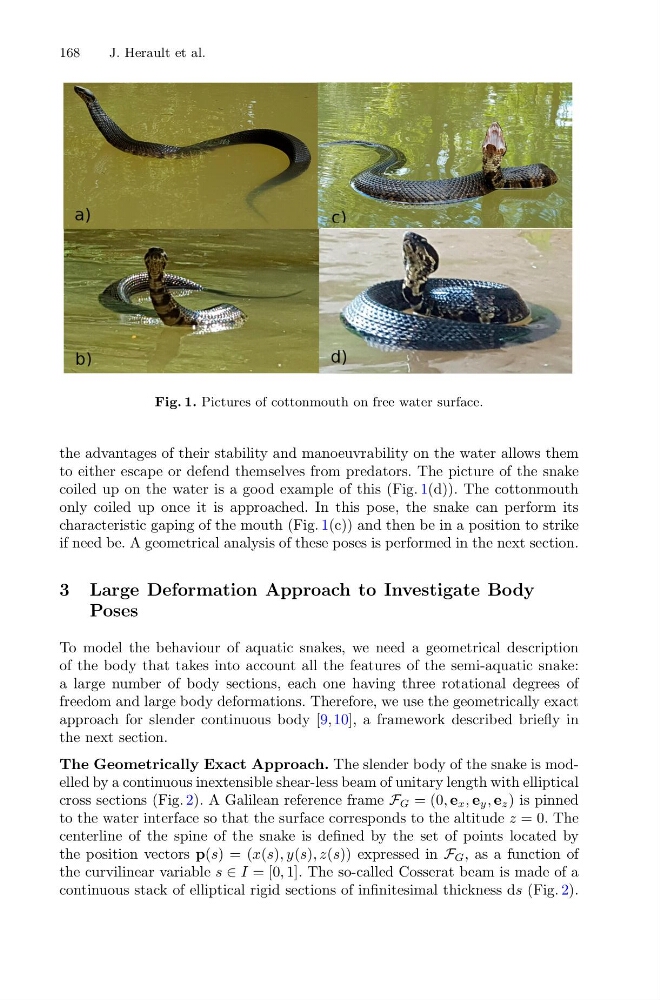
Fig. 1. Pictures of cottonmouth on free water surface.
the advantages of their stability and manoeuvrability on the water allows them
to either escape or defend themselves from predators. The picture of the snake
coiled up on the water is a good example of this (Fig. 1(d)). The cottonmouth
only coiled up once it is approached. In this pose, the snake can perform its
characteristic gaping of the mouth (Fig. 1(c)) and then be in a position to strike
if need be. A geometrical analysis of these poses is performed in the next section.
3 Large Deformation Approach to Investigate Body
Poses
To model the behaviour of aquatic snakes, we need a geometrical description
of the body that takes into account all the features of the semi-aquatic snake:
a large number of body sections, each one having three rotational degrees of
freedom and large body deformations. Therefore, we use the geometrically exact
approach for slender continuous body [9,10], a framework described briefly in
the next section.
The Geometrically Exact Approach. The slender body of the snake is modelled by a continuous inextensible shear-less beam of unitary length with elliptical
cross sections (Fig. 2). A Galilean reference frame F G = (0, e x , e y , e z ) is pinned
to the water interface so that the surface corresponds to the altitude z = 0. The
centerline of the spine of the snake is defined by the set of points located by
the position vectors p(s) = (x(s), y(s), z(s)) expressed in F G , as a function of
the curvilinear variable s ∈ I = [0, 1]. The so-called Cosserat beam is made of a
continuous stack of elliptical rigid sections of infinitesimal thickness ds (Fig. 2).
J. Herault et al.
Fig. 1. Pictures of cottonmouth on free water surface.
the advantages of their stability and manoeuvrability on the water allows them
to either escape or defend themselves from predators. The picture of the snake
coiled up on the water is a good example of this (Fig. 1(d)). The cottonmouth
only coiled up once it is approached. In this pose, the snake can perform its
characteristic gaping of the mouth (Fig. 1(c)) and then be in a position to strike
if need be. A geometrical analysis of these poses is performed in the next section.
3 Large Deformation Approach to Investigate Body
Poses
To model the behaviour of aquatic snakes, we need a geometrical description
of the body that takes into account all the features of the semi-aquatic snake:
a large number of body sections, each one having three rotational degrees of
freedom and large body deformations. Therefore, we use the geometrically exact
approach for slender continuous body [9,10], a framework described briefly in
the next section.
The Geometrically Exact Approach. The slender body of the snake is modelled by a continuous inextensible shear-less beam of unitary length with elliptical
cross sections (Fig. 2). A Galilean reference frame F G = (0, e x , e y , e z ) is pinned
to the water interface so that the surface corresponds to the altitude z = 0. The
centerline of the spine of the snake is defined by the set of points located by
the position vectors p(s) = (x(s), y(s), z(s)) expressed in F G , as a function of
the curvilinear variable s ∈ I = [0, 1]. The so-called Cosserat beam is made of a
continuous stack of elliptical rigid sections of infinitesimal thickness ds (Fig. 2).