

148
C. Goldsmith et al.
0
20
Slow Muscle Fiber
Membrane Voltage
0
= Ext
= Flex
mV
Joint Rotation
Open Loop
Closed Loop
t (s)
40
Hz
200
100
0
SETI Firing Frequency
= Ext
= Flex
0 2 4 6 8 10 0 2 4 6 8 10
t (s)
t (s)
0 2 4 6 8 10
t (s)
0 2 4 6 8 10
1.0
t (s)
0 2 4 6 8 10
t (s)
0 2 4 6 8 10
rad
Normal Case (no inhibition)
fCO
Stretch
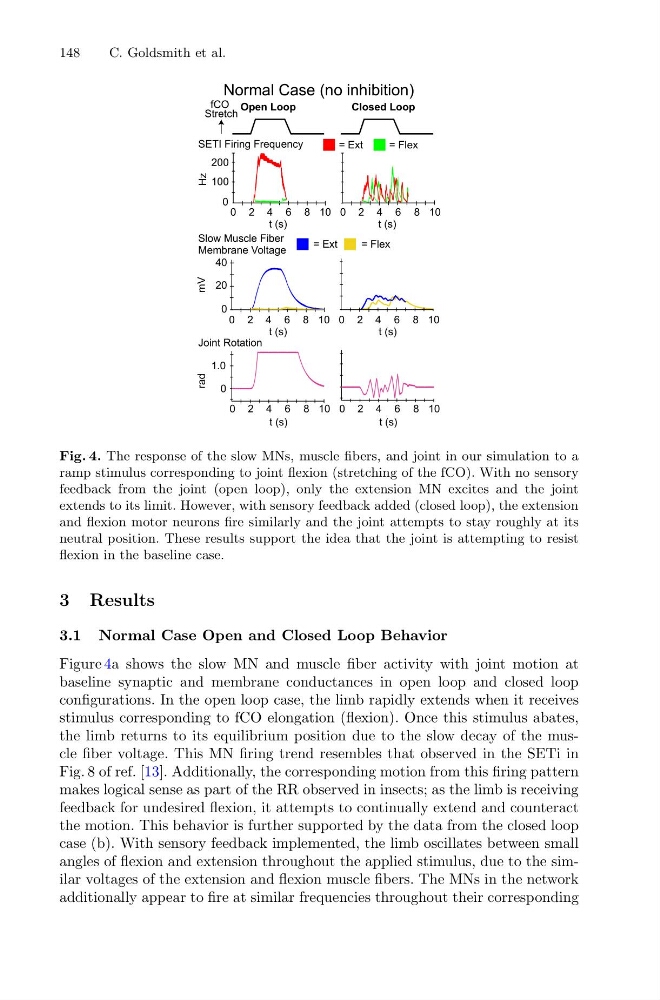
Fig. 4. The response of the slow MNs, muscle fibers, and joint in our simulation to a
ramp stimulus corresponding to joint flexion (stretching of the fCO). With no sensory
feedback from the joint (open loop), only the extension MN excites and the joint
extends to its limit. However, with sensory feedback added (closed loop), the extension
and flexion motor neurons fire similarly and the joint attempts to stay roughly at its
neutral position. These results support the idea that the joint is attempting to resist
flexion in the baseline case.
3 Results
3.1 Normal Case Open and Closed Loop Behavior
Figure 4a shows the slow MN and muscle fiber activity with joint motion at
baseline synaptic and membrane conductances in open loop and closed loop
configurations. In the open loop case, the limb rapidly extends when it receives
stimulus corresponding to fCO elongation (flexion). Once this stimulus abates,
the limb returns to its equilibrium position due to the slow decay of the muscle fiber voltage. This MN firing trend resembles that observed in the SETi in
Fig. 8 of ref. [13]. Additionally, the corresponding motion from this firing pattern
makes logical sense as part of the RR observed in insects; as the limb is receiving
feedback for undesired flexion, it attempts to continually extend and counteract
the motion. This behavior is further supported by the data from the closed loop
case (b). With sensory feedback implemented, the limb oscillates between small
angles of flexion and extension throughout the applied stimulus, due to the similar voltages of the extension and flexion muscle fibers. The MNs in the network
additionally appear to fire at similar frequencies throughout their corresponding
C. Goldsmith et al.
0
20
Slow Muscle Fiber
Membrane Voltage
0
= Ext
= Flex
mV
Joint Rotation
Open Loop
Closed Loop
t (s)
40
Hz
200
100
0
SETI Firing Frequency
= Ext
= Flex
0 2 4 6 8 10 0 2 4 6 8 10
t (s)
t (s)
0 2 4 6 8 10
t (s)
0 2 4 6 8 10
1.0
t (s)
0 2 4 6 8 10
t (s)
0 2 4 6 8 10
rad
Normal Case (no inhibition)
fCO
Stretch
Fig. 4. The response of the slow MNs, muscle fibers, and joint in our simulation to a
ramp stimulus corresponding to joint flexion (stretching of the fCO). With no sensory
feedback from the joint (open loop), only the extension MN excites and the joint
extends to its limit. However, with sensory feedback added (closed loop), the extension
and flexion motor neurons fire similarly and the joint attempts to stay roughly at its
neutral position. These results support the idea that the joint is attempting to resist
flexion in the baseline case.
3 Results
3.1 Normal Case Open and Closed Loop Behavior
Figure 4a shows the slow MN and muscle fiber activity with joint motion at
baseline synaptic and membrane conductances in open loop and closed loop
configurations. In the open loop case, the limb rapidly extends when it receives
stimulus corresponding to fCO elongation (flexion). Once this stimulus abates,
the limb returns to its equilibrium position due to the slow decay of the muscle fiber voltage. This MN firing trend resembles that observed in the SETi in
Fig. 8 of ref. [13]. Additionally, the corresponding motion from this firing pattern
makes logical sense as part of the RR observed in insects; as the limb is receiving
feedback for undesired flexion, it attempts to continually extend and counteract
the motion. This behavior is further supported by the data from the closed loop
case (b). With sensory feedback implemented, the limb oscillates between small
angles of flexion and extension throughout the applied stimulus, due to the similar voltages of the extension and flexion muscle fibers. The MNs in the network
additionally appear to fire at similar frequencies throughout their corresponding