

Haptic Object Identification for Advanced Manipulation Skills
137
1
2
3
4
0
0.1
0.2
0.3
# episode j
error [m]
¯
j
min
j
1
2
3
4
0
0.25
0.5
0.75
1
# episode j
error [m]
¯
j
min
j
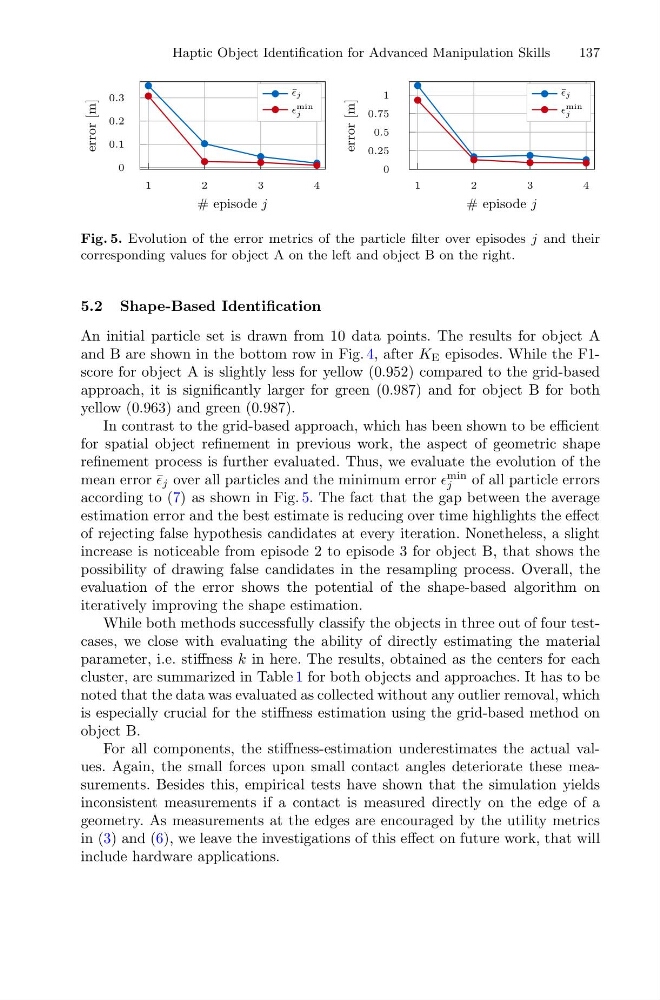
Fig. 5. Evolution of the error metrics of the particle filter over episodes j and their
corresponding values for object A on the left and object B on the right.
5.2 Shape-Based Identification
An initial particle set is drawn from 10 data points. The results for object A
and B are shown in the bottom row in Fig. 4, after K E episodes. While the F1score for object A is slightly less for yellow (0.952) compared to the grid-based
approach, it is significantly larger for green (0.987) and for object B for both
yellow (0.963) and green (0.987).
In contrast to the grid-based approach, which has been shown to be efficient
for spatial object refinement in previous work, the aspect of geometric shape
refinement process is further evaluated. Thus, we evaluate the evolution of the
mean error ¯
j over all particles and the minimum error
min
j
of all particle errors
according to (7) as shown in Fig. 5. The fact that the gap between the average
estimation error and the best estimate is reducing over time highlights the effect
of rejecting false hypothesis candidates at every iteration. Nonetheless, a slight
increase is noticeable from episode 2 to episode 3 for object B, that shows the
possibility of drawing false candidates in the resampling process. Overall, the
evaluation of the error shows the potential of the shape-based algorithm on
iteratively improving the shape estimation.
While both methods successfully classify the objects in three out of four testcases, we close with evaluating the ability of directly estimating the material
parameter, i.e. stiffness k in here. The results, obtained as the centers for each
cluster, are summarized in Table 1 for both objects and approaches. It has to be
noted that the data was evaluated as collected without any outlier removal, which
is especially crucial for the stiffness estimation using the grid-based method on
object B.
For all components, the stiffness-estimation underestimates the actual values. Again, the small forces upon small contact angles deteriorate these measurements. Besides this, empirical tests have shown that the simulation yields
inconsistent measurements if a contact is measured directly on the edge of a
geometry. As measurements at the edges are encouraged by the utility metrics
in (3) and (6), we leave the investigations of this effect on future work, that will
include hardware applications.
137
1
2
3
4
0
0.1
0.2
0.3
# episode j
error [m]
¯
j
min
j
1
2
3
4
0
0.25
0.5
0.75
1
# episode j
error [m]
¯
j
min
j
Fig. 5. Evolution of the error metrics of the particle filter over episodes j and their
corresponding values for object A on the left and object B on the right.
5.2 Shape-Based Identification
An initial particle set is drawn from 10 data points. The results for object A
and B are shown in the bottom row in Fig. 4, after K E episodes. While the F1score for object A is slightly less for yellow (0.952) compared to the grid-based
approach, it is significantly larger for green (0.987) and for object B for both
yellow (0.963) and green (0.987).
In contrast to the grid-based approach, which has been shown to be efficient
for spatial object refinement in previous work, the aspect of geometric shape
refinement process is further evaluated. Thus, we evaluate the evolution of the
mean error ¯
j over all particles and the minimum error
min
j
of all particle errors
according to (7) as shown in Fig. 5. The fact that the gap between the average
estimation error and the best estimate is reducing over time highlights the effect
of rejecting false hypothesis candidates at every iteration. Nonetheless, a slight
increase is noticeable from episode 2 to episode 3 for object B, that shows the
possibility of drawing false candidates in the resampling process. Overall, the
evaluation of the error shows the potential of the shape-based algorithm on
iteratively improving the shape estimation.
While both methods successfully classify the objects in three out of four testcases, we close with evaluating the ability of directly estimating the material
parameter, i.e. stiffness k in here. The results, obtained as the centers for each
cluster, are summarized in Table 1 for both objects and approaches. It has to be
noted that the data was evaluated as collected without any outlier removal, which
is especially crucial for the stiffness estimation using the grid-based method on
object B.
For all components, the stiffness-estimation underestimates the actual values. Again, the small forces upon small contact angles deteriorate these measurements. Besides this, empirical tests have shown that the simulation yields
inconsistent measurements if a contact is measured directly on the edge of a
geometry. As measurements at the edges are encouraged by the utility metrics
in (3) and (6), we leave the investigations of this effect on future work, that will
include hardware applications.