

138
V. Gabler et al.
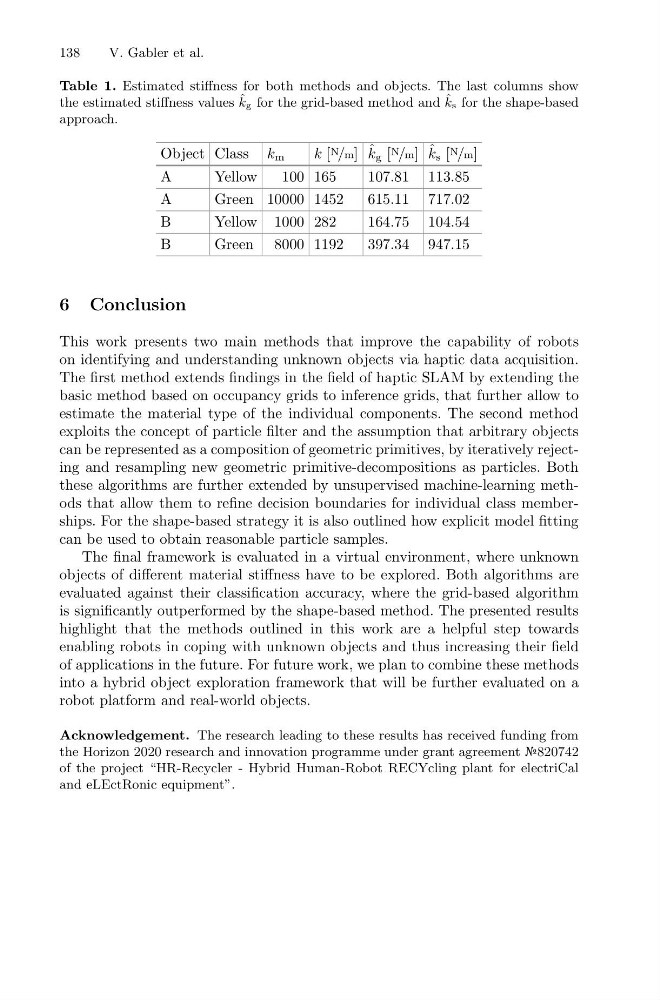
Table 1. Estimated stiffness for both methods and objects. The last columns show
the estimated stiffness values ˆ
kg for the grid-based method and ˆ
ks for the shape-based
approach.
Object Class k m
k [ N /m] ˆ
k g [ N /m] ˆ
k s [ N /m]
A
Yellow
100 165
107.81 113.85
A
Green 10000 1452
615.11 717.02
B
Yellow 1000 282
164.75 104.54
B
Green 8000 1192
397.34 947.15
6 Conclusion
This work presents two main methods that improve the capability of robots
on identifying and understanding unknown objects via haptic data acquisition.
The first method extends findings in the field of haptic SLAM by extending the
basic method based on occupancy grids to inference grids, that further allow to
estimate the material type of the individual components. The second method
exploits the concept of particle filter and the assumption that arbitrary objects
can be represented as a composition of geometric primitives, by iteratively rejecting and resampling new geometric primitive-decompositions as particles. Both
these algorithms are further extended by unsupervised machine-learning methods that allow them to refine decision boundaries for individual class memberships. For the shape-based strategy it is also outlined how explicit model fitting
can be used to obtain reasonable particle samples.
The final framework is evaluated in a virtual environment, where unknown
objects of different material stiffness have to be explored. Both algorithms are
evaluated against their classification accuracy, where the grid-based algorithm
is significantly outperformed by the shape-based method. The presented results
highlight that the methods outlined in this work are a helpful step towards
enabling robots in coping with unknown objects and thus increasing their field
of applications in the future. For future work, we plan to combine these methods
into a hybrid object exploration framework that will be further evaluated on a
robot platform and real-world objects.
Acknowledgement. The research leading to these results has received funding from
the Horizon 2020 research and innovation programme under grant agreement №820742
of the project “HR-Recycler - Hybrid Human-Robot RECYcling plant for electriCal
and eLEctRonic equipment”.
V. Gabler et al.
Table 1. Estimated stiffness for both methods and objects. The last columns show
the estimated stiffness values ˆ
kg for the grid-based method and ˆ
ks for the shape-based
approach.
Object Class k m
k [ N /m] ˆ
k g [ N /m] ˆ
k s [ N /m]
A
Yellow
100 165
107.81 113.85
A
Green 10000 1452
615.11 717.02
B
Yellow 1000 282
164.75 104.54
B
Green 8000 1192
397.34 947.15
6 Conclusion
This work presents two main methods that improve the capability of robots
on identifying and understanding unknown objects via haptic data acquisition.
The first method extends findings in the field of haptic SLAM by extending the
basic method based on occupancy grids to inference grids, that further allow to
estimate the material type of the individual components. The second method
exploits the concept of particle filter and the assumption that arbitrary objects
can be represented as a composition of geometric primitives, by iteratively rejecting and resampling new geometric primitive-decompositions as particles. Both
these algorithms are further extended by unsupervised machine-learning methods that allow them to refine decision boundaries for individual class memberships. For the shape-based strategy it is also outlined how explicit model fitting
can be used to obtain reasonable particle samples.
The final framework is evaluated in a virtual environment, where unknown
objects of different material stiffness have to be explored. Both algorithms are
evaluated against their classification accuracy, where the grid-based algorithm
is significantly outperformed by the shape-based method. The presented results
highlight that the methods outlined in this work are a helpful step towards
enabling robots in coping with unknown objects and thus increasing their field
of applications in the future. For future work, we plan to combine these methods
into a hybrid object exploration framework that will be further evaluated on a
robot platform and real-world objects.
Acknowledgement. The research leading to these results has received funding from
the Horizon 2020 research and innovation programme under grant agreement №820742
of the project “HR-Recycler - Hybrid Human-Robot RECYcling plant for electriCal
and eLEctRonic equipment”.