

Image-Based 2D PCD for Morphological Analysis of Tendrils-Like Structure
85
Then, we obtained the circumcenter, the correspondent radius, R i , from each
triplet, and the corresponding curvature, k i , defined as:
k i =
1
R i
, where R i = R circle (p i − d , p i , p i + d ).
(3)
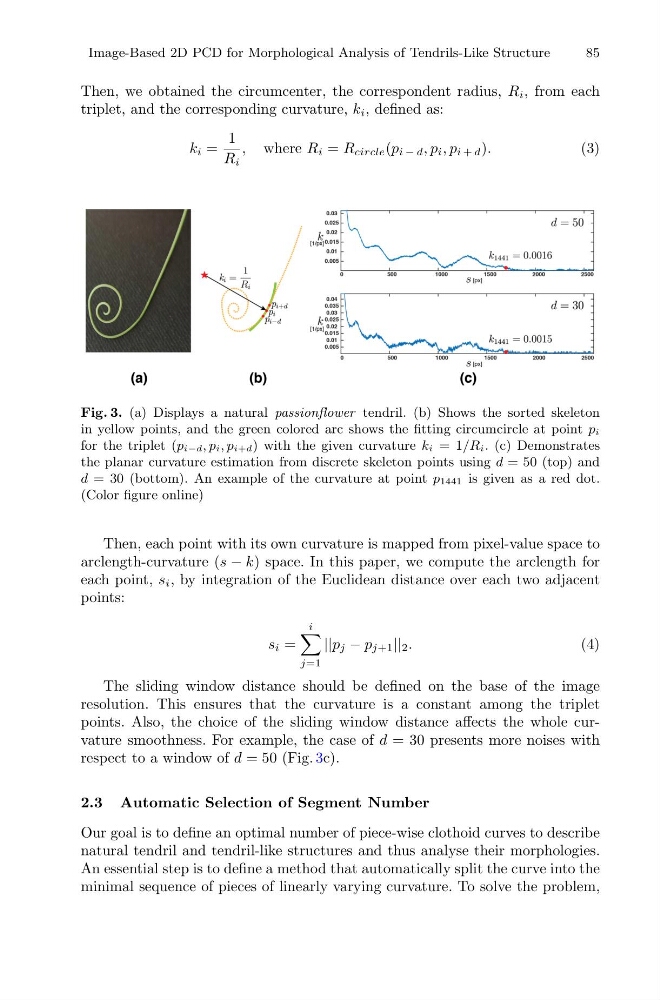
Fig. 3. (a) Displays a natural passionflower tendril. (b) Shows the sorted skeleton
in yellow points, and the green colored arc shows the fitting circumcircle at point pi
for the triplet (p i−d , pi, p i+d ) with the given curvature ki = 1/Ri. (c) Demonstrates
the planar curvature estimation from discrete skeleton points using d = 50 (top) and
d = 30 (bottom). An example of the curvature at point p1441 is given as a red dot.
(Color figure online)
Then, each point with its own curvature is mapped from pixel-value space to
arclength-curvature (s − k) space. In this paper, we compute the arclength for
each point, s i , by integration of the Euclidean distance over each two adjacent
points:
s i =
i
j=1
||p j − p j+1 || 2 .
(4)
The sliding window distance should be defined on the base of the image
resolution. This ensures that the curvature is a constant among the triplet
points. Also, the choice of the sliding window distance affects the whole curvature smoothness. For example, the case of d = 30 presents more noises with
respect to a window of d = 50 (Fig. 3c).
2.3 Automatic Selection of Segment Number
Our goal is to define an optimal number of piece-wise clothoid curves to describe
natural tendril and tendril-like structures and thus analyse their morphologies.
An essential step is to define a method that automatically split the curve into the
minimal sequence of pieces of linearly varying curvature. To solve the problem,
85
Then, we obtained the circumcenter, the correspondent radius, R i , from each
triplet, and the corresponding curvature, k i , defined as:
k i =
1
R i
, where R i = R circle (p i − d , p i , p i + d ).
(3)
Fig. 3. (a) Displays a natural passionflower tendril. (b) Shows the sorted skeleton
in yellow points, and the green colored arc shows the fitting circumcircle at point pi
for the triplet (p i−d , pi, p i+d ) with the given curvature ki = 1/Ri. (c) Demonstrates
the planar curvature estimation from discrete skeleton points using d = 50 (top) and
d = 30 (bottom). An example of the curvature at point p1441 is given as a red dot.
(Color figure online)
Then, each point with its own curvature is mapped from pixel-value space to
arclength-curvature (s − k) space. In this paper, we compute the arclength for
each point, s i , by integration of the Euclidean distance over each two adjacent
points:
s i =
i
j=1
||p j − p j+1 || 2 .
(4)
The sliding window distance should be defined on the base of the image
resolution. This ensures that the curvature is a constant among the triplet
points. Also, the choice of the sliding window distance affects the whole curvature smoothness. For example, the case of d = 30 presents more noises with
respect to a window of d = 50 (Fig. 3c).
2.3 Automatic Selection of Segment Number
Our goal is to define an optimal number of piece-wise clothoid curves to describe
natural tendril and tendril-like structures and thus analyse their morphologies.
An essential step is to define a method that automatically split the curve into the
minimal sequence of pieces of linearly varying curvature. To solve the problem,