

54
R. W. Taylor and V. Sandoghdar
in imaging the formation of lipid membranes in a similar label-free fashion. Here,
it is helpful to note that a small unilamellar vesicle (SUV) has already a sufficiently
large polarizability to be comfortably detected in iSCAT [117]. This high sensitivity
can be exploited to observe, in real time, the docking and rupture of SUVs with a
size down to 20 nm [118, 122] and coexisting dynamic phases within a supported
membrane [123].
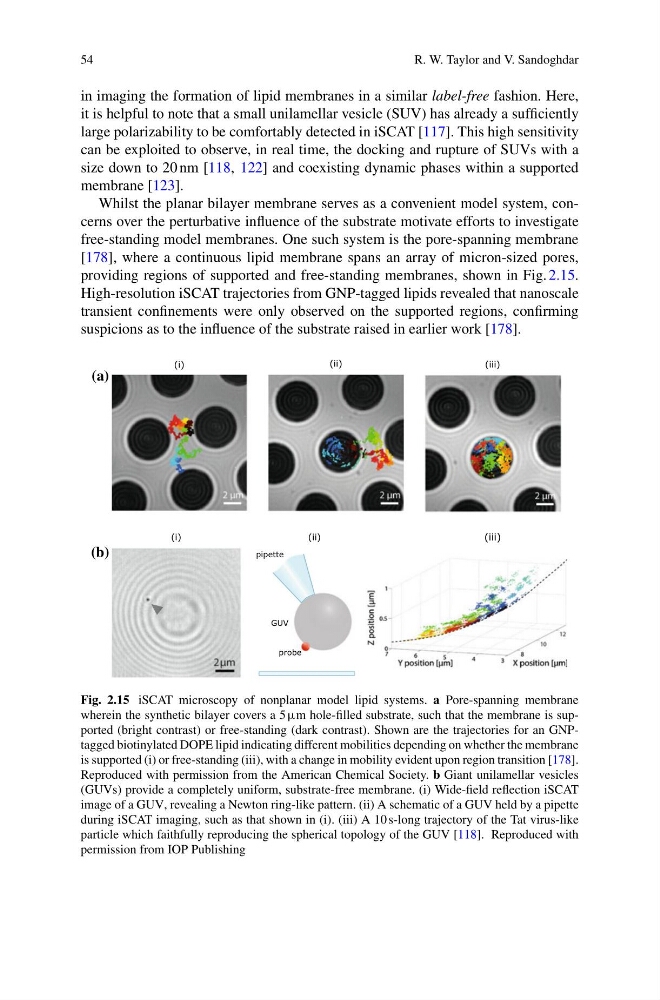
Whilst the planar bilayer membrane serves as a convenient model system, concerns over the perturbative influence of the substrate motivate efforts to investigate
free-standing model membranes. One such system is the pore-spanning membrane
[178], where a continuous lipid membrane spans an array of micron-sized pores,
providing regions of supported and free-standing membranes, shown in Fig. 2.15.
High-resolution iSCAT trajectories from GNP-tagged lipids revealed that nanoscale
transient confinements were only observed on the supported regions, confirming
suspicions as to the influence of the substrate raised in earlier work [178].
(a)
(b)
(i)
(ii)
(iii)
GUV
(i)
(ii)
(iii)
pipette
probe
Fig. 2.15 iSCAT microscopy of nonplanar model lipid systems. a Pore-spanning membrane
wherein the synthetic bilayer covers a 5 µm hole-filled substrate, such that the membrane is supported (bright contrast) or free-standing (dark contrast). Shown are the trajectories for an GNPtagged biotinylated DOPE lipid indicating different mobilities depending on whether the membrane
is supported (i) or free-standing (iii), with a change in mobility evident upon region transition [178].
Reproduced with permission from the American Chemical Society. b Giant unilamellar vesicles
(GUVs) provide a completely uniform, substrate-free membrane. (i) Wide-field reflection iSCAT
image of a GUV, revealing a Newton ring-like pattern. (ii) A schematic of a GUV held by a pipette
during iSCAT imaging, such as that shown in (i). (iii) A 10 s-long trajectory of the Tat virus-like
particle which faithfully reproducing the spherical topology of the GUV [118]. Reproduced with
permission from IOP Publishing
R. W. Taylor and V. Sandoghdar
in imaging the formation of lipid membranes in a similar label-free fashion. Here,
it is helpful to note that a small unilamellar vesicle (SUV) has already a sufficiently
large polarizability to be comfortably detected in iSCAT [117]. This high sensitivity
can be exploited to observe, in real time, the docking and rupture of SUVs with a
size down to 20 nm [118, 122] and coexisting dynamic phases within a supported
membrane [123].
Whilst the planar bilayer membrane serves as a convenient model system, concerns over the perturbative influence of the substrate motivate efforts to investigate
free-standing model membranes. One such system is the pore-spanning membrane
[178], where a continuous lipid membrane spans an array of micron-sized pores,
providing regions of supported and free-standing membranes, shown in Fig. 2.15.
High-resolution iSCAT trajectories from GNP-tagged lipids revealed that nanoscale
transient confinements were only observed on the supported regions, confirming
suspicions as to the influence of the substrate raised in earlier work [178].
(a)
(b)
(i)
(ii)
(iii)
GUV
(i)
(ii)
(iii)
pipette
probe
Fig. 2.15 iSCAT microscopy of nonplanar model lipid systems. a Pore-spanning membrane
wherein the synthetic bilayer covers a 5 µm hole-filled substrate, such that the membrane is supported (bright contrast) or free-standing (dark contrast). Shown are the trajectories for an GNPtagged biotinylated DOPE lipid indicating different mobilities depending on whether the membrane
is supported (i) or free-standing (iii), with a change in mobility evident upon region transition [178].
Reproduced with permission from the American Chemical Society. b Giant unilamellar vesicles
(GUVs) provide a completely uniform, substrate-free membrane. (i) Wide-field reflection iSCAT
image of a GUV, revealing a Newton ring-like pattern. (ii) A schematic of a GUV held by a pipette
during iSCAT imaging, such as that shown in (i). (iii) A 10 s-long trajectory of the Tat virus-like
particle which faithfully reproducing the spherical topology of the GUV [118]. Reproduced with
permission from IOP Publishing