

2 Interferometric Scattering (iSCAT) Microscopy and Related Techniques
53
(a)
(d)
( e )
(b)
(c)
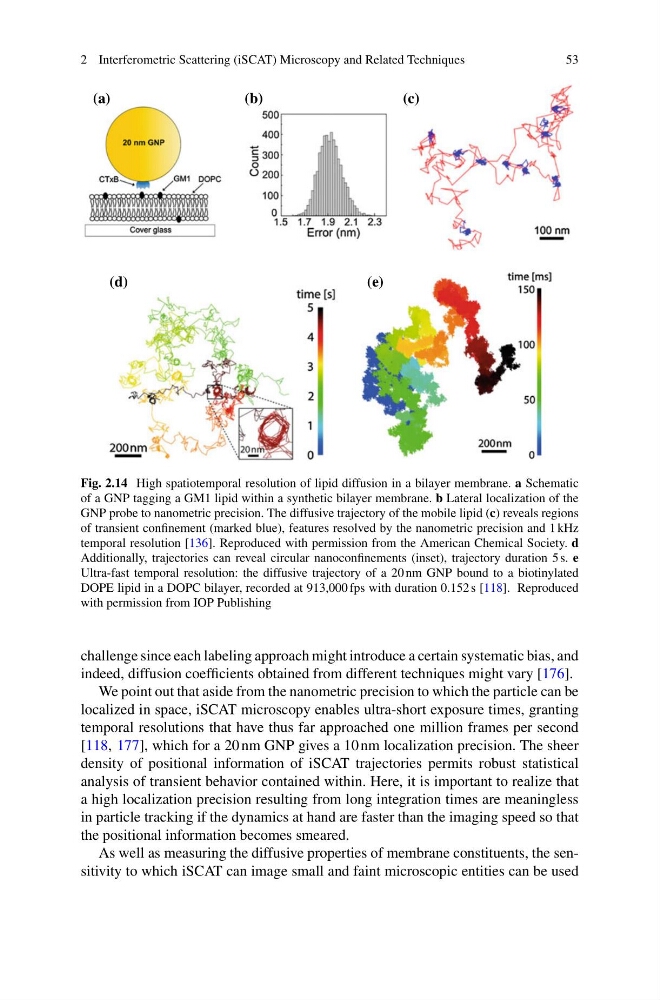
Fig. 2.14 High spatiotemporal resolution of lipid diffusion in a bilayer membrane. a Schematic
of a GNP tagging a GM1 lipid within a synthetic bilayer membrane. b Lateral localization of the
GNP probe to nanometric precision. The diffusive trajectory of the mobile lipid (c) reveals regions
of transient confinement (marked blue), features resolved by the nanometric precision and 1 kHz
temporal resolution [136]. Reproduced with permission from the American Chemical Society. d
Additionally, trajectories can reveal circular nanoconfinements (inset), trajectory duration 5 s. e
Ultra-fast temporal resolution: the diffusive trajectory of a 20 nm GNP bound to a biotinylated
DOPE lipid in a DOPC bilayer, recorded at 913,000 fps with duration 0.152 s [118]. Reproduced
with permission from IOP Publishing
challenge since each labeling approach might introduce a certain systematic bias, and
indeed, diffusion coefficients obtained from different techniques might vary [176].
We point out that aside from the nanometric precision to which the particle can be
localized in space, iSCAT microscopy enables ultra-short exposure times, granting
temporal resolutions that have thus far approached one million frames per second
[118, 177], which for a 20 nm GNP gives a 10 nm localization precision. The sheer
density of positional information of iSCAT trajectories permits robust statistical
analysis of transient behavior contained within. Here, it is important to realize that
a high localization precision resulting from long integration times are meaningless
in particle tracking if the dynamics at hand are faster than the imaging speed so that
the positional information becomes smeared.
As well as measuring the diffusive properties of membrane constituents, the sensitivity to which iSCAT can image small and faint microscopic entities can be used
53
(a)
(d)
( e )
(b)
(c)
Fig. 2.14 High spatiotemporal resolution of lipid diffusion in a bilayer membrane. a Schematic
of a GNP tagging a GM1 lipid within a synthetic bilayer membrane. b Lateral localization of the
GNP probe to nanometric precision. The diffusive trajectory of the mobile lipid (c) reveals regions
of transient confinement (marked blue), features resolved by the nanometric precision and 1 kHz
temporal resolution [136]. Reproduced with permission from the American Chemical Society. d
Additionally, trajectories can reveal circular nanoconfinements (inset), trajectory duration 5 s. e
Ultra-fast temporal resolution: the diffusive trajectory of a 20 nm GNP bound to a biotinylated
DOPE lipid in a DOPC bilayer, recorded at 913,000 fps with duration 0.152 s [118]. Reproduced
with permission from IOP Publishing
challenge since each labeling approach might introduce a certain systematic bias, and
indeed, diffusion coefficients obtained from different techniques might vary [176].
We point out that aside from the nanometric precision to which the particle can be
localized in space, iSCAT microscopy enables ultra-short exposure times, granting
temporal resolutions that have thus far approached one million frames per second
[118, 177], which for a 20 nm GNP gives a 10 nm localization precision. The sheer
density of positional information of iSCAT trajectories permits robust statistical
analysis of transient behavior contained within. Here, it is important to realize that
a high localization precision resulting from long integration times are meaningless
in particle tracking if the dynamics at hand are faster than the imaging speed so that
the positional information becomes smeared.
As well as measuring the diffusive properties of membrane constituents, the sensitivity to which iSCAT can image small and faint microscopic entities can be used