

428
A. V. Maslov and V. N. Astratov
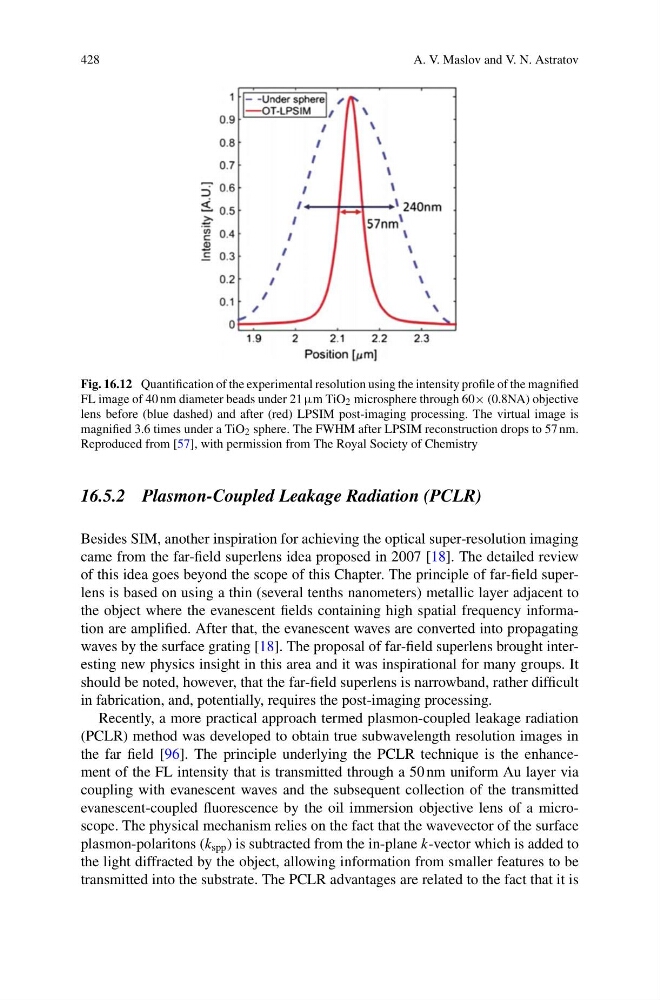
Fig. 16.12 Quantification of the experimental resolution using the intensity profile of the magnified
FL image of 40 nm diameter beads under 21 µm TiO 2 microsphere through 60× (0.8NA) objective
lens before (blue dashed) and after (red) LPSIM post-imaging processing. The virtual image is
magnified 3.6 times under a TiO 2 sphere. The FWHM after LPSIM reconstruction drops to 57 nm.
Reproduced from [57], with permission from The Royal Society of Chemistry
16.5.2 Plasmon-Coupled Leakage Radiation (PCLR)
Besides SIM, another inspiration for achieving the optical super-resolution imaging
came from the far-field superlens idea proposed in 2007 [18]. The detailed review
of this idea goes beyond the scope of this Chapter. The principle of far-field superlens is based on using a thin (several tenths nanometers) metallic layer adjacent to
the object where the evanescent fields containing high spatial frequency information are amplified. After that, the evanescent waves are converted into propagating
waves by the surface grating [18]. The proposal of far-field superlens brought interesting new physics insight in this area and it was inspirational for many groups. It
should be noted, however, that the far-field superlens is narrowband, rather difficult
in fabrication, and, potentially, requires the post-imaging processing.
Recently, a more practical approach termed plasmon-coupled leakage radiation
(PCLR) method was developed to obtain true subwavelength resolution images in
the far field [96]. The principle underlying the PCLR technique is the enhancement of the FL intensity that is transmitted through a 50 nm uniform Au layer via
coupling with evanescent waves and the subsequent collection of the transmitted
evanescent-coupled fluorescence by the oil immersion objective lens of a microscope. The physical mechanism relies on the fact that the wavevector of the surface
plasmon-polaritons (k spp ) is subtracted from the in-plane k-vector which is added to
the light diffracted by the object, allowing information from smaller features to be
transmitted into the substrate. The PCLR advantages are related to the fact that it is
A. V. Maslov and V. N. Astratov
Fig. 16.12 Quantification of the experimental resolution using the intensity profile of the magnified
FL image of 40 nm diameter beads under 21 µm TiO 2 microsphere through 60× (0.8NA) objective
lens before (blue dashed) and after (red) LPSIM post-imaging processing. The virtual image is
magnified 3.6 times under a TiO 2 sphere. The FWHM after LPSIM reconstruction drops to 57 nm.
Reproduced from [57], with permission from The Royal Society of Chemistry
16.5.2 Plasmon-Coupled Leakage Radiation (PCLR)
Besides SIM, another inspiration for achieving the optical super-resolution imaging
came from the far-field superlens idea proposed in 2007 [18]. The detailed review
of this idea goes beyond the scope of this Chapter. The principle of far-field superlens is based on using a thin (several tenths nanometers) metallic layer adjacent to
the object where the evanescent fields containing high spatial frequency information are amplified. After that, the evanescent waves are converted into propagating
waves by the surface grating [18]. The proposal of far-field superlens brought interesting new physics insight in this area and it was inspirational for many groups. It
should be noted, however, that the far-field superlens is narrowband, rather difficult
in fabrication, and, potentially, requires the post-imaging processing.
Recently, a more practical approach termed plasmon-coupled leakage radiation
(PCLR) method was developed to obtain true subwavelength resolution images in
the far field [96]. The principle underlying the PCLR technique is the enhancement of the FL intensity that is transmitted through a 50 nm uniform Au layer via
coupling with evanescent waves and the subsequent collection of the transmitted
evanescent-coupled fluorescence by the oil immersion objective lens of a microscope. The physical mechanism relies on the fact that the wavevector of the surface
plasmon-polaritons (k spp ) is subtracted from the in-plane k-vector which is added to
the light diffracted by the object, allowing information from smaller features to be
transmitted into the substrate. The PCLR advantages are related to the fact that it is