

416
A. V. Maslov and V. N. Astratov
0
1
2
3
4
0
1
2
3
4
5
6
7
8
9 10
(a)
(b)
σ/D
D/λ
0
2
4
6
8
10
0
1
2
3
4
5
6
7
8
9 10
P/P
0
D/λ
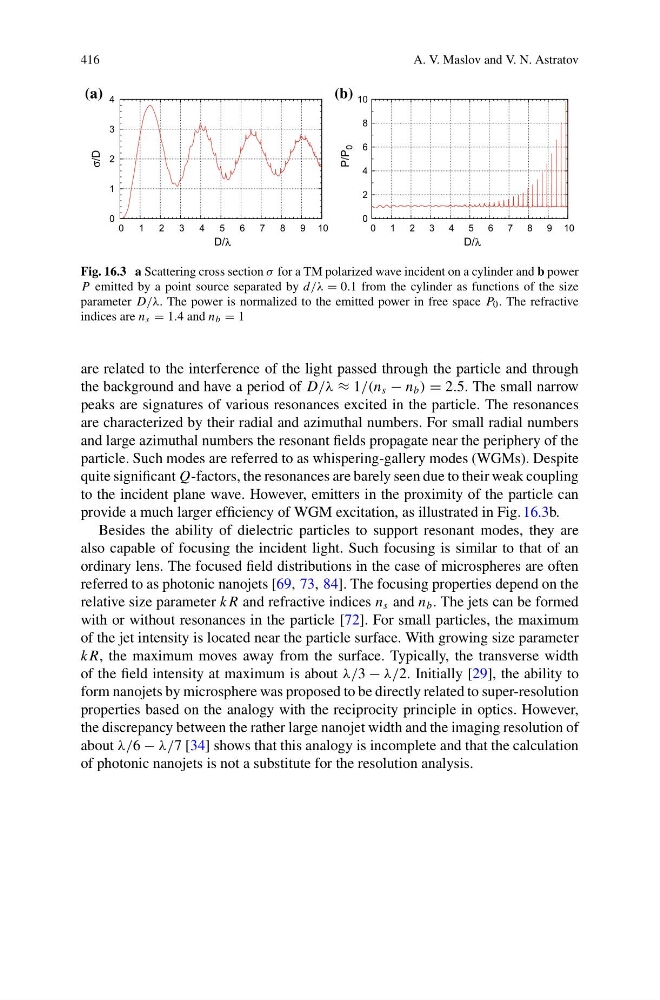
Fig. 16.3 a Scattering cross section σ for a TM polarized wave incident on a cylinder and b power
P emitted by a point source separated by d/λ = 0.1 from the cylinder as functions of the size
parameter D/λ. The power is normalized to the emitted power in free space P 0 . The refractive
indices are n s = 1.4 and n b = 1
are related to the interference of the light passed through the particle and through
the background and have a period of D/λ ≈ 1/(n s − n b ) = 2.5. The small narrow
peaks are signatures of various resonances excited in the particle. The resonances
are characterized by their radial and azimuthal numbers. For small radial numbers
and large azimuthal numbers the resonant fields propagate near the periphery of the
particle. Such modes are referred to as whispering-gallery modes (WGMs). Despite
quite significant Q-factors, the resonances are barely seen due to their weak coupling
to the incident plane wave. However, emitters in the proximity of the particle can
provide a much larger efficiency of WGM excitation, as illustrated in Fig. 16.3b.
Besides the ability of dielectric particles to support resonant modes, they are
also capable of focusing the incident light. Such focusing is similar to that of an
ordinary lens. The focused field distributions in the case of microspheres are often
referred to as photonic nanojets [69, 73, 84]. The focusing properties depend on the
relative size parameter k R and refractive indices n s and n b . The jets can be formed
with or without resonances in the particle [72]. For small particles, the maximum
of the jet intensity is located near the particle surface. With growing size parameter
k R, the maximum moves away from the surface. Typically, the transverse width
of the field intensity at maximum is about λ/3 − λ/2. Initially [29], the ability to
form nanojets by microsphere was proposed to be directly related to super-resolution
properties based on the analogy with the reciprocity principle in optics. However,
the discrepancy between the rather large nanojet width and the imaging resolution of
about λ/6 − λ/7 [34] shows that this analogy is incomplete and that the calculation
of photonic nanojets is not a substitute for the resolution analysis.
A. V. Maslov and V. N. Astratov
0
1
2
3
4
0
1
2
3
4
5
6
7
8
9 10
(a)
(b)
σ/D
D/λ
0
2
4
6
8
10
0
1
2
3
4
5
6
7
8
9 10
P/P
0
D/λ
Fig. 16.3 a Scattering cross section σ for a TM polarized wave incident on a cylinder and b power
P emitted by a point source separated by d/λ = 0.1 from the cylinder as functions of the size
parameter D/λ. The power is normalized to the emitted power in free space P 0 . The refractive
indices are n s = 1.4 and n b = 1
are related to the interference of the light passed through the particle and through
the background and have a period of D/λ ≈ 1/(n s − n b ) = 2.5. The small narrow
peaks are signatures of various resonances excited in the particle. The resonances
are characterized by their radial and azimuthal numbers. For small radial numbers
and large azimuthal numbers the resonant fields propagate near the periphery of the
particle. Such modes are referred to as whispering-gallery modes (WGMs). Despite
quite significant Q-factors, the resonances are barely seen due to their weak coupling
to the incident plane wave. However, emitters in the proximity of the particle can
provide a much larger efficiency of WGM excitation, as illustrated in Fig. 16.3b.
Besides the ability of dielectric particles to support resonant modes, they are
also capable of focusing the incident light. Such focusing is similar to that of an
ordinary lens. The focused field distributions in the case of microspheres are often
referred to as photonic nanojets [69, 73, 84]. The focusing properties depend on the
relative size parameter k R and refractive indices n s and n b . The jets can be formed
with or without resonances in the particle [72]. For small particles, the maximum
of the jet intensity is located near the particle surface. With growing size parameter
k R, the maximum moves away from the surface. Typically, the transverse width
of the field intensity at maximum is about λ/3 − λ/2. Initially [29], the ability to
form nanojets by microsphere was proposed to be directly related to super-resolution
properties based on the analogy with the reciprocity principle in optics. However,
the discrepancy between the rather large nanojet width and the imaging resolution of
about λ/6 − λ/7 [34] shows that this analogy is incomplete and that the calculation
of photonic nanojets is not a substitute for the resolution analysis.