

15 Super-Resolution Imaging and Microscopy by Dielectric …
395
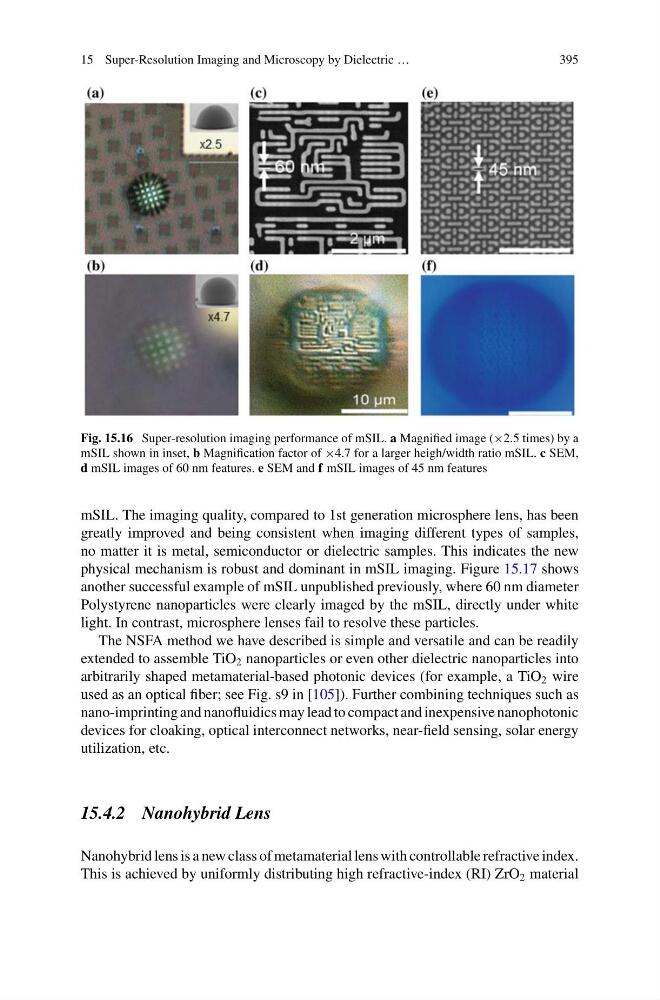
Fig. 15.16 Super-resolution imaging performance of mSIL. a Magnified image (×2.5 times) by a
mSIL shown in inset, b Magnification factor of ×4.7 for a larger heigh/width ratio mSIL. c SEM,
d mSIL images of 60 nm features. e SEM and f mSIL images of 45 nm features
mSIL. The imaging quality, compared to 1st generation microsphere lens, has been
greatly improved and being consistent when imaging different types of samples,
no matter it is metal, semiconductor or dielectric samples. This indicates the new
physical mechanism is robust and dominant in mSIL imaging. Figure 15.17 shows
another successful example of mSIL unpublished previously, where 60 nm diameter
Polystyrene nanoparticles were clearly imaged by the mSIL, directly under white
light. In contrast, microsphere lenses fail to resolve these particles.
The NSFA method we have described is simple and versatile and can be readily
extended to assemble TiO 2 nanoparticles or even other dielectric nanoparticles into
arbitrarily shaped metamaterial-based photonic devices (for example, a TiO 2 wire
used as an optical fiber; see Fig. s9 in [105]). Further combining techniques such as
nano-imprinting and nanofluidics may lead to compact and inexpensive nanophotonic
devices for cloaking, optical interconnect networks, near-field sensing, solar energy
utilization, etc.
15.4.2 Nanohybrid Lens
Nanohybrid lens is a new class of metamaterial lens with controllable refractive index.
This is achieved by uniformly distributing high refractive-index (RI) ZrO 2 material
395
Fig. 15.16 Super-resolution imaging performance of mSIL. a Magnified image (×2.5 times) by a
mSIL shown in inset, b Magnification factor of ×4.7 for a larger heigh/width ratio mSIL. c SEM,
d mSIL images of 60 nm features. e SEM and f mSIL images of 45 nm features
mSIL. The imaging quality, compared to 1st generation microsphere lens, has been
greatly improved and being consistent when imaging different types of samples,
no matter it is metal, semiconductor or dielectric samples. This indicates the new
physical mechanism is robust and dominant in mSIL imaging. Figure 15.17 shows
another successful example of mSIL unpublished previously, where 60 nm diameter
Polystyrene nanoparticles were clearly imaged by the mSIL, directly under white
light. In contrast, microsphere lenses fail to resolve these particles.
The NSFA method we have described is simple and versatile and can be readily
extended to assemble TiO 2 nanoparticles or even other dielectric nanoparticles into
arbitrarily shaped metamaterial-based photonic devices (for example, a TiO 2 wire
used as an optical fiber; see Fig. s9 in [105]). Further combining techniques such as
nano-imprinting and nanofluidics may lead to compact and inexpensive nanophotonic
devices for cloaking, optical interconnect networks, near-field sensing, solar energy
utilization, etc.
15.4.2 Nanohybrid Lens
Nanohybrid lens is a new class of metamaterial lens with controllable refractive index.
This is achieved by uniformly distributing high refractive-index (RI) ZrO 2 material