

394
Z. Wang and B. Luk’yanchuk
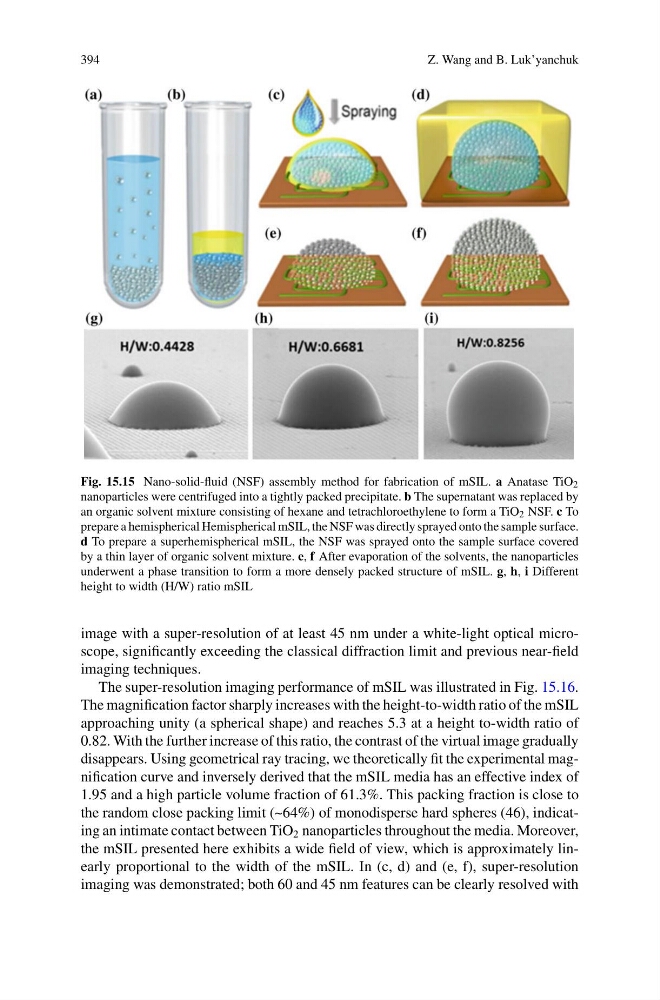
Fig. 15.15 Nano-solid-fluid (NSF) assembly method for fabrication of mSIL. a Anatase TiO 2
nanoparticles were centrifuged into a tightly packed precipitate. b The supernatant was replaced by
an organic solvent mixture consisting of hexane and tetrachloroethylene to form a TiO 2 NSF. c To
prepare a hemispherical Hemispherical mSIL, the NSF was directly sprayed onto the sample surface.
d To prepare a superhemispherical mSIL, the NSF was sprayed onto the sample surface covered
by a thin layer of organic solvent mixture. e, f After evaporation of the solvents, the nanoparticles
underwent a phase transition to form a more densely packed structure of mSIL. g, h, i Different
height to width (H/W) ratio mSIL
image with a super-resolution of at least 45 nm under a white-light optical microscope, significantly exceeding the classical diffraction limit and previous near-field
imaging techniques.
The super-resolution imaging performance of mSIL was illustrated in Fig. 15.16.
The magnification factor sharply increases with the height-to-width ratio of the mSIL
approaching unity (a spherical shape) and reaches 5.3 at a height to-width ratio of
0.82. With the further increase of this ratio, the contrast of the virtual image gradually
disappears. Using geometrical ray tracing, we theoretically fit the experimental magnification curve and inversely derived that the mSIL media has an effective index of
1.95 and a high particle volume fraction of 61.3%. This packing fraction is close to
the random close packing limit (~64%) of monodisperse hard spheres (46), indicating an intimate contact between TiO 2 nanoparticles throughout the media. Moreover,
the mSIL presented here exhibits a wide field of view, which is approximately linearly proportional to the width of the mSIL. In (c, d) and (e, f), super-resolution
imaging was demonstrated; both 60 and 45 nm features can be clearly resolved with
Z. Wang and B. Luk’yanchuk
Fig. 15.15 Nano-solid-fluid (NSF) assembly method for fabrication of mSIL. a Anatase TiO 2
nanoparticles were centrifuged into a tightly packed precipitate. b The supernatant was replaced by
an organic solvent mixture consisting of hexane and tetrachloroethylene to form a TiO 2 NSF. c To
prepare a hemispherical Hemispherical mSIL, the NSF was directly sprayed onto the sample surface.
d To prepare a superhemispherical mSIL, the NSF was sprayed onto the sample surface covered
by a thin layer of organic solvent mixture. e, f After evaporation of the solvents, the nanoparticles
underwent a phase transition to form a more densely packed structure of mSIL. g, h, i Different
height to width (H/W) ratio mSIL
image with a super-resolution of at least 45 nm under a white-light optical microscope, significantly exceeding the classical diffraction limit and previous near-field
imaging techniques.
The super-resolution imaging performance of mSIL was illustrated in Fig. 15.16.
The magnification factor sharply increases with the height-to-width ratio of the mSIL
approaching unity (a spherical shape) and reaches 5.3 at a height to-width ratio of
0.82. With the further increase of this ratio, the contrast of the virtual image gradually
disappears. Using geometrical ray tracing, we theoretically fit the experimental magnification curve and inversely derived that the mSIL media has an effective index of
1.95 and a high particle volume fraction of 61.3%. This packing fraction is close to
the random close packing limit (~64%) of monodisperse hard spheres (46), indicating an intimate contact between TiO 2 nanoparticles throughout the media. Moreover,
the mSIL presented here exhibits a wide field of view, which is approximately linearly proportional to the width of the mSIL. In (c, d) and (e, f), super-resolution
imaging was demonstrated; both 60 and 45 nm features can be clearly resolved with