

366
E. Khan and E. Narimanov
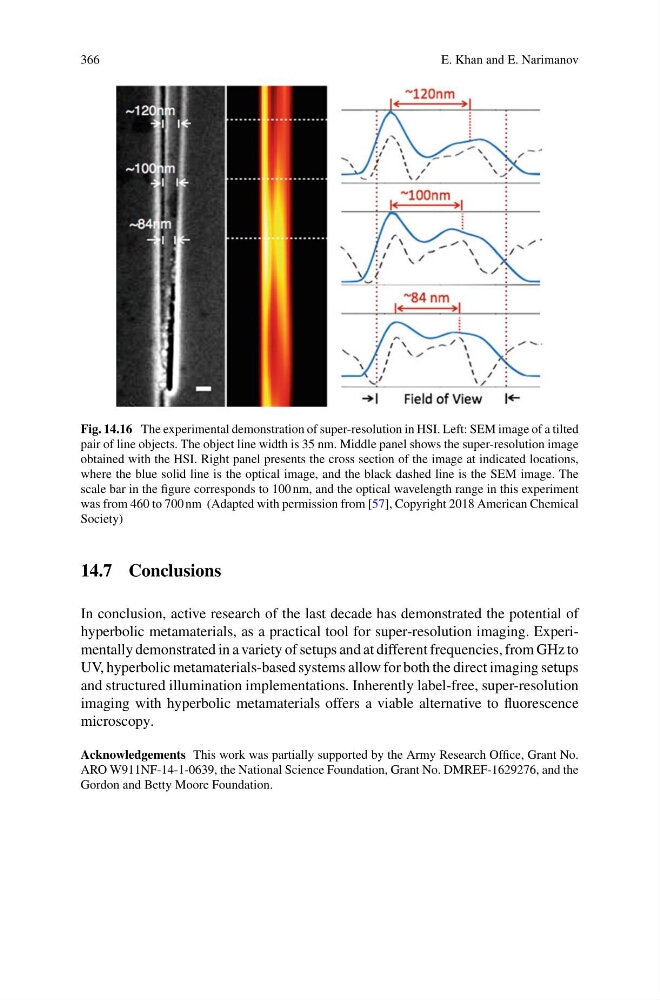
Fig. 14.16 The experimental demonstration of super-resolution in HSI. Left: SEM image of a tilted
pair of line objects. The object line width is 35 nm. Middle panel shows the super-resolution image
obtained with the HSI. Right panel presents the cross section of the image at indicated locations,
where the blue solid line is the optical image, and the black dashed line is the SEM image. The
scale bar in the figure corresponds to 100 nm, and the optical wavelength range in this experiment
was from 460 to 700 nm (Adapted with permission from [57], Copyright 2018 American Chemical
Society)
14.7 Conclusions
In conclusion, active research of the last decade has demonstrated the potential of
hyperbolic metamaterials, as a practical tool for super-resolution imaging. Experimentally demonstrated in a variety of setups and at different frequencies, from GHz to
UV, hyperbolic metamaterials-based systems allow for both the direct imaging setups
and structured illumination implementations. Inherently label-free, super-resolution
imaging with hyperbolic metamaterials offers a viable alternative to fluorescence
microscopy.
Acknowledgements This work was partially supported by the Army Research Office, Grant No.
ARO W911NF-14-1-0639, the National Science Foundation, Grant No. DMREF-1629276, and the
Gordon and Betty Moore Foundation.
E. Khan and E. Narimanov
Fig. 14.16 The experimental demonstration of super-resolution in HSI. Left: SEM image of a tilted
pair of line objects. The object line width is 35 nm. Middle panel shows the super-resolution image
obtained with the HSI. Right panel presents the cross section of the image at indicated locations,
where the blue solid line is the optical image, and the black dashed line is the SEM image. The
scale bar in the figure corresponds to 100 nm, and the optical wavelength range in this experiment
was from 460 to 700 nm (Adapted with permission from [57], Copyright 2018 American Chemical
Society)
14.7 Conclusions
In conclusion, active research of the last decade has demonstrated the potential of
hyperbolic metamaterials, as a practical tool for super-resolution imaging. Experimentally demonstrated in a variety of setups and at different frequencies, from GHz to
UV, hyperbolic metamaterials-based systems allow for both the direct imaging setups
and structured illumination implementations. Inherently label-free, super-resolution
imaging with hyperbolic metamaterials offers a viable alternative to fluorescence
microscopy.
Acknowledgements This work was partially supported by the Army Research Office, Grant No.
ARO W911NF-14-1-0639, the National Science Foundation, Grant No. DMREF-1629276, and the
Gordon and Betty Moore Foundation.