

364
E. Khan and E. Narimanov
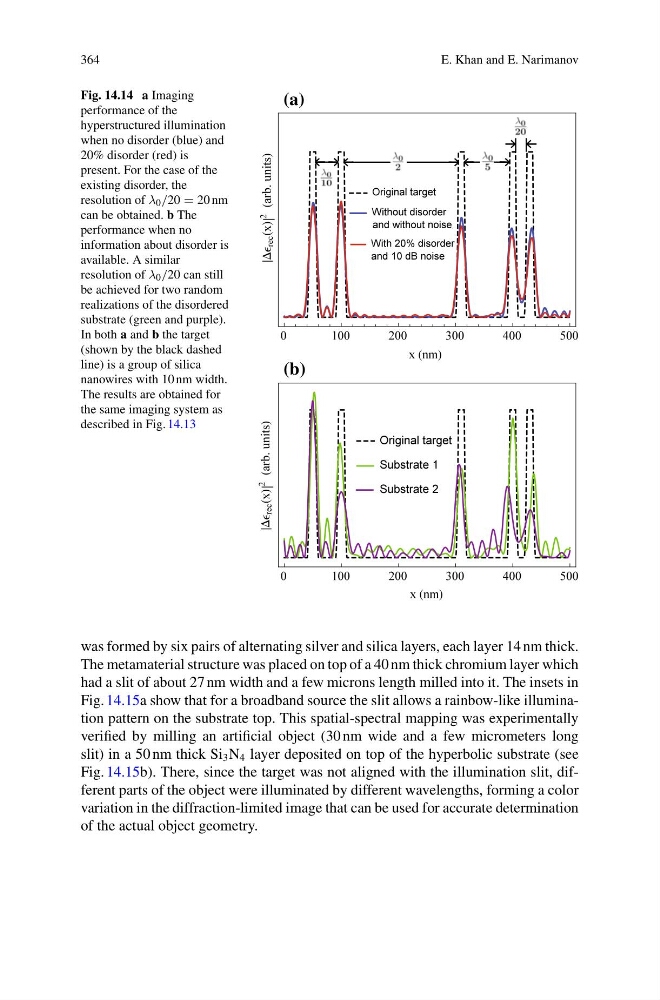
Fig. 14.14 a Imaging
performance of the
hyperstructured illumination
when no disorder (blue) and
20% disorder (red) is
present. For the case of the
existing disorder, the
resolution of λ 0 /20 = 20 nm
can be obtained. b The
performance when no
information about disorder is
available. A similar
resolution of λ 0 /20 can still
be achieved for two random
realizations of the disordered
substrate (green and purple).
In both a and b the target
(shown by the black dashed
line) is a group of silica
nanowires with 10 nm width.
The results are obtained for
the same imaging system as
described in Fig. 14.13
(a)
(b)
was formed by six pairs of alternating silver and silica layers, each layer 14 nm thick.
The metamaterial structure was placed on top of a 40 nm thick chromium layer which
had a slit of about 27 nm width and a few microns length milled into it. The insets in
Fig. 14.15a show that for a broadband source the slit allows a rainbow-like illumination pattern on the substrate top. This spatial-spectral mapping was experimentally
verified by milling an artificial object (30 nm wide and a few micrometers long
slit) in a 50 nm thick Si 3 N 4 layer deposited on top of the hyperbolic substrate (see
Fig. 14.15b). There, since the target was not aligned with the illumination slit, different parts of the object were illuminated by different wavelengths, forming a color
variation in the diffraction-limited image that can be used for accurate determination
of the actual object geometry.
E. Khan and E. Narimanov
Fig. 14.14 a Imaging
performance of the
hyperstructured illumination
when no disorder (blue) and
20% disorder (red) is
present. For the case of the
existing disorder, the
resolution of λ 0 /20 = 20 nm
can be obtained. b The
performance when no
information about disorder is
available. A similar
resolution of λ 0 /20 can still
be achieved for two random
realizations of the disordered
substrate (green and purple).
In both a and b the target
(shown by the black dashed
line) is a group of silica
nanowires with 10 nm width.
The results are obtained for
the same imaging system as
described in Fig. 14.13
(a)
(b)
was formed by six pairs of alternating silver and silica layers, each layer 14 nm thick.
The metamaterial structure was placed on top of a 40 nm thick chromium layer which
had a slit of about 27 nm width and a few microns length milled into it. The insets in
Fig. 14.15a show that for a broadband source the slit allows a rainbow-like illumination pattern on the substrate top. This spatial-spectral mapping was experimentally
verified by milling an artificial object (30 nm wide and a few micrometers long
slit) in a 50 nm thick Si 3 N 4 layer deposited on top of the hyperbolic substrate (see
Fig. 14.15b). There, since the target was not aligned with the illumination slit, different parts of the object were illuminated by different wavelengths, forming a color
variation in the diffraction-limited image that can be used for accurate determination
of the actual object geometry.