

14 Label-Free Super-Resolution Imaging with Hyperbolic Materials
363
(a)
(b)
x (nm)
200
100
0
100
200
0
100
200
x (nm)
200
100
0
100
200
y
(nm)
200
100
0
100
200
y
(nm)
200
100
|Δ obj|
2
|Δ rec|
2
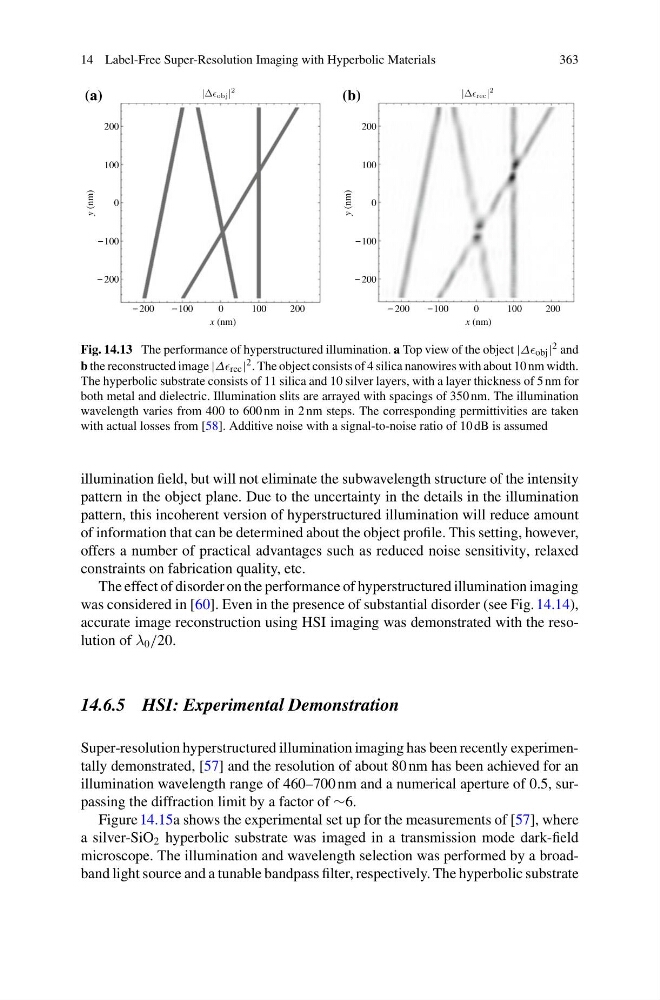
Fig. 14.13 The performance of hyperstructured illumination. a Top view of the object |Δ obj | 2 and
b the reconstructed image |Δ rec | 2 . The object consists of 4 silica nanowires with about 10 nm width.
The hyperbolic substrate consists of 11 silica and 10 silver layers, with a layer thickness of 5 nm for
both metal and dielectric. Illumination slits are arrayed with spacings of 350 nm. The illumination
wavelength varies from 400 to 600 nm in 2 nm steps. The corresponding permittivities are taken
with actual losses from [58]. Additive noise with a signal-to-noise ratio of 10 dB is assumed
illumination field, but will not eliminate the subwavelength structure of the intensity
pattern in the object plane. Due to the uncertainty in the details in the illumination
pattern, this incoherent version of hyperstructured illumination will reduce amount
of information that can be determined about the object profile. This setting, however,
offers a number of practical advantages such as reduced noise sensitivity, relaxed
constraints on fabrication quality, etc.
The effect of disorder on the performance of hyperstructured illumination imaging
was considered in [60]. Even in the presence of substantial disorder (see Fig. 14.14),
accurate image reconstruction using HSI imaging was demonstrated with the resolution of λ 0 /20.
14.6.5 HSI: Experimental Demonstration
Super-resolution hyperstructured illumination imaging has been recently experimentally demonstrated, [57] and the resolution of about 80 nm has been achieved for an
illumination wavelength range of 460–700 nm and a numerical aperture of 0.5, surpassing the diffraction limit by a factor of ∼6.
Figure 14.15a shows the experimental set up for the measurements of [57], where
a silver-SiO 2 hyperbolic substrate was imaged in a transmission mode dark-field
microscope. The illumination and wavelength selection was performed by a broadband light source and a tunable bandpass filter, respectively. The hyperbolic substrate
363
(a)
(b)
x (nm)
200
100
0
100
200
0
100
200
x (nm)
200
100
0
100
200
y
(nm)
200
100
0
100
200
y
(nm)
200
100
|Δ obj|
2
|Δ rec|
2
Fig. 14.13 The performance of hyperstructured illumination. a Top view of the object |Δ obj | 2 and
b the reconstructed image |Δ rec | 2 . The object consists of 4 silica nanowires with about 10 nm width.
The hyperbolic substrate consists of 11 silica and 10 silver layers, with a layer thickness of 5 nm for
both metal and dielectric. Illumination slits are arrayed with spacings of 350 nm. The illumination
wavelength varies from 400 to 600 nm in 2 nm steps. The corresponding permittivities are taken
with actual losses from [58]. Additive noise with a signal-to-noise ratio of 10 dB is assumed
illumination field, but will not eliminate the subwavelength structure of the intensity
pattern in the object plane. Due to the uncertainty in the details in the illumination
pattern, this incoherent version of hyperstructured illumination will reduce amount
of information that can be determined about the object profile. This setting, however,
offers a number of practical advantages such as reduced noise sensitivity, relaxed
constraints on fabrication quality, etc.
The effect of disorder on the performance of hyperstructured illumination imaging
was considered in [60]. Even in the presence of substantial disorder (see Fig. 14.14),
accurate image reconstruction using HSI imaging was demonstrated with the resolution of λ 0 /20.
14.6.5 HSI: Experimental Demonstration
Super-resolution hyperstructured illumination imaging has been recently experimentally demonstrated, [57] and the resolution of about 80 nm has been achieved for an
illumination wavelength range of 460–700 nm and a numerical aperture of 0.5, surpassing the diffraction limit by a factor of ∼6.
Figure 14.15a shows the experimental set up for the measurements of [57], where
a silver-SiO 2 hyperbolic substrate was imaged in a transmission mode dark-field
microscope. The illumination and wavelength selection was performed by a broadband light source and a tunable bandpass filter, respectively. The hyperbolic substrate