

362
E. Khan and E. Narimanov
the object polarization p(r) = (1/4π)((r) − 1)E i (r; ω), with E i (r; ω) being the
incident field.
When the object is placed close to the substrate and has a vertical dimension that
is small compared to the free-space wavelength, the polarization can be written as
p k =
1
8π 2
d
2 q E i (k + q; ω) Δ M (q)
where Δ M (q) is the spatial Fourier transform of the Motti projection of the object
profile,
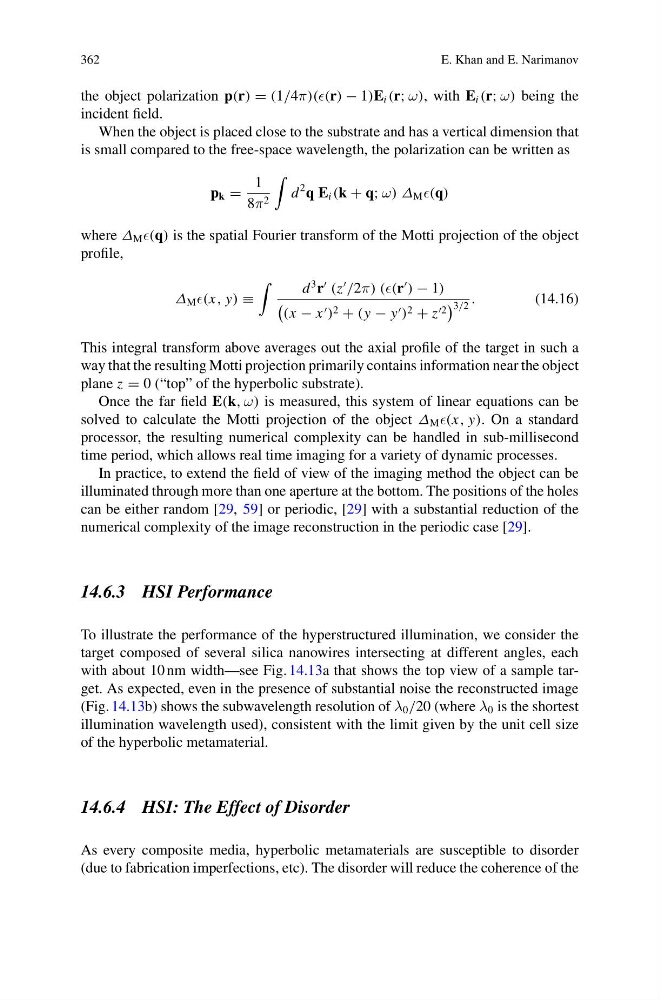
Δ M (x, y) ≡
d
3 r
(z
/2π) ((r
) − 1)
(x − x ) 2 + (y − y ) 2 + z 2
3/2 .
(14.16)
This integral transform above averages out the axial profile of the target in such a
way that the resulting Motti projection primarily contains information near the object
plane z = 0 (“top” of the hyperbolic substrate).
Once the far field E(k, ω) is measured, this system of linear equations can be
solved to calculate the Motti projection of the object Δ M (x, y). On a standard
processor, the resulting numerical complexity can be handled in sub-millisecond
time period, which allows real time imaging for a variety of dynamic processes.
In practice, to extend the field of view of the imaging method the object can be
illuminated through more than one aperture at the bottom. The positions of the holes
can be either random [29, 59] or periodic, [29] with a substantial reduction of the
numerical complexity of the image reconstruction in the periodic case [29].
14.6.3 HSI Performance
To illustrate the performance of the hyperstructured illumination, we consider the
target composed of several silica nanowires intersecting at different angles, each
with about 10 nm width—see Fig. 14.13a that shows the top view of a sample target. As expected, even in the presence of substantial noise the reconstructed image
(Fig. 14.13b) shows the subwavelength resolution of λ 0 /20 (where λ 0 is the shortest
illumination wavelength used), consistent with the limit given by the unit cell size
of the hyperbolic metamaterial.
14.6.4 HSI: The Effect of Disorder
As every composite media, hyperbolic metamaterials are susceptible to disorder
(due to fabrication imperfections, etc). The disorder will reduce the coherence of the
E. Khan and E. Narimanov
the object polarization p(r) = (1/4π)((r) − 1)E i (r; ω), with E i (r; ω) being the
incident field.
When the object is placed close to the substrate and has a vertical dimension that
is small compared to the free-space wavelength, the polarization can be written as
p k =
1
8π 2
d
2 q E i (k + q; ω) Δ M (q)
where Δ M (q) is the spatial Fourier transform of the Motti projection of the object
profile,
Δ M (x, y) ≡
d
3 r
(z
/2π) ((r
) − 1)
(x − x ) 2 + (y − y ) 2 + z 2
3/2 .
(14.16)
This integral transform above averages out the axial profile of the target in such a
way that the resulting Motti projection primarily contains information near the object
plane z = 0 (“top” of the hyperbolic substrate).
Once the far field E(k, ω) is measured, this system of linear equations can be
solved to calculate the Motti projection of the object Δ M (x, y). On a standard
processor, the resulting numerical complexity can be handled in sub-millisecond
time period, which allows real time imaging for a variety of dynamic processes.
In practice, to extend the field of view of the imaging method the object can be
illuminated through more than one aperture at the bottom. The positions of the holes
can be either random [29, 59] or periodic, [29] with a substantial reduction of the
numerical complexity of the image reconstruction in the periodic case [29].
14.6.3 HSI Performance
To illustrate the performance of the hyperstructured illumination, we consider the
target composed of several silica nanowires intersecting at different angles, each
with about 10 nm width—see Fig. 14.13a that shows the top view of a sample target. As expected, even in the presence of substantial noise the reconstructed image
(Fig. 14.13b) shows the subwavelength resolution of λ 0 /20 (where λ 0 is the shortest
illumination wavelength used), consistent with the limit given by the unit cell size
of the hyperbolic metamaterial.
14.6.4 HSI: The Effect of Disorder
As every composite media, hyperbolic metamaterials are susceptible to disorder
(due to fabrication imperfections, etc). The disorder will reduce the coherence of the