

14 Label-Free Super-Resolution Imaging with Hyperbolic Materials
359
In this sense, the hyperstructured illumination (HSI) [29] where the illumination
substrate is fabricated from a hyperbolic medium, with the maximum supported
wavenumber only limited by the inverse of the material unit cell size Λ, represents
the ultimate example of the latter approach—leading to the optical resolution on the
order of Λ.
14.6.1 HSI: The Concept
As was pointed out earlier (see (14.1)–(14.3)), a transparent dielectric material having
a positive permittivity , limits the wavenumber of propagating waves by a magnitude
threshold of
√
ω/c. A hyperbolic medium, on the other hand, having opposite
signs of (the real part of) the permittivity, say along x and z directions, so that
Re [ x ] Re
z
< 0, does not have this limitation, because its hyperbolic dispersion
for p-polarized light described by
k
2
x
z
+
k
2
z
x
=
ω
2
c 2 ,
(14.13)
does not put any upper bound on the magnitude of propagating wavevector k =
(k x , k z ) (see Fig. 14.2).
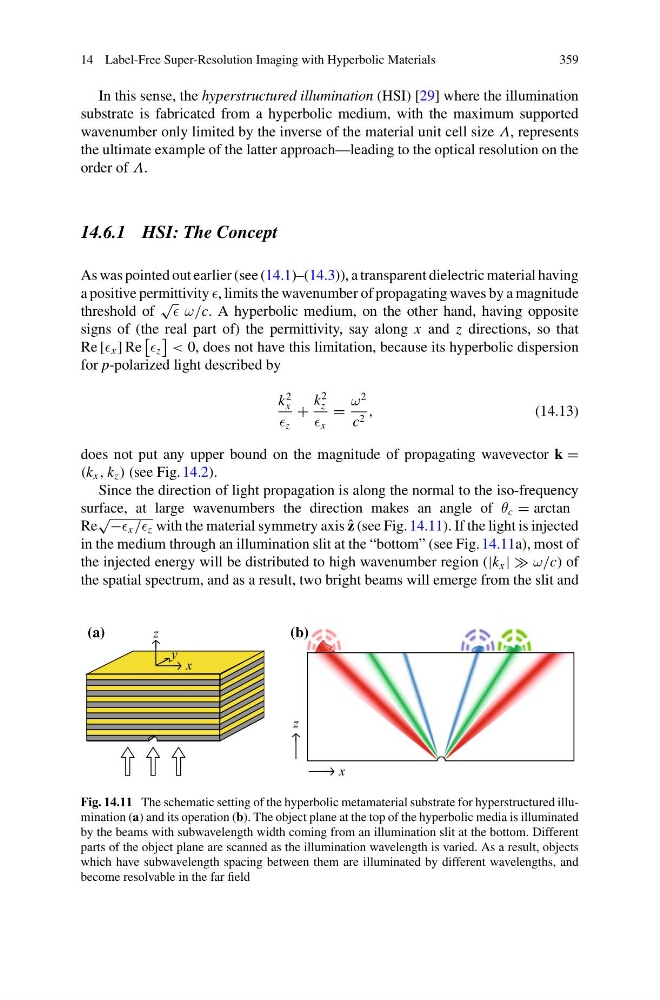
Since the direction of light propagation is along the normal to the iso-frequency
surface, at large wavenumbers the direction makes an angle of θ c = arctan
Re
√
− x / z with the material symmetry axis ˆ
z (see Fig. 14.11). If the light is injected
in the medium through an illumination slit at the “bottom” (see Fig. 14.11a), most of
the injected energy will be distributed to high wavenumber region (|k x | ω/c) of
the spatial spectrum, and as a result, two bright beams will emerge from the slit and
y x
z
x
z
(a)
(b)
Fig. 14.11 The schematic setting of the hyperbolic metamaterial substrate for hyperstructured illumination (a) and its operation (b). The object plane at the top of the hyperbolic media is illuminated
by the beams with subwavelength width coming from an illumination slit at the bottom. Different
parts of the object plane are scanned as the illumination wavelength is varied. As a result, objects
which have subwavelength spacing between them are illuminated by different wavelengths, and
become resolvable in the far field
359
In this sense, the hyperstructured illumination (HSI) [29] where the illumination
substrate is fabricated from a hyperbolic medium, with the maximum supported
wavenumber only limited by the inverse of the material unit cell size Λ, represents
the ultimate example of the latter approach—leading to the optical resolution on the
order of Λ.
14.6.1 HSI: The Concept
As was pointed out earlier (see (14.1)–(14.3)), a transparent dielectric material having
a positive permittivity , limits the wavenumber of propagating waves by a magnitude
threshold of
√
ω/c. A hyperbolic medium, on the other hand, having opposite
signs of (the real part of) the permittivity, say along x and z directions, so that
Re [ x ] Re
z
< 0, does not have this limitation, because its hyperbolic dispersion
for p-polarized light described by
k
2
x
z
+
k
2
z
x
=
ω
2
c 2 ,
(14.13)
does not put any upper bound on the magnitude of propagating wavevector k =
(k x , k z ) (see Fig. 14.2).
Since the direction of light propagation is along the normal to the iso-frequency
surface, at large wavenumbers the direction makes an angle of θ c = arctan
Re
√
− x / z with the material symmetry axis ˆ
z (see Fig. 14.11). If the light is injected
in the medium through an illumination slit at the “bottom” (see Fig. 14.11a), most of
the injected energy will be distributed to high wavenumber region (|k x | ω/c) of
the spatial spectrum, and as a result, two bright beams will emerge from the slit and
y x
z
x
z
(a)
(b)
Fig. 14.11 The schematic setting of the hyperbolic metamaterial substrate for hyperstructured illumination (a) and its operation (b). The object plane at the top of the hyperbolic media is illuminated
by the beams with subwavelength width coming from an illumination slit at the bottom. Different
parts of the object plane are scanned as the illumination wavelength is varied. As a result, objects
which have subwavelength spacing between them are illuminated by different wavelengths, and
become resolvable in the far field