

354
E. Khan and E. Narimanov
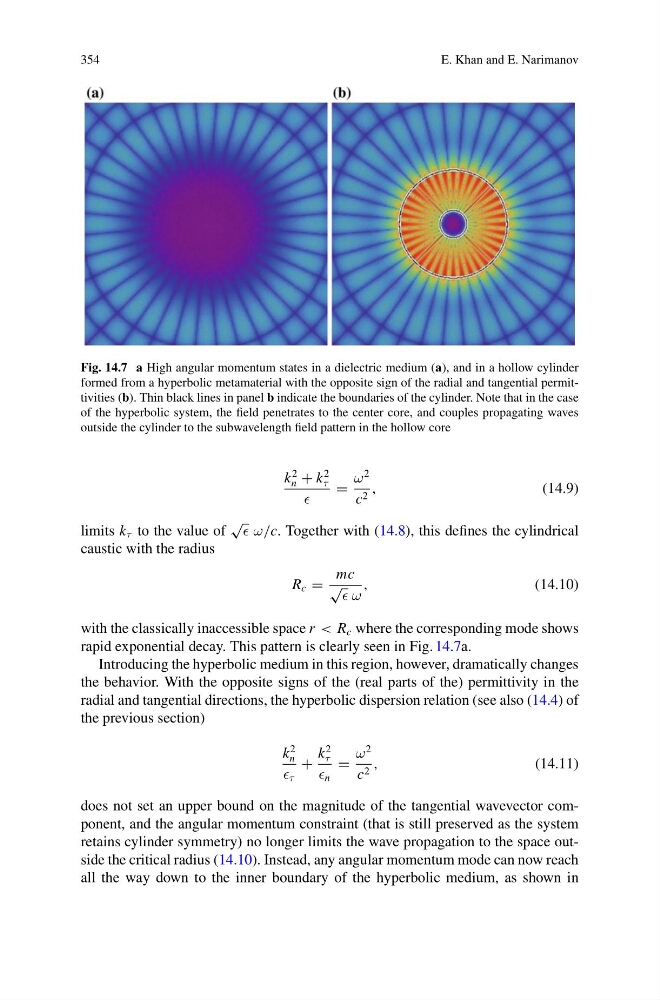
Fig. 14.7 a High angular momentum states in a dielectric medium (a), and in a hollow cylinder
formed from a hyperbolic metamaterial with the opposite sign of the radial and tangential permittivities (b). Thin black lines in panel b indicate the boundaries of the cylinder. Note that in the case
of the hyperbolic system, the field penetrates to the center core, and couples propagating waves
outside the cylinder to the subwavelength field pattern in the hollow core
k
2
n + k
2
τ
=
ω
2
c 2 ,
(14.9)
limits k τ to the value of
√ ω/c. Together with (14.8), this defines the cylindrical
caustic with the radius
R c =
mc
√ ω
,
(14.10)
with the classically inaccessible space r < R c where the corresponding mode shows
rapid exponential decay. This pattern is clearly seen in Fig. 14.7a.
Introducing the hyperbolic medium in this region, however, dramatically changes
the behavior. With the opposite signs of the (real parts of the) permittivity in the
radial and tangential directions, the hyperbolic dispersion relation (see also (14.4) of
the previous section)
k
2
n
τ
+
k
2
τ
n
=
ω
2
c 2 ,
(14.11)
does not set an upper bound on the magnitude of the tangential wavevector component, and the angular momentum constraint (that is still preserved as the system
retains cylinder symmetry) no longer limits the wave propagation to the space outside the critical radius (14.10). Instead, any angular momentum mode can now reach
all the way down to the inner boundary of the hyperbolic medium, as shown in
E. Khan and E. Narimanov
Fig. 14.7 a High angular momentum states in a dielectric medium (a), and in a hollow cylinder
formed from a hyperbolic metamaterial with the opposite sign of the radial and tangential permittivities (b). Thin black lines in panel b indicate the boundaries of the cylinder. Note that in the case
of the hyperbolic system, the field penetrates to the center core, and couples propagating waves
outside the cylinder to the subwavelength field pattern in the hollow core
k
2
n + k
2
τ
=
ω
2
c 2 ,
(14.9)
limits k τ to the value of
√ ω/c. Together with (14.8), this defines the cylindrical
caustic with the radius
R c =
mc
√ ω
,
(14.10)
with the classically inaccessible space r < R c where the corresponding mode shows
rapid exponential decay. This pattern is clearly seen in Fig. 14.7a.
Introducing the hyperbolic medium in this region, however, dramatically changes
the behavior. With the opposite signs of the (real parts of the) permittivity in the
radial and tangential directions, the hyperbolic dispersion relation (see also (14.4) of
the previous section)
k
2
n
τ
+
k
2
τ
n
=
ω
2
c 2 ,
(14.11)
does not set an upper bound on the magnitude of the tangential wavevector component, and the angular momentum constraint (that is still preserved as the system
retains cylinder symmetry) no longer limits the wave propagation to the space outside the critical radius (14.10). Instead, any angular momentum mode can now reach
all the way down to the inner boundary of the hyperbolic medium, as shown in