

14 Label-Free Super-Resolution Imaging with Hyperbolic Materials
353
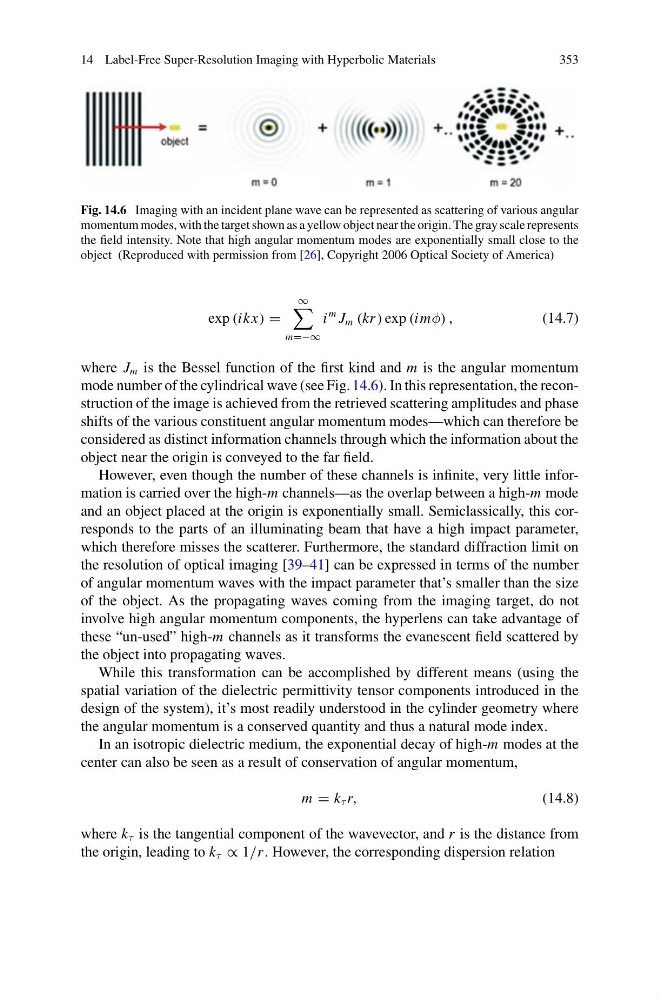
Fig. 14.6 Imaging with an incident plane wave can be represented as scattering of various angular
momentum modes, with the target shown as a yellow object near the origin. The gray scale represents
the field intensity. Note that high angular momentum modes are exponentially small close to the
object (Reproduced with permission from [26], Copyright 2006 Optical Society of America)
exp (ikx) =
∞
m=−∞
i
m J m (kr) exp (imφ) ,
(14.7)
where J m is the Bessel function of the first kind and m is the angular momentum
mode number of the cylindrical wave (see Fig. 14.6). In this representation, the reconstruction of the image is achieved from the retrieved scattering amplitudes and phase
shifts of the various constituent angular momentum modes—which can therefore be
considered as distinct information channels through which the information about the
object near the origin is conveyed to the far field.
However, even though the number of these channels is infinite, very little information is carried over the high-m channels—as the overlap between a high-m mode
and an object placed at the origin is exponentially small. Semiclassically, this corresponds to the parts of an illuminating beam that have a high impact parameter,
which therefore misses the scatterer. Furthermore, the standard diffraction limit on
the resolution of optical imaging [39–41] can be expressed in terms of the number
of angular momentum waves with the impact parameter that’s smaller than the size
of the object. As the propagating waves coming from the imaging target, do not
involve high angular momentum components, the hyperlens can take advantage of
these “un-used” high-m channels as it transforms the evanescent field scattered by
the object into propagating waves.
While this transformation can be accomplished by different means (using the
spatial variation of the dielectric permittivity tensor components introduced in the
design of the system), it’s most readily understood in the cylinder geometry where
the angular momentum is a conserved quantity and thus a natural mode index.
In an isotropic dielectric medium, the exponential decay of high-m modes at the
center can also be seen as a result of conservation of angular momentum,
m = k τ r,
(14.8)
where k τ is the tangential component of the wavevector, and r is the distance from
the origin, leading to k τ ∝ 1/r . However, the corresponding dispersion relation
353
Fig. 14.6 Imaging with an incident plane wave can be represented as scattering of various angular
momentum modes, with the target shown as a yellow object near the origin. The gray scale represents
the field intensity. Note that high angular momentum modes are exponentially small close to the
object (Reproduced with permission from [26], Copyright 2006 Optical Society of America)
exp (ikx) =
∞
m=−∞
i
m J m (kr) exp (imφ) ,
(14.7)
where J m is the Bessel function of the first kind and m is the angular momentum
mode number of the cylindrical wave (see Fig. 14.6). In this representation, the reconstruction of the image is achieved from the retrieved scattering amplitudes and phase
shifts of the various constituent angular momentum modes—which can therefore be
considered as distinct information channels through which the information about the
object near the origin is conveyed to the far field.
However, even though the number of these channels is infinite, very little information is carried over the high-m channels—as the overlap between a high-m mode
and an object placed at the origin is exponentially small. Semiclassically, this corresponds to the parts of an illuminating beam that have a high impact parameter,
which therefore misses the scatterer. Furthermore, the standard diffraction limit on
the resolution of optical imaging [39–41] can be expressed in terms of the number
of angular momentum waves with the impact parameter that’s smaller than the size
of the object. As the propagating waves coming from the imaging target, do not
involve high angular momentum components, the hyperlens can take advantage of
these “un-used” high-m channels as it transforms the evanescent field scattered by
the object into propagating waves.
While this transformation can be accomplished by different means (using the
spatial variation of the dielectric permittivity tensor components introduced in the
design of the system), it’s most readily understood in the cylinder geometry where
the angular momentum is a conserved quantity and thus a natural mode index.
In an isotropic dielectric medium, the exponential decay of high-m modes at the
center can also be seen as a result of conservation of angular momentum,
m = k τ r,
(14.8)
where k τ is the tangential component of the wavevector, and r is the distance from
the origin, leading to k τ ∝ 1/r . However, the corresponding dispersion relation