

300
M. J. Huttunen and A. Kiviniemi
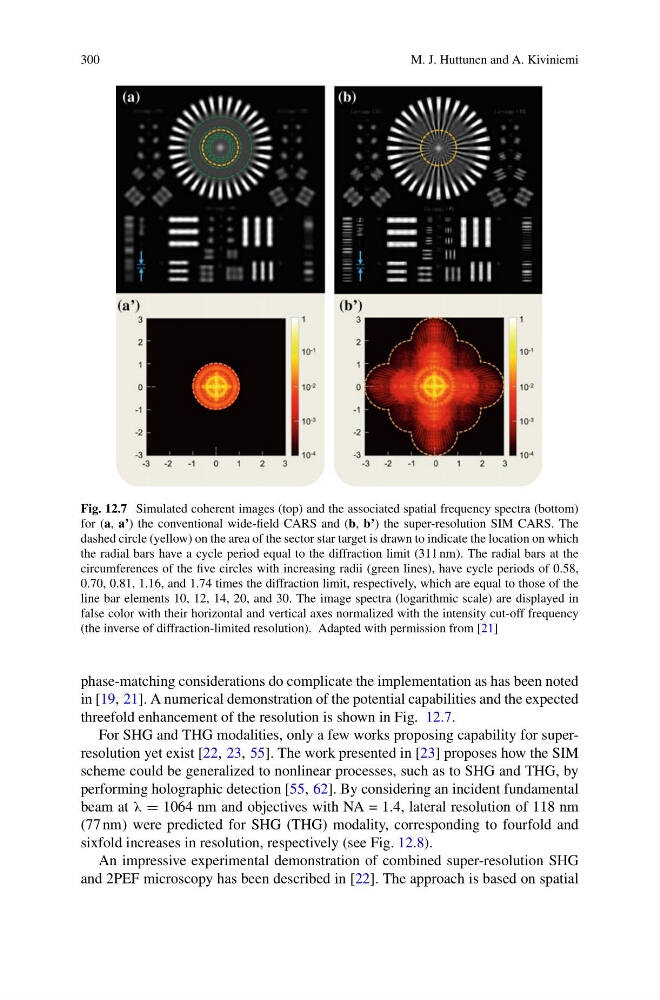
Fig. 12.7 Simulated coherent images (top) and the associated spatial frequency spectra (bottom)
for (a, a’) the conventional wide-field CARS and (b, b’) the super-resolution SIM CARS. The
dashed circle (yellow) on the area of the sector star target is drawn to indicate the location on which
the radial bars have a cycle period equal to the diffraction limit (311 nm). The radial bars at the
circumferences of the five circles with increasing radii (green lines), have cycle periods of 0.58,
0.70, 0.81, 1.16, and 1.74 times the diffraction limit, respectively, which are equal to those of the
line bar elements 10, 12, 14, 20, and 30. The image spectra (logarithmic scale) are displayed in
false color with their horizontal and vertical axes normalized with the intensity cut-off frequency
(the inverse of diffraction-limited resolution). Adapted with permission from [21]
phase-matching considerations do complicate the implementation as has been noted
in [19, 21]. A numerical demonstration of the potential capabilities and the expected
threefold enhancement of the resolution is shown in Fig. 12.7.
For SHG and THG modalities, only a few works proposing capability for superresolution yet exist [22, 23, 55]. The work presented in [23] proposes how the SIM
scheme could be generalized to nonlinear processes, such as to SHG and THG, by
performing holographic detection [55, 62]. By considering an incident fundamental
beam at λ = 1064 nm and objectives with NA = 1.4, lateral resolution of 118 nm
(77 nm) were predicted for SHG (THG) modality, corresponding to fourfold and
sixfold increases in resolution, respectively (see Fig. 12.8).
An impressive experimental demonstration of combined super-resolution SHG
and 2PEF microscopy has been described in [22]. The approach is based on spatial
M. J. Huttunen and A. Kiviniemi
Fig. 12.7 Simulated coherent images (top) and the associated spatial frequency spectra (bottom)
for (a, a’) the conventional wide-field CARS and (b, b’) the super-resolution SIM CARS. The
dashed circle (yellow) on the area of the sector star target is drawn to indicate the location on which
the radial bars have a cycle period equal to the diffraction limit (311 nm). The radial bars at the
circumferences of the five circles with increasing radii (green lines), have cycle periods of 0.58,
0.70, 0.81, 1.16, and 1.74 times the diffraction limit, respectively, which are equal to those of the
line bar elements 10, 12, 14, 20, and 30. The image spectra (logarithmic scale) are displayed in
false color with their horizontal and vertical axes normalized with the intensity cut-off frequency
(the inverse of diffraction-limited resolution). Adapted with permission from [21]
phase-matching considerations do complicate the implementation as has been noted
in [19, 21]. A numerical demonstration of the potential capabilities and the expected
threefold enhancement of the resolution is shown in Fig. 12.7.
For SHG and THG modalities, only a few works proposing capability for superresolution yet exist [22, 23, 55]. The work presented in [23] proposes how the SIM
scheme could be generalized to nonlinear processes, such as to SHG and THG, by
performing holographic detection [55, 62]. By considering an incident fundamental
beam at λ = 1064 nm and objectives with NA = 1.4, lateral resolution of 118 nm
(77 nm) were predicted for SHG (THG) modality, corresponding to fourfold and
sixfold increases in resolution, respectively (see Fig. 12.8).
An impressive experimental demonstration of combined super-resolution SHG
and 2PEF microscopy has been described in [22]. The approach is based on spatial