

12 Nonlinear Label-Free Super-Resolution Microscopy Using Structured Illumination
299
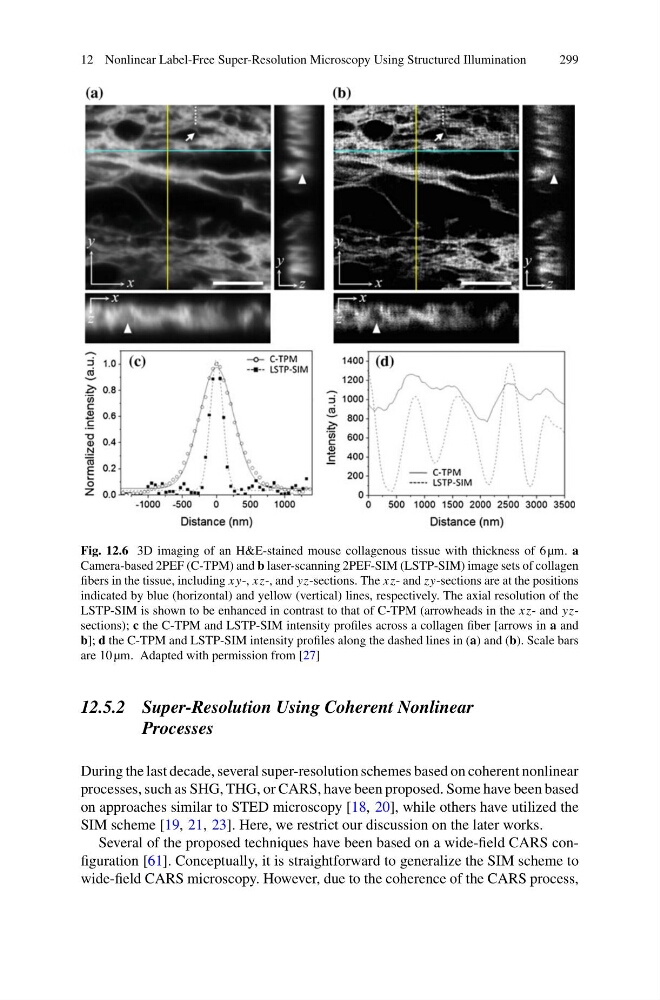
Fig. 12.6 3D imaging of an H&E-stained mouse collagenous tissue with thickness of 6 µm. a
Camera-based 2PEF (C-TPM) and b laser-scanning 2PEF-SIM (LSTP-SIM) image sets of collagen
fibers in the tissue, including xy-, xz-, and yz-sections. The xz- and zy-sections are at the positions
indicated by blue (horizontal) and yellow (vertical) lines, respectively. The axial resolution of the
LSTP-SIM is shown to be enhanced in contrast to that of C-TPM (arrowheads in the xz- and yzsections); c the C-TPM and LSTP-SIM intensity profiles across a collagen fiber [arrows in a and
b]; d the C-TPM and LSTP-SIM intensity profiles along the dashed lines in (a) and (b). Scale bars
are 10 µm. Adapted with permission from [27]
12.5.2 Super-Resolution Using Coherent Nonlinear
Processes
During the last decade, several super-resolution schemes based on coherent nonlinear
processes, such as SHG, THG, or CARS, have been proposed. Some have been based
on approaches similar to STED microscopy [18, 20], while others have utilized the
SIM scheme [19, 21, 23]. Here, we restrict our discussion on the later works.
Several of the proposed techniques have been based on a wide-field CARS configuration [61]. Conceptually, it is straightforward to generalize the SIM scheme to
wide-field CARS microscopy. However, due to the coherence of the CARS process,
299
Fig. 12.6 3D imaging of an H&E-stained mouse collagenous tissue with thickness of 6 µm. a
Camera-based 2PEF (C-TPM) and b laser-scanning 2PEF-SIM (LSTP-SIM) image sets of collagen
fibers in the tissue, including xy-, xz-, and yz-sections. The xz- and zy-sections are at the positions
indicated by blue (horizontal) and yellow (vertical) lines, respectively. The axial resolution of the
LSTP-SIM is shown to be enhanced in contrast to that of C-TPM (arrowheads in the xz- and yzsections); c the C-TPM and LSTP-SIM intensity profiles across a collagen fiber [arrows in a and
b]; d the C-TPM and LSTP-SIM intensity profiles along the dashed lines in (a) and (b). Scale bars
are 10 µm. Adapted with permission from [27]
12.5.2 Super-Resolution Using Coherent Nonlinear
Processes
During the last decade, several super-resolution schemes based on coherent nonlinear
processes, such as SHG, THG, or CARS, have been proposed. Some have been based
on approaches similar to STED microscopy [18, 20], while others have utilized the
SIM scheme [19, 21, 23]. Here, we restrict our discussion on the later works.
Several of the proposed techniques have been based on a wide-field CARS configuration [61]. Conceptually, it is straightforward to generalize the SIM scheme to
wide-field CARS microscopy. However, due to the coherence of the CARS process,