

12 Nonlinear Label-Free Super-Resolution Microscopy Using Structured Illumination
295
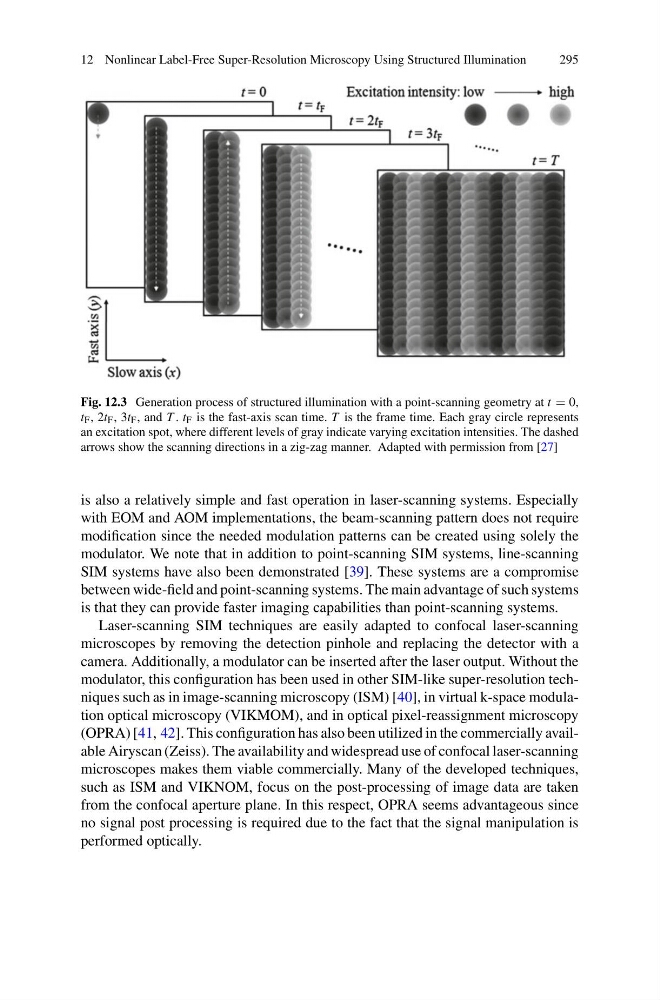
Fig. 12.3 Generation process of structured illumination with a point-scanning geometry at t = 0,
t F , 2t F , 3t F , and T . t F is the fast-axis scan time. T is the frame time. Each gray circle represents
an excitation spot, where different levels of gray indicate varying excitation intensities. The dashed
arrows show the scanning directions in a zig-zag manner. Adapted with permission from [27]
is also a relatively simple and fast operation in laser-scanning systems. Especially
with EOM and AOM implementations, the beam-scanning pattern does not require
modification since the needed modulation patterns can be created using solely the
modulator. We note that in addition to point-scanning SIM systems, line-scanning
SIM systems have also been demonstrated [39]. These systems are a compromise
between wide-field and point-scanning systems. The main advantage of such systems
is that they can provide faster imaging capabilities than point-scanning systems.
Laser-scanning SIM techniques are easily adapted to confocal laser-scanning
microscopes by removing the detection pinhole and replacing the detector with a
camera. Additionally, a modulator can be inserted after the laser output. Without the
modulator, this configuration has been used in other SIM-like super-resolution techniques such as in image-scanning microscopy (ISM) [40], in virtual k-space modulation optical microscopy (VIKMOM), and in optical pixel-reassignment microscopy
(OPRA) [41, 42]. This configuration has also been utilized in the commercially available Airyscan (Zeiss). The availability and widespread use of confocal laser-scanning
microscopes makes them viable commercially. Many of the developed techniques,
such as ISM and VIKNOM, focus on the post-processing of image data are taken
from the confocal aperture plane. In this respect, OPRA seems advantageous since
no signal post processing is required due to the fact that the signal manipulation is
performed optically.
295
Fig. 12.3 Generation process of structured illumination with a point-scanning geometry at t = 0,
t F , 2t F , 3t F , and T . t F is the fast-axis scan time. T is the frame time. Each gray circle represents
an excitation spot, where different levels of gray indicate varying excitation intensities. The dashed
arrows show the scanning directions in a zig-zag manner. Adapted with permission from [27]
is also a relatively simple and fast operation in laser-scanning systems. Especially
with EOM and AOM implementations, the beam-scanning pattern does not require
modification since the needed modulation patterns can be created using solely the
modulator. We note that in addition to point-scanning SIM systems, line-scanning
SIM systems have also been demonstrated [39]. These systems are a compromise
between wide-field and point-scanning systems. The main advantage of such systems
is that they can provide faster imaging capabilities than point-scanning systems.
Laser-scanning SIM techniques are easily adapted to confocal laser-scanning
microscopes by removing the detection pinhole and replacing the detector with a
camera. Additionally, a modulator can be inserted after the laser output. Without the
modulator, this configuration has been used in other SIM-like super-resolution techniques such as in image-scanning microscopy (ISM) [40], in virtual k-space modulation optical microscopy (VIKMOM), and in optical pixel-reassignment microscopy
(OPRA) [41, 42]. This configuration has also been utilized in the commercially available Airyscan (Zeiss). The availability and widespread use of confocal laser-scanning
microscopes makes them viable commercially. Many of the developed techniques,
such as ISM and VIKNOM, focus on the post-processing of image data are taken
from the confocal aperture plane. In this respect, OPRA seems advantageous since
no signal post processing is required due to the fact that the signal manipulation is
performed optically.