

296
M. J. Huttunen and A. Kiviniemi
12.4 Nonlinear Optical Processes
In nonlinear optical processes several fields interact with matter, creating new field
components oscillating at new frequencies [16, 17]. Perhaps the most studied nonlinear process is called second harmonic generation (SHG), during which two fields
at the fundamental frequency ω are converted into a new field oscillating at doubled
frequency 2ω. In an analogous process of third harmonic generation (THG), three
incident fields at the fundamental frequency ω are converted into a new field with
a tripled frequency 3ω. Coherent anti-Stokes Raman scattering (CARS) is another
widely used third-order nonlinear process where three incident fields with different
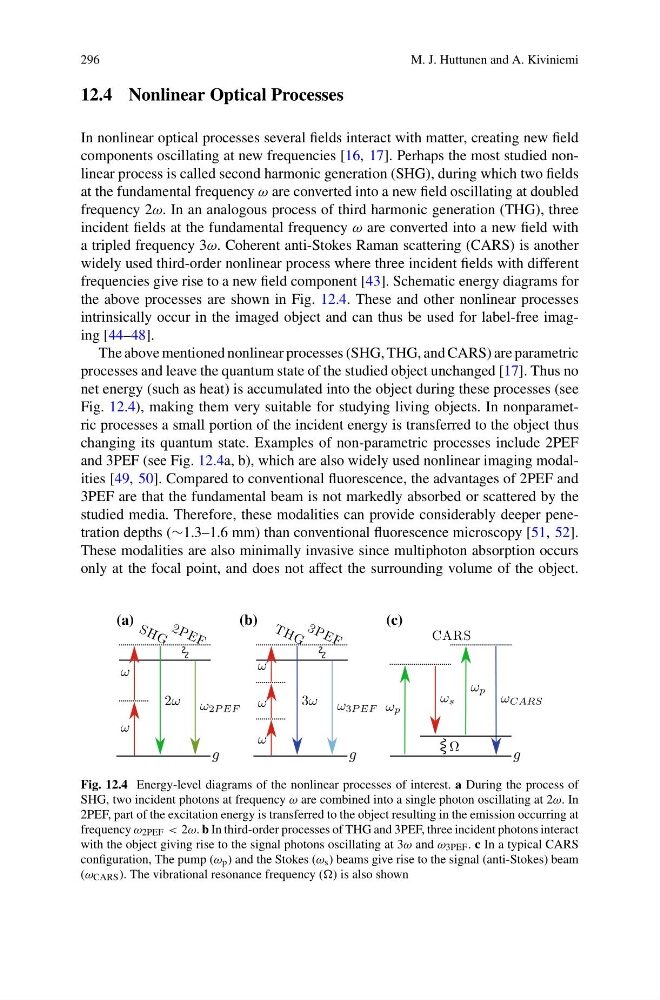
frequencies give rise to a new field component [43]. Schematic energy diagrams for
the above processes are shown in Fig. 12.4. These and other nonlinear processes
intrinsically occur in the imaged object and can thus be used for label-free imaging [44–48].
The above mentioned nonlinear processes (SHG, THG, and CARS) are parametric
processes and leave the quantum state of the studied object unchanged [17]. Thus no
net energy (such as heat) is accumulated into the object during these processes (see
Fig. 12.4), making them very suitable for studying living objects. In nonparametric processes a small portion of the incident energy is transferred to the object thus
changing its quantum state. Examples of non-parametric processes include 2PEF
and 3PEF (see Fig. 12.4a, b), which are also widely used nonlinear imaging modalities [49, 50]. Compared to conventional fluorescence, the advantages of 2PEF and
3PEF are that the fundamental beam is not markedly absorbed or scattered by the
studied media. Therefore, these modalities can provide considerably deeper penetration depths (∼1.3–1.6 mm) than conventional fluorescence microscopy [51, 52].
These modalities are also minimally invasive since multiphoton absorption occurs
only at the focal point, and does not affect the surrounding volume of the object.
S H G
2 P E F
T H G
3 P E F
CARS
(a)
(b)
(c)
Fig. 12.4 Energy-level diagrams of the nonlinear processes of interest. a During the process of
SHG, two incident photons at frequency ω are combined into a single photon oscillating at 2ω. In
2PEF, part of the excitation energy is transferred to the object resulting in the emission occurring at
frequency ω 2PEF < 2ω. b In third-order processes of THG and 3PEF, three incident photons interact
with the object giving rise to the signal photons oscillating at 3ω and ω 3PEF . c In a typical CARS
configuration, The pump (ω p ) and the Stokes (ω s ) beams give rise to the signal (anti-Stokes) beam
(ω CARS ). The vibrational resonance frequency () is also shown
M. J. Huttunen and A. Kiviniemi
12.4 Nonlinear Optical Processes
In nonlinear optical processes several fields interact with matter, creating new field
components oscillating at new frequencies [16, 17]. Perhaps the most studied nonlinear process is called second harmonic generation (SHG), during which two fields
at the fundamental frequency ω are converted into a new field oscillating at doubled
frequency 2ω. In an analogous process of third harmonic generation (THG), three
incident fields at the fundamental frequency ω are converted into a new field with
a tripled frequency 3ω. Coherent anti-Stokes Raman scattering (CARS) is another
widely used third-order nonlinear process where three incident fields with different
frequencies give rise to a new field component [43]. Schematic energy diagrams for
the above processes are shown in Fig. 12.4. These and other nonlinear processes
intrinsically occur in the imaged object and can thus be used for label-free imaging [44–48].
The above mentioned nonlinear processes (SHG, THG, and CARS) are parametric
processes and leave the quantum state of the studied object unchanged [17]. Thus no
net energy (such as heat) is accumulated into the object during these processes (see
Fig. 12.4), making them very suitable for studying living objects. In nonparametric processes a small portion of the incident energy is transferred to the object thus
changing its quantum state. Examples of non-parametric processes include 2PEF
and 3PEF (see Fig. 12.4a, b), which are also widely used nonlinear imaging modalities [49, 50]. Compared to conventional fluorescence, the advantages of 2PEF and
3PEF are that the fundamental beam is not markedly absorbed or scattered by the
studied media. Therefore, these modalities can provide considerably deeper penetration depths (∼1.3–1.6 mm) than conventional fluorescence microscopy [51, 52].
These modalities are also minimally invasive since multiphoton absorption occurs
only at the focal point, and does not affect the surrounding volume of the object.
S H G
2 P E F
T H G
3 P E F
CARS
(a)
(b)
(c)
Fig. 12.4 Energy-level diagrams of the nonlinear processes of interest. a During the process of
SHG, two incident photons at frequency ω are combined into a single photon oscillating at 2ω. In
2PEF, part of the excitation energy is transferred to the object resulting in the emission occurring at
frequency ω 2PEF < 2ω. b In third-order processes of THG and 3PEF, three incident photons interact
with the object giving rise to the signal photons oscillating at 3ω and ω 3PEF . c In a typical CARS
configuration, The pump (ω p ) and the Stokes (ω s ) beams give rise to the signal (anti-Stokes) beam
(ω CARS ). The vibrational resonance frequency () is also shown