

12 Nonlinear Label-Free Super-Resolution Microscopy Using Structured Illumination
293
The details of the procedure for extending the spatial frequency support in all
possible directions are already well explained, for example, in [7, 23, 29], and due
to this reason, we only outline the basic principles here. In short, we make use of
the fact that for the case of linear SIM the FT of the recorded image ˆ
I det is a linear
superposition of three terms [see (12.9)], which all have a different dependence on φ.
Therefore, by performing three or more measurements while varying φ, the resulting
system of linear equations can be easily solved for [30]. For the case of nonlinear
SIM, the FT of the recorded image ˆ
I det is composed of more than three terms [see
(12.10)], and therefore more than three measurements are required.
Once the terms have been separated, they are reassembled in the spatial frequency
domain. Since even the ideal form of the OTF of an incoherent system is conical, the
separated spatial frequency images are biased. This bias can be mitigated by filtering, where Wiener filtering is most commonly used [12, 31]. This step is essential
for reconstructing a good quality super-resolution image, since the spatial frequency
images are both biased by the shape of the OTF and contain noise. The above mentioned filtering technique requires a priori knowledge of the OTF, but such knowledge
is not strictly necessary since approaches based on blind deconvolution have also been
demonstrated [32, 33].
After correcting for the bias (and noise), the images are reassembled by shifting
them to their correct locations. The images can be conveniently moved by taking
use of the shifting property of the FT and thus multiplying the respective real space
images by cosine waves resulting in shift in the spatial frequency domain. After the
correct locations have been found, the overlapping pixels are combined with their
weighted averages. Once these steps have been completed, the lateral resolution of the
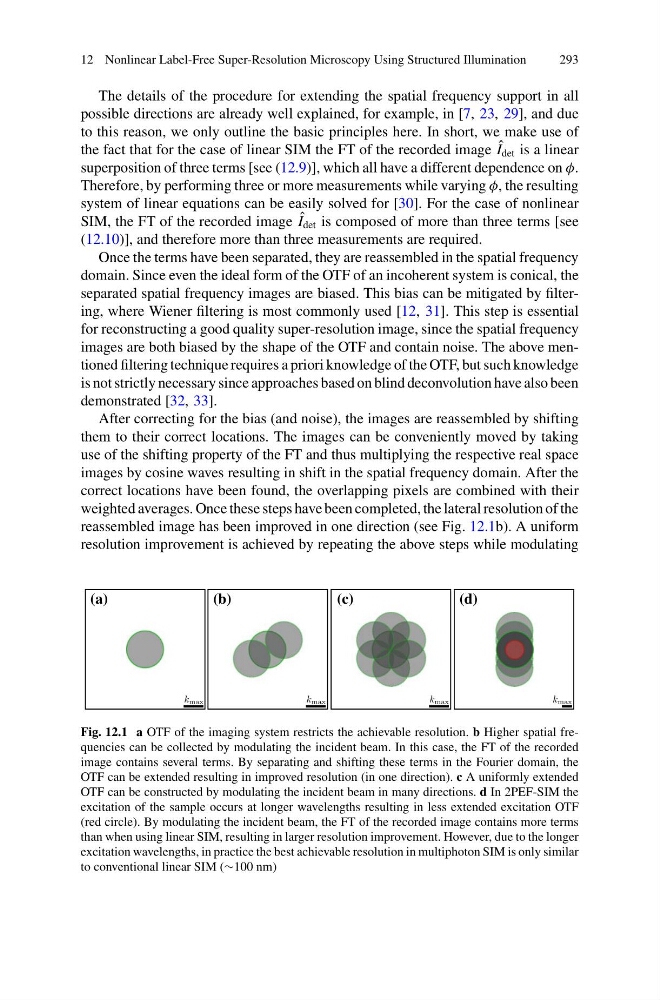
reassembled image has been improved in one direction (see Fig. 12.1b). A uniform
resolution improvement is achieved by repeating the above steps while modulating
(a)
(b)
(c)
(d)
Fig. 12.1 a OTF of the imaging system restricts the achievable resolution. b Higher spatial frequencies can be collected by modulating the incident beam. In this case, the FT of the recorded
image contains several terms. By separating and shifting these terms in the Fourier domain, the
OTF can be extended resulting in improved resolution (in one direction). c A uniformly extended
OTF can be constructed by modulating the incident beam in many directions. d In 2PEF-SIM the
excitation of the sample occurs at longer wavelengths resulting in less extended excitation OTF
(red circle). By modulating the incident beam, the FT of the recorded image contains more terms
than when using linear SIM, resulting in larger resolution improvement. However, due to the longer
excitation wavelengths, in practice the best achievable resolution in multiphoton SIM is only similar
to conventional linear SIM (∼100 nm)
293
The details of the procedure for extending the spatial frequency support in all
possible directions are already well explained, for example, in [7, 23, 29], and due
to this reason, we only outline the basic principles here. In short, we make use of
the fact that for the case of linear SIM the FT of the recorded image ˆ
I det is a linear
superposition of three terms [see (12.9)], which all have a different dependence on φ.
Therefore, by performing three or more measurements while varying φ, the resulting
system of linear equations can be easily solved for [30]. For the case of nonlinear
SIM, the FT of the recorded image ˆ
I det is composed of more than three terms [see
(12.10)], and therefore more than three measurements are required.
Once the terms have been separated, they are reassembled in the spatial frequency
domain. Since even the ideal form of the OTF of an incoherent system is conical, the
separated spatial frequency images are biased. This bias can be mitigated by filtering, where Wiener filtering is most commonly used [12, 31]. This step is essential
for reconstructing a good quality super-resolution image, since the spatial frequency
images are both biased by the shape of the OTF and contain noise. The above mentioned filtering technique requires a priori knowledge of the OTF, but such knowledge
is not strictly necessary since approaches based on blind deconvolution have also been
demonstrated [32, 33].
After correcting for the bias (and noise), the images are reassembled by shifting
them to their correct locations. The images can be conveniently moved by taking
use of the shifting property of the FT and thus multiplying the respective real space
images by cosine waves resulting in shift in the spatial frequency domain. After the
correct locations have been found, the overlapping pixels are combined with their
weighted averages. Once these steps have been completed, the lateral resolution of the
reassembled image has been improved in one direction (see Fig. 12.1b). A uniform
resolution improvement is achieved by repeating the above steps while modulating
(a)
(b)
(c)
(d)
Fig. 12.1 a OTF of the imaging system restricts the achievable resolution. b Higher spatial frequencies can be collected by modulating the incident beam. In this case, the FT of the recorded
image contains several terms. By separating and shifting these terms in the Fourier domain, the
OTF can be extended resulting in improved resolution (in one direction). c A uniformly extended
OTF can be constructed by modulating the incident beam in many directions. d In 2PEF-SIM the
excitation of the sample occurs at longer wavelengths resulting in less extended excitation OTF
(red circle). By modulating the incident beam, the FT of the recorded image contains more terms
than when using linear SIM, resulting in larger resolution improvement. However, due to the longer
excitation wavelengths, in practice the best achievable resolution in multiphoton SIM is only similar
to conventional linear SIM (∼100 nm)