

292
M. J. Huttunen and A. Kiviniemi
d =
λ
2NA
=
1
2k
max
,
(12.6)
where λ
is the wavelength of the emitted light and NA is the numerical aperture of the
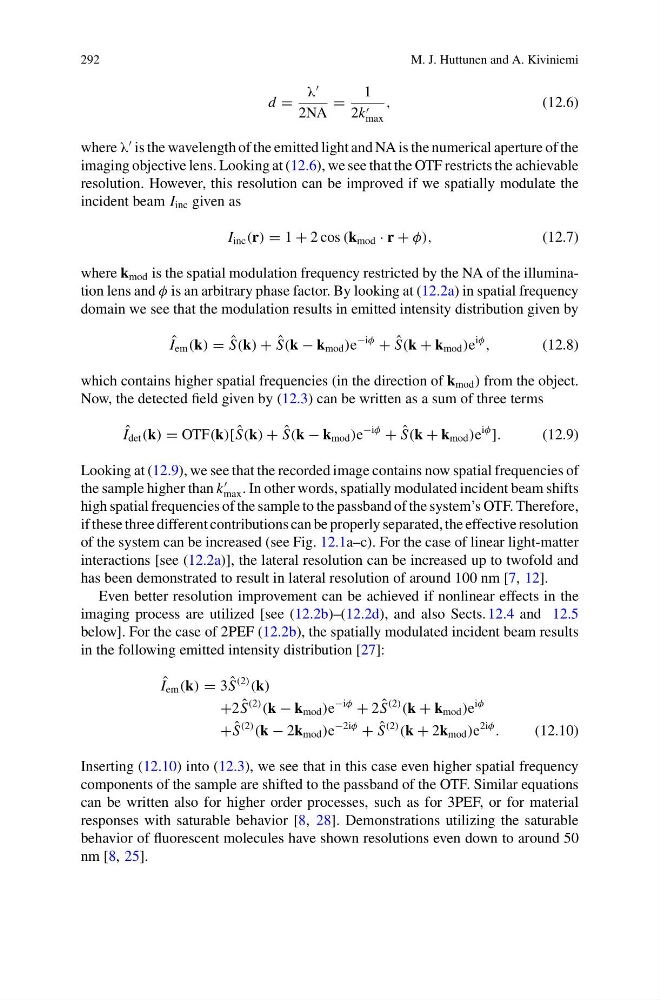
imaging objective lens. Looking at (12.6), we see that the OTF restricts the achievable
resolution. However, this resolution can be improved if we spatially modulate the
incident beam I inc given as
I inc (r) = 1 + 2 cos (k mod · r + φ),
(12.7)
where k mod is the spatial modulation frequency restricted by the NA of the illumination lens and φ is an arbitrary phase factor. By looking at (12.2a) in spatial frequency
domain we see that the modulation results in emitted intensity distribution given by
ˆ
I em (k) = ˆ
S(k) + ˆ
S(k − k mod )e
−iφ
+ ˆ
S(k + k mod )e
iφ
,
(12.8)
which contains higher spatial frequencies (in the direction of k mod ) from the object.
Now, the detected field given by (12.3) can be written as a sum of three terms
ˆ
I det (k) = OTF(k)[ ˆ
S(k) + ˆ
S(k − k mod )e
−iφ
+ ˆ
S(k + k mod )e
iφ
].
(12.9)
Looking at (12.9), we see that the recorded image contains now spatial frequencies of
the sample higher than k
max . In other words, spatially modulated incident beam shifts
high spatial frequencies of the sample to the passband of the system’s OTF. Therefore,
if these three different contributions can be properly separated, the effective resolution
of the system can be increased (see Fig. 12.1a–c). For the case of linear light-matter
interactions [see (12.2a)], the lateral resolution can be increased up to twofold and
has been demonstrated to result in lateral resolution of around 100 nm [7, 12].
Even better resolution improvement can be achieved if nonlinear effects in the
imaging process are utilized [see (12.2b)–(12.2d), and also Sects. 12.4 and 12.5
below]. For the case of 2PEF (12.2b), the spatially modulated incident beam results
in the following emitted intensity distribution [27]:
ˆ
I em (k) = 3 ˆ
S
(2)
(k)
+2 ˆ
S
(2)
(k − k mod )e
−iφ
+ 2 ˆ
S
(2)
(k + k mod )e
iφ
+ ˆ
S
(2)
(k − 2k mod )e
−2iφ
+ ˆ
S
(2)
(k + 2k mod )e
2iφ
.
(12.10)
Inserting (12.10) into (12.3), we see that in this case even higher spatial frequency
components of the sample are shifted to the passband of the OTF. Similar equations
can be written also for higher order processes, such as for 3PEF, or for material
responses with saturable behavior [8, 28]. Demonstrations utilizing the saturable
behavior of fluorescent molecules have shown resolutions even down to around 50
nm [8, 25].
M. J. Huttunen and A. Kiviniemi
d =
λ
2NA
=
1
2k
max
,
(12.6)
where λ
is the wavelength of the emitted light and NA is the numerical aperture of the
imaging objective lens. Looking at (12.6), we see that the OTF restricts the achievable
resolution. However, this resolution can be improved if we spatially modulate the
incident beam I inc given as
I inc (r) = 1 + 2 cos (k mod · r + φ),
(12.7)
where k mod is the spatial modulation frequency restricted by the NA of the illumination lens and φ is an arbitrary phase factor. By looking at (12.2a) in spatial frequency
domain we see that the modulation results in emitted intensity distribution given by
ˆ
I em (k) = ˆ
S(k) + ˆ
S(k − k mod )e
−iφ
+ ˆ
S(k + k mod )e
iφ
,
(12.8)
which contains higher spatial frequencies (in the direction of k mod ) from the object.
Now, the detected field given by (12.3) can be written as a sum of three terms
ˆ
I det (k) = OTF(k)[ ˆ
S(k) + ˆ
S(k − k mod )e
−iφ
+ ˆ
S(k + k mod )e
iφ
].
(12.9)
Looking at (12.9), we see that the recorded image contains now spatial frequencies of
the sample higher than k
max . In other words, spatially modulated incident beam shifts
high spatial frequencies of the sample to the passband of the system’s OTF. Therefore,
if these three different contributions can be properly separated, the effective resolution
of the system can be increased (see Fig. 12.1a–c). For the case of linear light-matter
interactions [see (12.2a)], the lateral resolution can be increased up to twofold and
has been demonstrated to result in lateral resolution of around 100 nm [7, 12].
Even better resolution improvement can be achieved if nonlinear effects in the
imaging process are utilized [see (12.2b)–(12.2d), and also Sects. 12.4 and 12.5
below]. For the case of 2PEF (12.2b), the spatially modulated incident beam results
in the following emitted intensity distribution [27]:
ˆ
I em (k) = 3 ˆ
S
(2)
(k)
+2 ˆ
S
(2)
(k − k mod )e
−iφ
+ 2 ˆ
S
(2)
(k + k mod )e
iφ
+ ˆ
S
(2)
(k − 2k mod )e
−2iφ
+ ˆ
S
(2)
(k + 2k mod )e
2iφ
.
(12.10)
Inserting (12.10) into (12.3), we see that in this case even higher spatial frequency
components of the sample are shifted to the passband of the OTF. Similar equations
can be written also for higher order processes, such as for 3PEF, or for material
responses with saturable behavior [8, 28]. Demonstrations utilizing the saturable
behavior of fluorescent molecules have shown resolutions even down to around 50
nm [8, 25].