

12 Nonlinear Label-Free Super-Resolution Microscopy Using Structured Illumination
291
12.2 Structured Illumination Microscopy
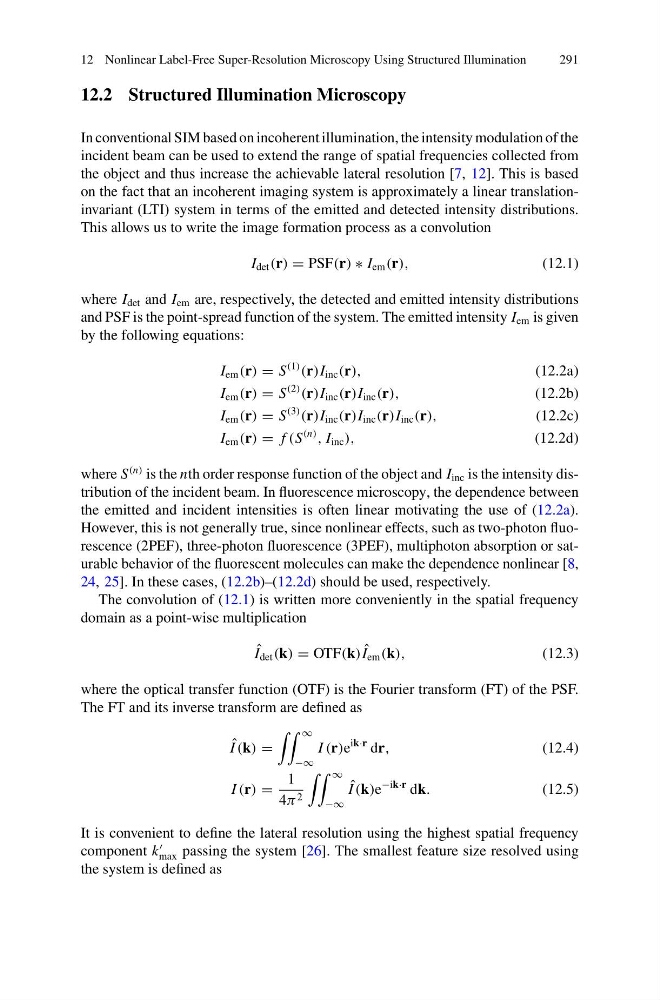
In conventional SIM based on incoherent illumination, the intensity modulation of the
incident beam can be used to extend the range of spatial frequencies collected from
the object and thus increase the achievable lateral resolution [7, 12]. This is based
on the fact that an incoherent imaging system is approximately a linear translationinvariant (LTI) system in terms of the emitted and detected intensity distributions.
This allows us to write the image formation process as a convolution
I det (r) = PSF(r) ∗ I em (r),
(12.1)
where I det and I em are, respectively, the detected and emitted intensity distributions
and PSF is the point-spread function of the system. The emitted intensity I em is given
by the following equations:
I em (r) = S
(1)
(r)I inc (r),
(12.2a)
I em (r) = S
(2)
(r)I inc (r)I inc (r),
(12.2b)
I em (r) = S
(3)
(r)I inc (r)I inc (r)I inc (r),
(12.2c)
I em (r) = f (S
(n)
, I inc ),
(12.2d)
where S
(n) is the nth order response function of the object and I inc is the intensity distribution of the incident beam. In fluorescence microscopy, the dependence between
the emitted and incident intensities is often linear motivating the use of (12.2a).
However, this is not generally true, since nonlinear effects, such as two-photon fluorescence (2PEF), three-photon fluorescence (3PEF), multiphoton absorption or saturable behavior of the fluorescent molecules can make the dependence nonlinear [8,
24, 25]. In these cases, (12.2b)–(12.2d) should be used, respectively.
The convolution of (12.1) is written more conveniently in the spatial frequency
domain as a point-wise multiplication
ˆ
I det (k) = OTF(k) ˆ
I em (k),
(12.3)
where the optical transfer function (OTF) is the Fourier transform (FT) of the PSF.
The FT and its inverse transform are defined as
ˆ
I (k) =
∞
−∞
I (r)e
ik·r dr,
(12.4)
I (r) =
1
4π 2
∞
−∞
ˆ
I (k)e
−ik·r dk.
(12.5)
It is convenient to define the lateral resolution using the highest spatial frequency
component k
max passing the system [26]. The smallest feature size resolved using
the system is defined as
291
12.2 Structured Illumination Microscopy
In conventional SIM based on incoherent illumination, the intensity modulation of the
incident beam can be used to extend the range of spatial frequencies collected from
the object and thus increase the achievable lateral resolution [7, 12]. This is based
on the fact that an incoherent imaging system is approximately a linear translationinvariant (LTI) system in terms of the emitted and detected intensity distributions.
This allows us to write the image formation process as a convolution
I det (r) = PSF(r) ∗ I em (r),
(12.1)
where I det and I em are, respectively, the detected and emitted intensity distributions
and PSF is the point-spread function of the system. The emitted intensity I em is given
by the following equations:
I em (r) = S
(1)
(r)I inc (r),
(12.2a)
I em (r) = S
(2)
(r)I inc (r)I inc (r),
(12.2b)
I em (r) = S
(3)
(r)I inc (r)I inc (r)I inc (r),
(12.2c)
I em (r) = f (S
(n)
, I inc ),
(12.2d)
where S
(n) is the nth order response function of the object and I inc is the intensity distribution of the incident beam. In fluorescence microscopy, the dependence between
the emitted and incident intensities is often linear motivating the use of (12.2a).
However, this is not generally true, since nonlinear effects, such as two-photon fluorescence (2PEF), three-photon fluorescence (3PEF), multiphoton absorption or saturable behavior of the fluorescent molecules can make the dependence nonlinear [8,
24, 25]. In these cases, (12.2b)–(12.2d) should be used, respectively.
The convolution of (12.1) is written more conveniently in the spatial frequency
domain as a point-wise multiplication
ˆ
I det (k) = OTF(k) ˆ
I em (k),
(12.3)
where the optical transfer function (OTF) is the Fourier transform (FT) of the PSF.
The FT and its inverse transform are defined as
ˆ
I (k) =
∞
−∞
I (r)e
ik·r dr,
(12.4)
I (r) =
1
4π 2
∞
−∞
ˆ
I (k)e
−ik·r dk.
(12.5)
It is convenient to define the lateral resolution using the highest spatial frequency
component k
max passing the system [26]. The smallest feature size resolved using
the system is defined as