

280
O. Tzang et al.
11.6.2 Nonlinear Photo-acoustic Feedback Signal
for Focusing Through Scattering Media
Motivated by the potential for high-resolution imaging deep inside biological tissues
using wavefront shaping for controlling light propagation across scattering media,
Tzang et al. used a lock-in detection scheme for measuring nonlinear photo-acoustic
(PA) signals [48]. The goal was to use the nonlinear contributions for focusing tighter
and potentially higher resolution imaging.
PA imaging is a hybrid modality that achieves optical contrast based on the PA
effect by which absorption induces a transient thermo-elastic expansion and an associated acoustic emission [49]. PA reveals label-free optical contrast correlated to
chemical composition by exciting the sample with different optical wavelengths,
and it is considered a promising method for deep tissue biomedical imaging. In most
PA modalities, the SNR of small, deeply buried, targets inside tissue is weak, and
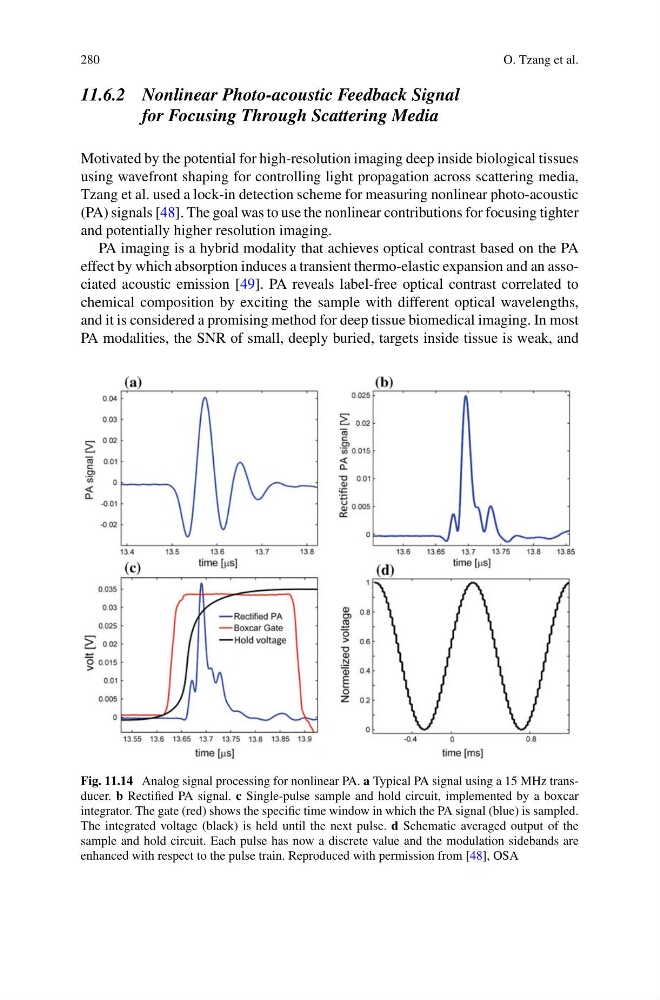
Fig. 11.14 Analog signal processing for nonlinear PA. a Typical PA signal using a 15 MHz transducer. b Rectified PA signal. c Single-pulse sample and hold circuit, implemented by a boxcar
integrator. The gate (red) shows the specific time window in which the PA signal (blue) is sampled.
The integrated voltage (black) is held until the next pulse. d Schematic averaged output of the
sample and hold circuit. Each pulse has now a discrete value and the modulation sidebands are
enhanced with respect to the pulse train. Reproduced with permission from [48], OSA
O. Tzang et al.
11.6.2 Nonlinear Photo-acoustic Feedback Signal
for Focusing Through Scattering Media
Motivated by the potential for high-resolution imaging deep inside biological tissues
using wavefront shaping for controlling light propagation across scattering media,
Tzang et al. used a lock-in detection scheme for measuring nonlinear photo-acoustic
(PA) signals [48]. The goal was to use the nonlinear contributions for focusing tighter
and potentially higher resolution imaging.
PA imaging is a hybrid modality that achieves optical contrast based on the PA
effect by which absorption induces a transient thermo-elastic expansion and an associated acoustic emission [49]. PA reveals label-free optical contrast correlated to
chemical composition by exciting the sample with different optical wavelengths,
and it is considered a promising method for deep tissue biomedical imaging. In most
PA modalities, the SNR of small, deeply buried, targets inside tissue is weak, and
Fig. 11.14 Analog signal processing for nonlinear PA. a Typical PA signal using a 15 MHz transducer. b Rectified PA signal. c Single-pulse sample and hold circuit, implemented by a boxcar
integrator. The gate (red) shows the specific time window in which the PA signal (blue) is sampled.
The integrated voltage (black) is held until the next pulse. d Schematic averaged output of the
sample and hold circuit. Each pulse has now a discrete value and the modulation sidebands are
enhanced with respect to the pulse train. Reproduced with permission from [48], OSA